Monday, June 15, 2009

The 'Depression' "Quietly" Deepens

The Depression Quietly Deepens
It Is Lonely In The Diminishing Camp Of Bears


By Ambrose Evans-Pritchard. | 17 June 2009

Those of us who still question whether the world has purged its toxins have been reduced to the same tiny band of moaning Druids from early 2007, when we shook our heads in disbelief as the carry trade swept Iceland to fresh madness and bankers laughed off sub-prime rot at Bear Stearns.

We learned then to thicken our skins with walnut juice, lie down in dark rooms, and dissent from Goldman Sachs. Such seclusion is called for once again as Goldman replays its BRIC anthem and raises its oil forecast to $85 a barrel this year, betting that the world will roar back on a tidal wave of 'liquidity'. (It is perhaps unkind to mention that Goldman issued a $200 call at the top of the speculative frenzy last year— just before oil crashed— but they have broad shoulders.)

Note that Total's Jean-Jacques Mosconi said markets are awash with so much crude that almost 100m barrels (a near record) are stored on tankers at sea. Note too that May electricity use fell 10% in China's industrial hub of Guangdong from a year earlier. This is revealing, given that China's fiscal boost has reached peak and will fade later this year.

For guidance on where we are in this long-drawn saga, I look to Berkeley's Barry Eichengreen, author of the Great Depression classic "Golden Fetters"— which avoids the error of viewing the 1930s through a US prism. He has crunched the latest data with Trinity College Dublin's Kevin O'Rourke for VoxEU, concluding that the global rupture over the last nine months has been more violent than in the earlier slump. This is logical. Global debt leverage is much greater this time.

The fall in industrial output has been roughly equal to the 1929-1930 stage for Germany and the Anglo-Saxons, but worse for Japan, France, Italy, and Eastern Europe. The collapse in world trade has been swifter: the global equity crash has been twice as bad. "It's a depression alright. The good news is that the policy response is very different. The question now is whether that response will work," they said.

The elastic was bound to snap back, just as it did in the giant bear rally of early 1931. [[The point being that, this time however, the response has been several times greater than that of the FDR administration in 1933. : normxxx]] Whether the underlying economy has begun to heal is another matter. World Bank chief economist Justin Yifu Lin said capacity utilization is running at an historic low of 50%-60%. Companies will have to fire a lot of workers. This is where the danger lies, and why he fears that deflation is creeping up on us.

Trade data from Asia are flashing warning signals again. Korea's exports were down 28.3% in May, reversing the April rebound. Malaysia has slipped to -26%, and India has touched a new low of -33%. US freight data is getting worse, not better. The Association of American Railroads said traffic was down 22% in the third week of May from a year earlier. Canadian freight was down 34%.

The American Trucking Association (ATA) said it saw fresh drops of 4.5% in March and a further 2.2% in April. Tonnage is down 13% over 12 months. Bob Costello, the ATA's chief economist, said companies have not cut inventories fast enough to keep pace with declining sales. The contraction in truck volume has "accelerated".

Yes, the Baltic Dry Index for bulk shipping of resources has quadrupled since January, but this [largely] reflects China's bid to stockpile metals while prices are so low. [[Unfortunately, they have since run out of storage!: normxxx]]

Stephen Roach, Morgan Stanley's Far East chief, fears an "Asian Relapse", saying the region is prisoner to its fatal dependency on exports to the West. The export share of GDP has risen from 36% to 47% across developing Asia over the last decade. "China's incipient rebound relies on a time-worn stimulus formula: upping the ante on infrastructure spending in anticipation of an eventual rebound of global demand," he said. The strategy cannot work this time because "Americans have exhausted their credit and their desire to borrow". Consumption will fall from its peak of 72% of GDP to the "pre-bubble norm" of 67%, if not more.

David Rosenberg from Gluskins Sheff expects Americans to retrench ferociously as 78 million baby boomers face the looming threat of penury in old age. "The big story is that the personal savings rate hit a 15-year high of 5.7% in April. I believe it could test the post-War peak of 15%. Too many pundits are still living in the old paradigm of Americans shopping till they drop," he said.

If he is right, this will shatter the surplus economies of China, Japan, and Germany, unless they adjust incredibly rapidly to the new world order. Germany seems not even to understand the problem it faces. Chancellor Angela Merkel lashed out last week at 'quantitative easing' by the Fed, the Bank of England, and the European Central Bank, repeating the silly mantra that this will set off an 'inflationary storm'.

How can it do so when the velocity of circulation has collapsed, and unemployment is rising everywhere? The Fed's "monetary multiplier" ended last week at 0.867, half its average of 1.7 over the last decade. The credit mechanism is still broken. This is what happened in Japan in its Lost Decade.

The ECB says the eurozone economy will contract until mid-2010, at best. Germany's trade association (Wirtschaftsverbände) warned Mrs Merkel last week that the credit drought threatens to become "life-threatening by the summer at the latest". The list of countries in deflation is growing every month: Ireland (-3.5%), Thailand (-3.3%), China (-1.5%), Switzerland (-1.0%), Spain (-0.8%), the US (-0.7%), Singapore (-0.7%), Taiwan (-0.5%), Belgium (-0.4%), Japan (-0.1%), Sweden (-0.1%), Germany (-0.0%).

Yet the financial markets seem to think otherwise, and this has its own awful consequences. Inflation fears have driven 10-year US Treasury yields to 3.86%, a full point above levels in March when the Fed intervened to force rates down. US mortgage rates have jumped to 5.29%. Gilts have reached 3.92%, and French 10-year bonds are at 4.05%.

This bond revolt is enough to bring any global recovery to a shuddering halt. The irony is that those fretting loudest about inflation may themselves just tip us into outright deflation, with all the perils of an effectively compounding debt trap. It is Angela Merkel who plays with fire.

Saturday, June 13, 2009

Random Notes…

Random Notes…
Click here for a link to complete article:

By Montyhigh | 11 June 2009

Unadjusted Year Over Year: USA Retail Sales Down 11%

Here's The Year Over Year Summary Of The Commerce Department's Retail Sales Figures For May 2009:
Associated Press Spin: "Retail sales climb 0.5 percent in May… Retail sales rose by the largest amount in four months in May, as a rebound in demand at auto dealerships and gas stations helped to offset continued weakness at department stores".

[ Normxxx Here:  FWIW, the "rebound in demand at auto dealerships" was a one off phenomenon due to the absolute collapse of the US dealerships and consequent fire sales and the "rebound in demand at …gas stations" was due almost entirely to the increase in gas prices, NOT any large increase in gallons sold…  ]

Commerce Department News Release: click here.
Key Numbers: Commerce Department Retail And Food Services Sales Unadjusted May 2009: $355,414,000,000 vs May 2008: $399,979,000,000.
My Spreadsheet (click here)

Here's my uneducated interpretation— Retail sales are dismal and are falling faster than last month. The economy is still shrinking. This is a very important LEADING indicator. Don't fall for the spin.

Unadjusted Year Over Year: Labor Department Initial Jobless Claims Up 55%

Here's the scoop on the Labor Department's weekly initial jobs claims report:
Associated Press Headline And Lead: "New jobless claims drop more than expected to 601K… The number of newly laid-off Americans filing for jobless benefits fell for the third time in the past four weeks, fresh evidence that companies are cutting fewer jobs".
Labor Department News Release: click here.
Key Numbers: The advance number of actual initial claims under state programs, unadjusted, totaled 576,695 in the week ending June 6, an increase of 76,312 from the previous week. There were 373,046 initial claims in the comparable week in 2008.
My Spreadsheet (click here)

Quick Comment: Unadjusted jobless claims jumped 76,312 last week. After adjustment they "drop more than expected". Hmmm, when was the last time we saw adjusted numbers worse than the unadjusted numbers?

Here's my uneducated interpretation— Initial jobless claims is a leading indicator and clearly job losses are way worse than they were a year ago. The Associated Press, as usual, puts a "positive" spin on the numbers.

Year Over Year: USA Homeforeclosures Up 18%
Of course, the AP headline makes it sound like things are getting better. I think this quote puts it in perspective: "Despite the drop from April, it was the third-highest monthly rate since Irvine, Calif.-based RealtyTrac began its report in January 2005, and the third straight month with more than 300,000 households receiving a foreclosure filing".

Year Over Year: China's May Exports Down 26.4%

How can an export-driven economy grow at 6% a year (as China is forecasting) when its exports are down 26.4%? Click here for the story. The export collapse is accelerating from down 22.6% in April and down 17.6% in March. Imports are also down 25.2% for May indicating that 'internal' stimulus of the economy is not making up for the downturn in the export part of the economy.

It seems pretty clear that the Chinese economy is shrinking— not growing. The "expert opinion" has been that the China would lead the world out of the global downturn. That doesn't seem to be happening.

I can't explain why the prices of copper and other commodities are rising. I'm looking to go short when the LME inventories start rising again.

[ Normxxx Here:  It turns out that the canny Chinese could not resist the "give away prices" of commodities in the present market and have been busily buying and squirrelling away commodites. However, they seem to have run out of storage space. Just look what's happened to the Baltic Dry Index lately!  ]

Mike Kachanovsky's On Gold Vs Silver And His Number On Junior Mining Stock: Impact Silver (IPT.V)

Mike Kachanovsky's favorite junior mining stock is my favorite silver Jr mining stock (actually only primarily a silver Jr mining stock): "…the number-one junior mining stock in the world, in my opinion, would be IMPACT Silver (TSX.V:IPT)".

In the same article, Kachanovsky makes the case for silver better than most. He claims the the ratio of silver to gold in the earth's crust is 15 to 1. I'd like to find his back up for that [NOTE: Wikipedia provides three values that are approximately 70, 25 and 18 to 1]. With the current price ratio (gold to silver) over 50 to 1, Kachanovsky expects the ratio of prices, over time, to revert to his 15 to 1 ratio. He argues that the rapidly falling above ground silver inventories (that are approaching zero compared to historical stockpile levels) implies that this narrowing will occur relative soon.

This seems to be a pretty good argument to me, although that 70 to 1 Wikipedia value leaves me with less than full certainty.

The way I think it is best to look at it is on the basis of the relative costs of production which, with gross simplification, becomes a grams / tonne comparison for a common mining method. Nearly all silver mining is underground mining, so I compare two underground miners, Impact Silver (the best silver Jr miner according to Kachanovsky) and Dynasty Metals And Mining's Zaruma project (a high-grade underground gold project). I compare the most recent headline drill hole announcement from Impact Silver with the Zaruma project's Measured and Indicated Resource as follows:

Impact Silver: "204g/t silver across 8.5 meters and 280g/t silver across 4.5m".
Dynasty Metals And Mining's Zaruma Project: "Measured and Indicated Gold resource of 1,110,200 oz at an average grade of 13.93 g/t*".

The resulting Gold / Silver ratio is thus 20 to 1 [280 / 13.93]. Of course, different projects will have different ratios, but I think this is reasonably representative. So, I conclude that there is a reasonably good argument for the Gold / Silver price ratio falling and for silver to rise in price relative to gold. I'm much more heavily weighted into gold Jr miners right now because of the clear expectation of high profits at current prices. I may shift more money into silver as a result of this analysis.


John Hussman On "When Does Price Inflation Kick In?"

From John Hussman's weekly discussing what the Federal Reserve has been doing:

"As it happened, rather than following policies that would have allowed for a sustainable recovery, our policy makers opted for a stunningly unethical strategy of making bank bondholders whole with well over a trillion dollars in public funds, watering down accounting rules to allow banks to go quietly insolvent. [[Caveat: BB supposed it was necessary in order to prevent a run on the dollar, as most of those bonds were held by foreign private and central banks.: normxxx]] [Then using these doctored results] while reporting 'encouraging' "operating profits," 'looking beyond' the continued shortfall of loan loss reserves in relation to loan defaults, and doing nothing meaningful with regard to foreclosures, whose rates continue to soar and which face a fresh wave later this year and well into 2010 and 2011. These policy responses have more than doubled the U.S. monetary base within a period of months, added a trillion more in outstanding Treasury debt, and virtually assured that the value of those government liabilities will be 'repriced' in relation to goods and services over the coming decade. A range of different methodologies suggest a doubling in U.S. consumer prices over the coming decade, though with the majority of this pressure occurring 3-4 years out and beyond."

My interpretation: Hussman says big inflation is coming, but not real soon.

Pretty Entertaining / Insightful Anecdote: The Moment Hussman Decided To Go Into Finance

Just a couple of paragraphs.

Global Economy Turned Around Yet? Korean Exports For May Down 28% Year Over Year

Here's the quote of honor: "Y/y, exports were down around 28%."

Here's the chart of honor

The article goes on to say that Taiwan's May exports are down 31% year over year, but this is an improvement over April. In fairness, the overall tone of the article is less bearish than my pointing out what seems like terribly bearish data.

  M O R E. . .

Thursday, June 11, 2009

Debt Continues To Rise Out Of Control

Debt Continues To Rise: So Much For De-Leveraging

By Rolfe Winkler, CFA | 11 June 2009

So much for de-leveraging.

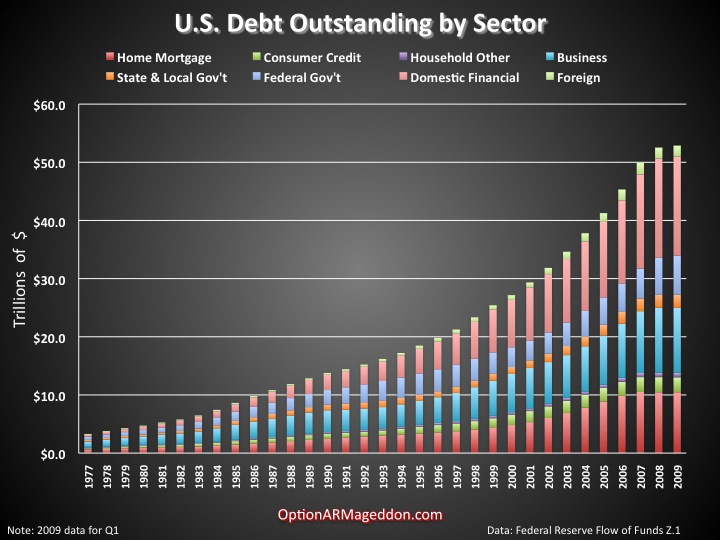
The Fed published its latest Flow of Funds report Thursday. One key takeaway: While total debt is growing more slowly, it is still growing. Since Q3 ‘08 households have cut their debt (slightly), but the federal government is borrowing so rapidly, overall debt continues to expand.


Click Here, or on the image, to see a larger, undistorted image.


By the way, the Fed only includes publicly held debt when calculating total federal government borrowings, $6.7 trillion at the end of Q1. This excludes over $4 trillion owed to the Social Security "trust fund". More importantly, it excludes $60 trillion of unfunded future liabilities for Medicare and Social Security. (see the debt clock above)


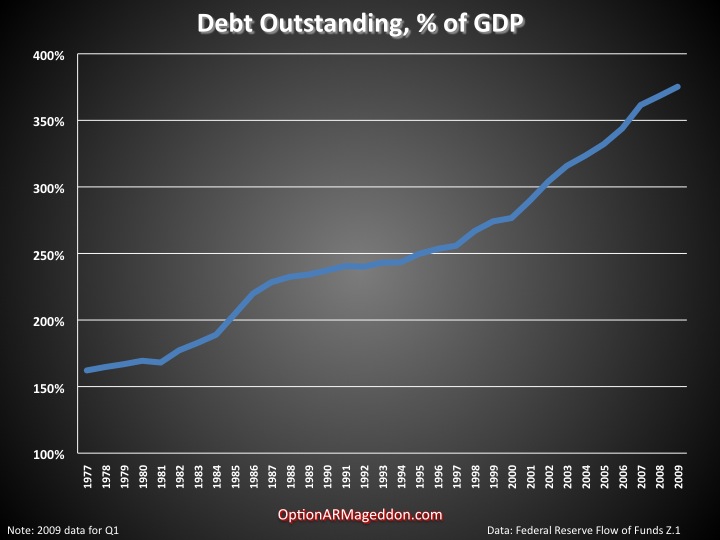
Click Here, or on the image, to see a larger, undistorted image.


The second chart (above) puts the data into perspective. As a percentage of GDP, debt continues to expand, from 368% at the end of Q4 to 375% at the end of Q1. It’s been said that the income statement is the past, but the balance sheet is the future. Our balance sheet is getting worse. Those who see "green shoots" believe the crisis is abating. But they don’t understand its origin: a credit bubble that, in the aggregate, continues to inflate. [[Even during a severe recession! : normxxx]]The equity value of our economy is going down— think the stock market and housing equity (see below). At the same time our debt is going up. In other words, America’s leverage continues to expand.

The only way to climb out of a debt-induced depression is to pay down debt or to write it off. Levering up only delays the inevitable. Unfortunately Americans, and lately the Obama administration, have shown absolutely no political will to try either remedy. Republicans decry growing deficits, but do you ever hear them enumerate the cuts they would make? Clearly our plan is to keep borrowing until our lenders cut us off.

Speaking Of Crashing Equity


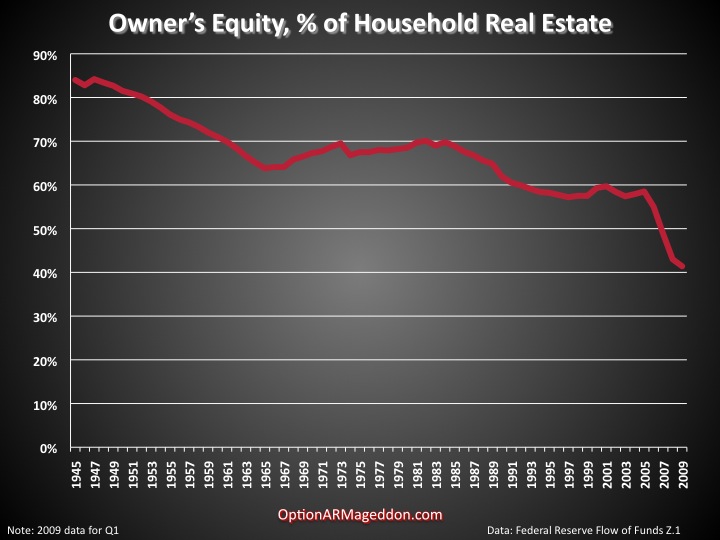
Click Here, or on the image, to see a larger, undistorted image.


This last chart (above) plots the amount of equity Americans have in their homes. This figure has been crashing as house prices fall while mortgage debt stays roughly constant. At the end of 2007 the figure was 49%, at the end of last year 43%. It now stands at 41.4%. And as CR notes: "approximately 31% of households do not have a mortgage. So the 50+ million households with mortgages have far less than 41.4% equity". [[It's even worse. Figure at least another 19% have very large equity in their homes— they have been diligently paying off their mortgage and are about to retire (or have retired). So, about 50% of the mortgages out there account for about 80% - 90% of the mortage debt. And those mortgagers probably average less than 30% equity in their homes. Want to wager what happens when a goodly portion of them just "walk away from those underwater homes"? : normxxx]]
Real Estate Investment (Dis)Trusts

By Dan Amoss | 11 June 2009

I’m confident that the trend for REITs will be down through the end of 2009. That’s why I suggest buying the UltaShort Real Estate ProShares ETF (NYSE: SRS. Current price ~$18) as a way to profit from weakness in the REIT sector. But fasten your seatbelt! SRS will be volatile!

REITs may appear cheap, but they are very dangerous to hold right now. A basic tenet of corporate finance is that a company or a sector is only creating value for shareholders if its return on invested capital (ROIC) exceeds its weighted average cost of capital (WACC). If its WACC exceeds its ROIC, it is destroying value. This describes the situation facing the REIT sector for the next few years. Most REITs cannot float unsecured debt at anything less than 10% or 12%, so their cost of capital is high and rising. At the same time, due to the glut of supply in commercial real estate supply, and waning demand from stressed tenants, the returns on incremental investment in new capacity are very low— possibly negative.

Summing it all up: REITs will be destroying shareholder value until supply and demand for commercial real estate reaches equilibrium. The free market is screaming as loudly as it can that millions of square feet of capacity need to be absorbed or eliminated over the next several years in order for the surviving REITs to have a chance at generating respectable returns on capital.

This process has barely even begun, after the biggest lending binge in the history of commercial real estate. It will last a long time. The lending binge ensured that a large swathe of REITs will not make it to see the next commercial real estate up-cycle, which is still several years away at minimum. The title to many properties will go back to creditors in bankruptcy, and auctions will bring down asset values across the sector until they are cheap enough to earn respectable returns in a weak rental environment.

Another example of stress surfaced earlier this week. The auction to settle credit default swaps related to the General Growth Properties bankruptcy indicates serious pain to come for mall REIT owners: GGP’s senior loans effectively liquidated for 44 cents on the dollar! This means that lenders are demanding extreme discounts and high yields to hold debts secured by mall collateral. This isn’t good news for peers like Kimco (NYSE: KIM) and Simon Property Group (NYSE: SPG). Another argument I’ve seen lately is that REITs will be a good inflation hedge if you buy them at these prices. This is an overly simplistic view of Fed-created inflation and its ultimate symptoms.

Fed Chairman Bernanke can debase the dollar all he wants, but most of the new dollars will act to push up the prices of goods and services in sectors with relatively tight capacity. Mostly, this translates into lower living standards for the average American— an echo of the 1970s, only without the real estate appreciation. The Fed’s inflation will find its way into tangible assets like gold and silver, oil and gas, uranium ore, farmland, potash mines, and any other commodity China needs to import. Conversely, the fed’s inflation will NOT find its way into the pricing of American shopping malls, which arre in a condition of extreme oversupply.

Over time, the capacity to supply light, sweet oil to the global economy will be far tighter than the capacity to supply American retailers with real estate in malls. Demand for oil will be far more resilient than the U.S.-centric consensus expects, while demand for discretionary items— like "Color Fiend Neon Green Hair Spray" at Hot Topic (this product actually exists)— will fluctuate up and down, but generally head lower. Rising prices for several necessary goods and services will crowd out discretionary spending in many family budgets.

Inflation does not re-inflate old bubbles— especially in the case of residential and commercial real estate. It will only slow the previously violent deleveraging process. On a related note, it was a breath of fresh air to hear Howard Davidowitz of Davidowitz & Associates interviewed on Bloomberg Radio recently. (You can find a link to download an mp3 of the 17-minute interview here). Davidowitz has decades of in-the-trenches experience in retail consulting and analysis. Rarely do you find an industry analyst express an informed opinion so forcefully in the mainstream financial media. I highly recommend listening to the interview for an overview of how the retail and commercial real estate business will evolve in the coming quarters.

A preview: It ain’t good.

[Editor Joel’s Note: Faithful readers may remember Dan for being way out front on calling the implosion of Lehman Bros. last year. That play handed his Strategic Short Report readers a chance at bagging over 400%… and that was in the face of everyone who said "the worst is over" after Bear Stearns’ collapse a few months earlier.

Now, those same people are shouting "green shoots" and telling you that the worst is over (again). Meanwhile, the guy who actually got it right is warning of more trouble to come. Hmm…what’s an investor to do?

An Economy Still At The Brink

An Economy Still At The Brink

By Sandy B. Lewis and William D. Cohan | 7 June 2009

Sandy B. Lewis, an organic farmer, founded SB Lewis & Co., a brokerage house. William D. Cohan, a contributing editor at Fortune and former Wall Street banker, is the author of "House of Cards: A Tale of Hubris and Wretched Excess on Wall Street."

Whether at a fund-raising dinner for wealthy supporters in Beverly Hills, or at an Air Force base in Nevada, or at Charlie Rose’s table in New York City, President Obama is conducting an all-out campaign to try to make us feel a whole lot better about the economy as quickly as possible. "It’s safe to say we have stepped back from the brink, that there is some calm that didn’t exist before," he told donors at the Beverly Hilton Hotel late last month. Mr. Obama thinks that the way to revive the economy is to restore confidence in it. If the mood is right, the capital will flow. But this belief is dangerously misguided.

We are sympathetic to the extraordinary challenge the president faces, but if we’ve learned anything at all two years into the worst financial crisis of our lifetimes, it is that a capital-markets system this dependent on public confidence is a shockingly inadequate foundation upon which to rest our economy. We have both spent large chunks of our lives working on Wall Street, absorbing its ethic and mores. We’re concerned that nothing has really been fixed. We’re doubly concerned that people appear to feel the worst of the storm is over— and in this, they are aided and abetted by a hugely popular and charismatic president and by the fact that the Dow has increased by 35 percent or so since Mr. Obama started to lay out his economic plans in March.

(Disclosure: One of us, Mr. Lewis, was convicted on federal charges of stock manipulation in 1989, pardoned by President Bill Clinton in 2001 and had his lifetime trading ban overturned by the Securities and Exchange Commission in 2006; documents relating to the case can be found at sblewis.net.)

But wishing for improvement and managing by the Dow’s swings are a fool’s game. The storm is not over, not by a long shot. Huge structural flaws remain in the architecture of our financial system, and many of the fixes that the Obama administration has proposed will do little to address them and may make them worse.

At another fund-raising event, for Senator Harry Reid, President Obama said: "We didn’t ask for the challenges that we face. But we are determined to answer the call to meet those challenges, to cast aside the old arguments and overcome the stubborn divisions and move forward as one people and one nation …. It will take time but I promise you, I promise you, I’ll always tell you the truth about the challenges we face."

Keeping that statement in mind— as well as an abiding faith in the importance of properly functioning capital markets— we have come up with a set of questions meant to challenge a popular president, with vast majorities in Congress, to find the flaws in the system, to figure out what’s being done to fix them and to get to the truth about the difficulties we face as we set out to restore the proper functioning of our markets and our standing in the world.


Six months ago, nobody believed that our banking system was well designed, functioning smoothly or properly regulated— so why then are we so desperately anxious to restore that very model as the status quo? Nearly every new program emanating these days from the Treasury Department— the Term Asset-Backed Securities Loan Facility, the Public Private Investment Program, the "stress tests" of major banks— appears to have been designed to either paper over or to prop up a system that has clearly failed. Instead of hauling out the new drywall to cover up the existing studs, let’s seriously consider ripping down the entire structure, dynamiting the foundation and building a new system that rewards taking prudent risks, allocates capital where it is needed, allows all investors to get accurate and timely financial information and increases value to shareholders and creditors.

As a start, the best-compensated executives at the top of these big banks, hedge funds and private-equity firms should be treated like those general partners of yore. If a firm takes prudent risks that pay off, this top layer of management should be well compensated. But if the risks these people take are imprudent and the losses grave, they should expect to lose their jobs.

Instead of getting guaranteed salaries or huge bonuses, they should have the bulk of their net worth completely at risk for a long stretch of time— 10 years come to mind— for the decisions they make/made while in charge. This would go a long way toward re-aligning the interests of these firms with those of their shareholders and clients and the American people, who have been saddled with their risks and mistakes.


Why is so much effort being put into propping up those at the top of the economic pyramid— the money-center banks, the insurance companies, the hedge funds and so forth— when during a period of [asset] deflation like the one we are in, any recovery will come only by restoring the confidence of the people down at the bottom of the pyramid? [[6.0 million of whom have already lost their jobs and a far greater number of whom have undergone foreclosure (since the peak in housing prices) or have fallen behind on payments but have not yet received foreclosure notices.: normxxx]]

Confidence will return only when jobs can be found and mortgage payments made. Even if Mr. Obama’s claim is true that his $780 billion stimulus package "saved or created" some 150,000 jobs, we seem a long way away from the point where those struggling to get by will feel like spending again. What happens when people buy a car once every 10 years instead of once every two or three, especially now that we taxpayers own such a big percentage of the American auto industry?


Instead of promising the imminent return of good times, why isn’t Mr. Obama talking more about the importance of living within our means and not spending money we don’t have on things we don’t need? We used to be a frugal nation. The president should be talking about kicking our addictions to easy credit, to quick fixes and to a culture of more is better (and Congress’s new credit-card legislation, while perhaps eliminating some of the worst aspects of that industry, certainly didn’t send the right message about personal finance). Gas-guzzling S.U.V.’s, cigarette boats, no-income mortgages and private jets should be relegated to the junk heaps of history, or better yet, put in a museum dedicated to never forgetting the greed and avarice that led us so far astray.


Why is the morphine drip still in the veins of the financial system? These trillions in profligate federal spending are intended to make us feel better again even though feeling pain, and dealing with it responsibly, would be healthier in the long run. It is time to stop rescuing the banks that got us into this mess. If that means more bank failures on a grander scale or the dismemberment of Citigroup, so be it. Depositors will be protected— up to $250,000 per account— but shareholders, creditors and, sadly, many employees will, for the long-term health of the system, need to feel the market’s wrath.


Is there to be any limit on bailouts? We have now thrown money at the big banks, any number of regional ones, insurance companies, General Motors, Chrysler and state and local governments. Will we soon be bailing out Dartmouth, which just lost its AAA bond rating?

Is there no room left for what the Austrian economist Joseph Schumpeter termed "creative destruction"? And what is the plan to get the American people out of all these equity stakes we now own and don’t want? Furthermore, for government leaders to decide who shall live and who shall die in an economic sense opens them up to legitimate charges of crony capitalism and favoritism. [[And, arguably, it destroyed the Soviet Union.: normxxx]] We will benefit in the long run from a return to market discipline.


Why has Mr. Obama surrounded himself largely with economic advisers who are theoreticians and academics— distinguished though they may be— but not those who have sat on a trading desk, made a market, managed a portfolio or set a spread? In our view, one of the ways out of this economic conundrum is to have experienced traders— not hothouse flowers— design incentives that will encourage the market to have buyers and sellers meet anew around the proper valuations of assets.

This market, propped up by a pliant Financial Accounting Standards Board and/or government-sponsored programs that appear to be virtually giving money away so that financial firms will buy assets they would not ordinarily buy, cannot long endure. We’re not talking about putting the fox in charge of the henhouse— just about adding people who know how markets function in the real world into a few of those important seats in Washington. [[We should take a leaf from FDR's book, who appointed Joe P. Kennedy, a Wall Streeet banker and financier, to head up the newly created SEC. JPK did a bang up job during his tenure. It took some 60 years to destroy what he put together.: normxxx]]


Why isn’t the Obama administration working night and day to give the public a vastly increased amount of detailed information about what happens in financial markets? Ever since traders started disappearing from the floor of the New York Stock Exchange in the last decade of the 20th century, there has been less and less transparency about the price and volume of trades. The New York Stock Exchange really exists in name only, as computers execute a very large percentage of all trades, far away from any exchange.

As a result, there is little flow of information, and small investors are paying the price. The beneficiaries, no surprise, are the remains of the old Wall Street broker-dealers— now bank-holding companies like Goldman Sachs and Morgan Stanley— that can see in advance what their clients are interested in buying, and might trade the same stocks for their own accounts. Incredibly, despite the events of last fall, nearly every one of Wall Street’s proprietary trading desks can still take the same huge risks and then, if they get into trouble, head to the Federal Reserve for 'short-term rescue' financing. [[…without even blushing: normxxx]]

Here’s something that should change in terms of transparency. The most recent price that any stock traded for should be published online in real time for all to see. And the public should have access to a new type of electronic ticker that provides market information in language that all can understand, not just the insiders.

As for those impossibly complex securities that caused so much of the trouble— among them derivatives, credit-default swaps and asset-backed securities— the S.E.C. should have the power to make public all the documentation surrounding these weapons of mass financial destruction. This should include all data about the current costs of buying and selling them and the cash flow underlying them. We also need widely accessible, real-time reporting of all trades in the bond market. We bet Mike Bloomberg’s company could help design such a system for our benefit.


Why is the government still complicit in making the system ever less transparent, even when it comes to what should clearly be considered public information? For instance, it took more than a year for the Federal Reserve to disclose that it had agreed to pay BlackRock— the huge money manager that is 45 percent owned by Bank of America— and others, $71 million in a no-bid contract. They were hired to 'manage' the $30 billion of toxic assets [[that they themselves had helped to create and: normxxx]] that JPMorgan did not want when it bought Bear Stearns in March 2008. And that is only one of the five contracts BlackRock has with the government as a result of this crisis— the nature of the other contracts remains secret.

Treasury Secretary Timothy Geithner has made much of financialstability.gov, the Treasury’s new Web site dedicated to "transparency, oversight and accountability." But try to find, for example, just one record of a bona fide credit-default swap, or the names of the hedge-fund and private-equity investors who have participated in the Term Asset-Backed Securities Loan Facility bonanza. It was only a lawsuit filed by a watchdog group that convinced the Treasury to divulge any details. Such as former Secretary Henry Paulson’s secret October meeting with the chief executives of the 10 largest Wall Street firms to force them to take money from the Troubled Asset Relief Program. A lawsuit filed last November by Bloomberg News to force the Federal Reserve to reveal the details on more than $2 trillion in loans that went to banks including Citigroup and Goldman Sachs is still pending in federal court.

And what has become of the S.E.C.’s year-old investigation into who made short-dated, out-of-the-money bets in March 2008 hoping Bear Stearns would fail— bets that were suddenly worth millions of dollars when the company did collapse later that month? Why do we still not know why Mr. Paulson, Mr. Geithner and the Federal Reserve chairman, Ben Bernanke, allowed Lehman Brothers to file bankruptcy last Sept. 15 but then, a day later, saved A.I.G.? [[Because the downfall of A.I.G. would also have taken down GS, Paulson's old company!?!: normxxx]] Or why last November this trio decided to absorb potential losses on $301 billion of Citigroup’s shaky assets, when conventional wisdom among insiders held that they were worth only $150 billion at best?

Also, before Dick Fuld, Lehman Brothers’ chief executive, appeared before the House Committee on Oversight and Government Reform last October, the Committee demanded from company executives boxes of documents about what happened at Lehman and why. Where are those documents? Why hasn’t President Obama insisted on public hearings over what happened during this financial crisis?


Not a single top executive of a Wall Street securities firm responsible for causing the worldwide financial crisis [[and for which the world justifiable or not lays most of the blame on the US: normxxx]] has had the courage or the decency to step forward in front of the cameras and explain to the American people in his own words exactly how and why he allowed his firm to cause the crisis. Both Mr. Fuld and Alan Schwartz, the chief executive of Bear Stearns at the end, in their Congressional testimony blamed the proverbial once-in-a-century 'financial tsunami'. Do they or any of their peers really think this is true? [["De debil made them do it!?!": normxxx]]

There may be a way to find out. There is much talk nowadays coming from top bankers— Lloyd Blankfein of Goldman Sachs, Jamie Dimon of JPMorganChase, John Mack of Morgan Stanley and even Ken Lewis of Bank of America— about seeing how quickly they can repay to the Treasury the TARP money Mr. Paulson forced on them. One precondition of their being allowed to repay the funds should be a requirement that each gives a public deposition and explains, under oath, what truly happened and why.

Such a public hearing would be meant only to offer a truthful assessment of the errors in judgment made at each firm and to promote understanding, so that we— somehow— can avoid repeating the same mistakes again. It would not be about indictments. These men should be offered use immunity from prosecution for their honest testimony, but only with a clear understanding that the failure to tell the truth at any point would result in serious legal consequences.

The hearing could be complemented by a truth-seeking commission established to hear the accounts of several people who have departed the scene, including, among others, Mr. Paulson, former Treasury Secretary Robert Rubin and former Wall Street chiefs like Mr. Fuld, Hank Greenberg of A.I.G., Sanford Weill of Citigroup, Jimmy Cayne of Bear Stearns and Stan O’Neal of Merrill Lynch. While far removed from their positions of authority, these men have tales to tell about how this crisis got started and why.


Why are we not looking to change our current civil and criminal racketeering statutes, which are playing a perverse role in investigations of the crisis? Statutes meant to give prosecutors extraordinary powers of seizure before an indictment is handed up, or to impose treble damages, are appropriately used to break up rings of criminal behavior like the Mafia or drug cartels. But a few clever prosecutors could use such laws to bring charges against people or firms in the financial services industry whose innocent patterns of "bad behavior" played important roles in the collapse.

Do we have to wait for the state prosecutors to lead the way? Such outright seizure of capital or assets through use of the racketeering statutes can do much harm by giving prosecutors an unnecessarily powerful role in our capital markets. There must be a way to keep what is good about the statutes and to make sure they are not used for ill in trying to get to the bottom of the financial meltdown.

We are in one of those "generational revolutions" that Jefferson said were as important as anything else to the proper functioning of our democracy. We can no longer pretend that our collective behavior as a nation for the past 25 years has been worthy of us as a people. Many of us hoped that Barack Obama’s election would redress the dire decline in our collective ethic.

We are 139 days into his presidency, and while there is still plenty of hope that Mr. Obama will fulfill his mandate, his record on searching out the causes of the financial crisis has not been reassuring. He must do what is necessary to restore the American people’s— and the world’s— faith in American capitalism and in our nation. Answering our questions may help us get back on track. But time is wasting.

[ Normxxx Here:  P.S. Alan Greenspan no longer believes that "markets are self-correcting"— at least not without destroying the world economy as a byproduct!  ]

Option Arms Threaten Housing

Option Arms Threaten Housing Rebound As Resets Peak

By Brian Louis | 11 June 2009

June 11 (Bloomberg)— Shirley Breitmaier’s mortgage payment started out at $98 when she refinanced her three-bedroom home in Galt, California, in 2007. The 73-year-old widow may see it jump to $3,500 a month in two years. Breitmaier had taken out a payment-option adjustable rate mortgage (ARM), a loan popular during the housing boom for its low minimum payments before resetting at higher costs 'later'. [['Later' has arrived about now and doesn't even peak until 2011!: normxxx]]

About 1 million option ARMs are estimated to reset higher in the next four years, according to real estate data firm First American CoreLogic of Santa Ana, California. About three quarters of those loans will adjust next year and in 2011, with the peak coming in August 2011 when about 54,000 loans recast, the data show. Option ARM borrowers hit with unaffordable monthly payments are another threat to the housing recovery and the economy, said Susan Wachter, a professor of real estate finance at the University of Pennsylvania’s Wharton School in Philadelphia.

Owners who surrender properties to the bank rather than make higher payments for homes that have plummeted in value will further depress real estate prices and add to the inventory of properties on the market, she said. "The option ARM recasts will drive up the foreclosure supply, undermining the recovery in the housing market," Wachter said in an interview. "The option ARMs will be part of the reason that the path to recovery will be long and slow". Option ARM recasts will mean more pain for California, the state with the most foreclosures in the U.S.

$750 Billion Problem

More than $750 billion of option ARMs were originated in the U.S. between 2004 and 2008, according to data from First American and Inside Mortgage Finance of Bethesda, Maryland. California accounted for 58 percent of option ARMs, according to a report by T2 Partners LLC, citing data from Amherst Securities and Loan Performance. Shirley Breitmaier took out a $315,000 option ARM to refinance a previous loan on her house. Her payments started at 3/8 of 1 percent, or less than $100 a month, according to Cameron Pannabecker, the owner of Cal-Pro Mortgage and the Mortgage Modification Center in Stockton, California, who is working with Breitmaier. The loan allowed her to forgo higher payments by adding the unpaid balance to the principal. She’ll be required to start paying principal and interest to amortize the debt when the loan reaches 145 percent of the original amount borrowed.

Hoping For Help

Breitmaier, who has been in the home for 45 years and lives with her daughter, now fears she will lose the off-white stucco house that’s a hub for her family. "I wish the government would bail us out like the banks and the car businesses," she said. "I’d like to go from here to the grave next to my husband". Paul Financial LLC originated the loan and it was sold to GMAC, Pannabecker said.

"This loan is a perfect example front to back, bottom to top, of everything that has gone wrong over the last five to seven years," Pannabecker said. "The consumer had a product pushed on them that they had no hope of understanding". GMAC is working with Breitmaier and will review all of her options, said Jeannine Bruin, a spokeswoman for the company. Bruin declined to be more specific, citing the firm’s customer confidentiality policy.

Inexpensive Payments

Peter Paul of Paul Financial, based in San Rafael, California, said he wasn’t familiar with Breitmaier’s loan agreement but disagreed with Pannabecker’s characterization. "The problem is, real estate values went down[!?!]" Paul said. Paul said he’s winding down the company and hasn’t made any loans since the fall of 2007.

Option ARMs typically recast after five years and the lower payments can end before that time if the loan balance increases to 110 percent or 125 percent of the original mortgage, according to a Federal Reserve brochure on its Web site. These home loans were primarily marketed to people with good credit scores, said Dirk van Dijk, director of research at Zacks Investment Research in Chicago. They were also sold to the elderly and immigrants who were lured by inexpensive payments, said Maeve Elise Brown, executive director of Housing and Economic Rights Advocates in Oakland, California.

Refinancing is impossible in many states given the nationwide drop in prices. Mortgage rates are also rising. The average 30-year rate jumped to 5.59 percent in the week ended June 11 from 5.29 percent a week earlier, Freddie Mac said today. In California, the median existing single-family home price dropped 37 percent in April to $256,700 from a year earlier, according to the state Association of Realtors.

Late Payments Soar

"Once you start amortizing that loan, the payment is going to shoot up," said David Watts, a London-based strategist with research firm CreditSights. The delinquency rate for payment-option ARMs originated in 2006 and bundled into securities is soaring, according to a May 5 report from Deutsche Bank AG. Over the past year, payments 60 days late or more on option ARMs originated in 2006 have almost doubled to 42.44 percent from 23.26 percent, Deutsche Bank said. For 2007 loans, the rate has climbed from 10.1 percent to 35.25 percent.

"We’re already seeing much higher levels of delinquencies of these option ARM loans even before you reach the point of the recast," said Paul Leonard, the California director of the non— profit Center for Responsible Lending. The threat of soaring payments has counselors at Housing and Economic Rights Advocates busy. "There’s a level of hopelessness to the phone calls now," said Brown.

Wednesday, June 10, 2009

Get Ready For Inflation…

Get Ready For Inflation And Higher Interest Rates
The Unprecedented Expansion Of The Money Supply Could Make The '70s Look Benign.


By Arthur B. Laffer | 10 June 2009

Rahm Emanuel was only giving voice to widespread political wisdom when he said that a crisis should never be "wasted." Crises enable vastly accelerated political agendas and initiatives scarcely conceivable under calmer circumstances. So it goes now.

Here we stand more than a year into a grave economic crisis with a projected budget deficit of 13% of GDP. That's more than twice the size of the next largest deficit since World War II. And this projected deficit is the culmination of a year when the federal government, at taxpayers' expense, acquired enormous stakes in the banking, auto, mortgage, health-care and insurance industries.

With the crisis, the ill-conceived government reactions, and the ensuing economic downturn, the unfunded liabilities of federal programs— such as Social Security, civil-service and military pensions, the Pension Benefit Guarantee Corporation, Medicare and Medicaid— are over the $100 trillion mark. With U.S. GDP and federal tax receipts at about $14 trillion and $2.4 trillion respectively, such a debt all but guarantees higher interest rates, massive tax increases, and [some kind of] partial default on government promises. But as bad as the fiscal picture is, panic-driven monetary policies portend even direr consequences. We can expect rapidly rising prices and much, much higher interest rates over the next four or five years, and a concomitant deleterious impact on output and employment not unlike the late 1970s.

About eight months ago, starting in early September 2008, the Bernanke Fed did an abrupt about-face and radically increased the monetary base— which is comprised of currency in circulation, member bank reserves held at the Fed, and vault cash— by a little less than $1 trillion. The Fed controls the monetary base 100% and does so by purchasing and selling assets in the open market. By such a radical move, the Fed signaled a 180-degree shift in its focus from an anti-INflation position to an anti-DEflation position.

The percentage increase in the monetary base is the largest increase in the past 50 years by a factor of 10 (see chart nearby). It is so far outside the realm of our prior experiential base that historical comparisons are rendered difficult if not meaningless. The currency-in-circulation component of the monetary base— which prior to the expansion had comprised 95% of the monetary base— has risen by a little less than 10%, while bank reserves have increased almost 20-fold. Now the currency-in-circulation component of the monetary base is a smidgen less than 50% of the monetary base. Yikes!

Bank reserves are crucially important because they are the foundation upon which banks are able to expand their liabilities and thereby increase the quantity of money. Banks are required to hold a certain fraction of their liabilities— demand deposits and other checkable deposits— in reserves held at the Fed or in vault cash. Prior to the huge increase in bank reserves, banks had been constrained from expanding loans by their reserve positions.

They weren't able to inject liquidity into the economy, which had been so desperately needed in response to the liquidity crisis that began in 2007 and continued into 2008. But since last September, all of that has changed. Banks now have huge amounts of excess reserves, enabling them to make lots of net new loans.

The way a bank or the banking system makes new loans is conceptually pretty simple. Banks find an entity that they believe to be credit-worthy that also wants a loan, and in exchange for the new company's IOU (i.e., loan) the bank opens up a checking account for the customer. For the bank's sake, the hope is that the interest paid by the borrower more than makes up for the cost and risk of the loan. The recently ballyhooed "stress tests" on banks are nothing more than checking how well a bank can weather differing levels of default risk.

What's important for the overall economy, however, is how fast these loans are made and how rapidly the quantity of money increases. For our purposes, money is the sum total of all currency in circulation, bank demand deposits, other checkable deposits, and travelers checks (economists call this M1). When reserve constraints on banks are removed, it does take the banks time to make new loans.

But given sufficient time, they will make enough new loans until they are once again reserve constrained. The expansion of money, given an increase in the monetary base, is inevitable, and will ultimately result in higher inflation and interest rates. In shorter time frames, the expansion of money can also result in higher stock prices, a weaker currency, and increases in commodity prices such as oil and gold.

At present, banks are doing just what we would expect them to do. They are making new loans and increasing overall bank liabilities (i.e., money). The 12-month growth rate of M1 is now in the 15% range, and close to its highest level of the past half century. With an increased trust in the overall banking system, the panic demand for money has begun to and should continue to recede.

The dramatic drop in output and employment in the U.S. economy will also reduce the demand for money. Reduced demand for money combined with rapid growth in money is a surefire recipe for inflation and higher interest rates. The higher interest rates themselves will also further reduce the demand for money, thereby exacerbating inflationary pressures. It's a catch-22.

It's difficult to estimate the magnitude of the inflationary and interest-rate consequences of the Fed's actions because, frankly, we haven't ever seen anything like this in the U.S. To date what's happened is potentially far more inflationary than were the monetary policies of the 1970s, when the prime interest rate peaked at 21.5% and inflation peaked in the low double digits. Gold prices went from $35 per ounce to $850 per ounce, and the dollar collapsed on the foreign exchanges. It wasn't a pretty picture.

Now the Fed can, and I believe should, do what it must to mitigate the inevitable consequences of its unwarranted increase in the monetary base. It should contract the monetary base back to where it otherwise would have been, plus a slight increase geared toward economic expansion. Absent this major contraction in the monetary base, the Fed should increase reserve requirements on member banks to absorb the excess reserves. Given that banks are now paid interest on their reserves and short-term rates are very low, raising reserve requirements should not exact too much of a penalty on the banking system, and the long-term gains of the lessened inflation would many times over warrant whatever short-term costs there might be.

Alas, I doubt very much that the Fed will do what is necessary to guard against future inflation and higher interest rates. If the Fed were to reduce the monetary base by $1 trillion, it would need to sell a net $1 trillion in bonds. This would put the Fed in direct competition with Treasury's planned issuance of about $2 trillion worth of bonds over the coming 12 months. Failed auctions would become the norm and bond prices would tumble, reflecting a massive oversupply of government bonds.

In addition, a rapid contraction of the monetary base as I propose would cause a contraction in bank lending, or at best limit expansion. This is exactly what happened in 2000 and 2001 when the Fed contracted the monetary base the last time. The economy quickly dipped into recession. While the short-term pain of a deepened recession is quite sharp, the long-term consequences of double-digit inflation are devastating. For Fed Chairman Ben Bernanke it's a Hobson's choice. For me the issue is how to protect assets for my grandchildren.

Mr. Laffer is the chairman of Laffer Associates and co-author of "The End of Prosperity: How Higher Taxes Will Doom the Economy— If We Let It Happen" (Threshold, 2008).