Saturday, December 19, 2009

Nostalgia For The Gold Standard Is Misplaced

Up And Down Wall Street
Nostalgia For The Gold Standard Is Misplaced:
Adherence To Gold Spread The Great Depression In The 1930s And Won't Address The Problems Of Today.


By Randall W. Forsyth | 17 December 2009

Is this the golden moment? With the price of gold hitting a record over $1,200 an ounce earlier this month, the precious metal has been attracting the public's attention in a way not seen since its previous peak in January 1980. In the process, gold is being hawked by cable television talk-show hosts at one end of the spectrum while gold-selling services are being fronted by rap stars. New ways to own the metal, such as the phenomenally successful SPDR Gold Trust exchange-traded fund (GLD), which has attracted over $40 billion, has gained additional buyers for gold.

The fundamental force behind the surge in gold is, of course, the economic crisis from which we may (or may not) be emerging. The inevitable outcome of the credit bubble and bust is a vicious debt and asset deflation that threatens to drag down the economy into a depression. That is, if the massive responses of governments of unprecedented deficits and money-printing don't produce hyperinflation. [[Or, more likely, as the Fed and Treasury square off against each other, as of old, waves of deflation and inflation, each following the other, until everything is reduced to nothing.: normxxx]]

No wonder prophecies of a Spenglerian demise of the dollar are proliferating. That's only fanned by the scolding from foreign creditors such as China, on whom the nation is dependent as at no time since the U.S. became a superpower [[, and whose attempts to follow in the 'mercantilist' footsteps of 1970s Japan is more than a little to blame for our current crisis: normxxx]] What started the U.S. down the road to monetary perdition, say many such critics, was the abandonment of the gold standard, the last remnants of which were shredded when President Nixon ended the dollar's convertibility into gold at $35 an ounce in August 1971. That act unleashed the price inflation of the 1970s[!?!] and the debt excesses of this decade, they contend. To paraphrase Dostoyevsky, if gold is dead, 'then all is permitted'.

In the perfect world of the gold standard, during expansions of output and surpluses of trade, gold flows into the country. That produces a monetary expansion, resulting in a boom, which pushes up prices. That, in turn, attracts cheaper imports and produces an outflow of gold to pay for them. The resulting monetary contraction cools off the economy; prices decline, exports rise and gold flows back in, starting a new expansion. [[What is NOT allowed for in this neat model is an ever expanding population, necessitating an ever expanding gold supply— well beyond that which the mines can supply, except in depression— and the subsequent painful 'panics' as the value of increasingly scarce money (gold) attempts to 'readjust' to a new, greater value (i.e., the CPI drops and we have deflation).: normxxx]]

This system functions totally without governments' or central banks' fiddling in the monetary process. Money— which is gold— flows back and forth between countries as automatically as the tides, which in theory is the main attraction of a gold standard. Credit inflations that are fueled by central banks' keeping interest rates below their natural level would be eliminated, along with the converse of rates being held too high, resulting in deflation. [[But not the inflations due to excessive reliance on private bankers' IOUs— the progenitor of derivatives— and hence resulting in the most painful 'panics/adjustments' under the rule of gold.: normxxx]]

In practice, therefore, the experience with the gold standard has been quite different than the theory. Contrary to the nostalgia shown by fans new and old who would favor a return to a 'gold standard', history shows that adherence to the gold standard severely deepened and widened the Great Depression of the 1930s, spreading it to just about every corner of society and everywhere around the globe. Moreover, a gold standard today would have prevented the heroic measures taken to counter the current 'Great Recession'.
[ Normxxx Here:  Indeed, the gold standard was probably the cause of the regularly recurring 'panics'/depressions of the 19th century— many deeper and far longer than our famous Great Depression of the '30s . What made the Great Depression so special was that it was the first one in which industrial workers far outnumbered farmers and farm workers— and there were no substantial mechanisms in place to prevent 'city' people from chronic malnutrition or outright starvation (unless they could return to live with or 'sponge' food off a relative who was still farming). And many died of the diseases persuant to severe chronic malnutrition and starvation, by 1932, when most private and public charities— and many cities— were already bankrupt and could no longer help. (States, like the Federal government, felt no direct responsibility for their utterly destitute.)

Ironic that President Herbert H. Hoover never believed this, considering that he was known for his great food 'relief' efforts in Europe after WWI. Just for meaningful comparisons, while the overall unemployment peak figure of the '30s is given as
~25%, that for industrial workers only was probably well in excess of 35% (comparable to the 22% 'true' unemployment figure of today).  ]
Economist Barry Eichengreen of the University of California, Berkeley, has researched and written extensively about the Great Depression and its monetary roots. While most analyses center on the U.S.— concentrating on the 1929 Crash, Herbert Hoover's tax increases, the Smoot-Hawley tariff and misguided Fed policy— Eichengreen poses the question of why so many countries were hit with the same shock at the same time.

His answer: under the rules of the gold standard, all nations that adhered to it had to follow deflationary policies simultaneously. Adjustments to falls in exports in response to contractions in global trade required deflation to bring down export prices. Conversely, monetary ease and devaluation were prohibited by definition under gold.

"The choice of deflation over devaluation was the most important factor determining the course of the Depression," Eichengreen wrote in a 2001 paper (co-authored with Peter Temin of MIT). "Policy makers in all industrial countries insisted that the way out of depression was not to 'debase' the currency but instead to cut wages, lower production costs, and reduce the prices of goods and services [[as we are well on the way to doing today, even without being on the gold standard: normxxx]]. Devaluation did not become a respectable option until much later— until after an unprecedented crisis had rendered the respectable unrespectable, and vice versa."

Moreover, Eichengreen also has written extensively that those countries that finally either abandoned gold altogether or devalued their currencies in terms of gold began to recover from the Depression sooner than those who hewed to gold. In 1931, Britain abandoned gold and began to recover after the Bank of England was freed to lower its lending rate. The markets then expected the U.S. to follow suit, resulting on a run on the dollar. Instead, the Fed more than doubled the discount rate at the very depths of the Depression, further exacerbating the downturn.

By 1933, with the dollar's devaluation through the increase of the price of gold to $35 an ounce from $20.67 (no thanks to HHH; thanks to FDR), the U.S. economy DID embark on a recovery with gross domestic product expanding nearly 9% per annum through 1937. Then the Fed sharply tightened policy [[by dramatically increasing the banks' reserve requirements— and hence reducing their lendable funds—: normxxx]] to absorb the [[ merely imputed: normxxx]] "excessive reserves" in the banking system that it "feared posed a threat of inflation". Fiscal policy also was tightened as well [[FDR misguidedly attempted to honor his 1932 campaign pledge to 'balance the budget' in time for the 1936 election: normxxx]]. The second leg down of the Depression commenced more or less promptly and did not fully end until America's entrance into World War II [[and the ensuing enormous deficits: normxxx]].

Impassioned adherents of the gold standard gloss over the inability to counter deflation. Modern democracies simply will not tolerate the Dickensian unemployment and suffering brought on by debt deflations, however, which is why the Federal Reserve was invented/created during Teddy Roosevelt's 'Progressive Era' that also had previously brought anti-trust laws and the beginnings of other government regulation of business. For all its faults, the floating dollar monetary system permitted policy makers to react aggressively to the worst economic crisis since the 1930s and prevent the Great Depression 2.0 this time around.

Now, the challenge is to heed the message of the soaring gold price [[and even the emasculated CPI: normxxx]], but not 'mechanistically', as the gold standard would demand by [[immediately: normxxx]] raising interest rates. The problem is on the fiscal side, from trillion-dollar deficits as far as the eye can see. A change in monetary policy will do little to address that disaster.

[[My own view is that since the government seems willing to do anything to maintain our Hummongous Banker and Brokerage businesses (HBBs), it should be able to reap some of those obscene profits simply by retaining a 49% stake in the proceeds of these banks/brokers. It seems morally bankrupt to tax productive workers and businesses just to support the excesses of the nonproductive, antidemocratic and socially dangerous HBBs. But, instead, it has blessed Citi's 'payback' with a several billion dollar tax break! Oh, it must be nice to be a HBB and own the government.: normxxx]]

Tuesday, December 15, 2009

Decidedly Speculative

Decidedly Speculative
Click here for a link to ORIGINAL article:

By John P. Hussman, Ph.D. | 14 December 2009
All rights reserved and actively enforced.


Excerpt Follows:

"Second Wave" Concerns Begin To Appear

As part of our ongoing attention to what I've called "second wave" credit risks, we're just beginning to hear concerns about fresh credit problems: foreclosures and loan losses from other corners. A few of these concerns are from particularly credible voices, which makes us feel, well, slightly less alone in our analysis.

Last week, RealtyTrac reported that November foreclosure filings declined modestly from their peak in July. RealtyTrac SVP Richard Sharga appeared on Bloomberg and CNBC to discuss the numbers, saying:
"I'm afraid we might be looking at a false-positive trend right now. We haven't seen any improvement in underlying conditions. We're still looking at high levels of unemployment, we're still looking at a high percentage of mortgages being underwater, and we're still looking at limited credit availability which makes getting a loan difficult. So there's no organic reason for these numbers to be going down and what we think what's going on are some process delays and government intervention that is artificially delaying things.

"
I think that first quarter of next year we'll see a new wave of foreclosure activity. Delinquencies have been going up— we have
five and a half million homeowners who are late on their mortgage payments right now, and many of those, under normal circumstances, would have already been in foreclosure. But the Treasury is asking lenders to make doubly sure that anybody who qualifies for the HAMP program or other modification program gets in those programs. We think we'll probably hit the historic peak next year, in 2010, as a lot of the Option-ARM loans reset, as unemployment related foreclosures peak, before numbers finally start to settle down a little bit in 2011. We're expecting the first quarter to be pretty ugly."

Striking a similar chord, on Tuesday, Meredith Whitney appeared as the guest host on CNBC's Squawk Box. Whitney was one of the few Wall Street analysts who foresaw the recent credit crisis, and also anticipated what I've called the "March-November 2009 lull" in credit difficulties. Having been generally positive on the financials since the first quarter, she recently became quite negative. At the end of the broadcast, when asked to end on just one short, positive note, she replied, "The Blind Side was an amazing movie."

Whitney noted,
"In the second quarter, you had banks recapitalizing themselves with huge equity volumes, you had a lot of write-ups throughout the year, but the core loan books have been declining dramatically, so what's left? The toxic assets have all been written up. There's a very limited cash market for them. You would never know about the degradation in asset quality (of loans backed by Fannie Mae) because the government has been buying the paper. [[…so the banks and speculators made out like the bandits they are…: normxxx]] The paper has never traded higher. There's still time (for toxic assets to become a major problem again). They have to because there are not cash flows to support the payments on those bonds, and the bonds will break covenants. What's happening is that the banks are going to have to start selling stuff, and so you'll start seeing a yard sale to raise capital."
One of the main concerns Whitney expressed was the collapse in credit availability.
"In the last cycle in the early 1990's, the economy slowed and banks stopped lending but the securitization market was really getting started, so consumers actually had more liquidity. Now, consumers and businesses are being stuck by— banks aren't lending and there's no securitization. So you haven't had this amount of credit contraction. There has been a trillion and a half of credit taken away from credit card lines, and that is accelerating with all the regulatory changes. So the numbers just aren't big enough from a government standpoint to mitigate the decline in credit, which is ultimately going to influence behavior. The component parts do not add up. You cannot get to a robust economic recovery with so many states under duress."
Looking forward to next year, Whitney warned of a 2010 outlook
"…which is so disturbing on so many levels to have so many Americans be kicked out of the financial system, and the consequence both political and economic of that is a real issue— you can't get around. It's never happened before in this country or in the modern economy. The biggest trend in 2010 will be seeing who gets kicked out of the banking system."

Meanwhile, in January, new accounting rules will kick in which will force banks to move off-balance-sheet "structured investment vehicles," "trust preferred assets" and other beasts onto their balance sheet, which is expected to result in some sharp hits to bank capital. In response, regulators such as the FDIC will most probably be called upon 'to look the other way' for a while. Floyd Norris of the New York Times refers to these off-balance-sheet assets as
"…a black hole that regulatory rules had ignored in assessing how much capital the banks needed to hold. The beauty of those securities was that they were really debt that the holding companies could call capital. Having that "capital" meant the bank could take on more debt. A system that lets a bank borrow more money because it has already borrowed money— rather than because it has sold stock— is hardly a wise one."

Monday, December 14, 2009

Reckless Myopia

Reckless Myopia
Click here for a link to ORIGINAL article:

By John P. Hussman, Ph.D. | 15 December 2009
All rights reserved and actively enforced.


I was wrong.

Not about the implosion of the credit markets, which I urgently warned about in 2007 and early 2008. Not about the recession, which we shifted to anticipating in November 2007. Not about the plunge in the stock market, which erased the entire 2002-2007 market gain, which was no surprise. Not about the "ebb and flow" of short-term data, which I frequently noted could produce a powerful (though perhaps abruptly terminated) market advance even in the face of dangerous longer-term cross-currents. I expect not even about the "surprising" second wave of credit distress that we can expect as we move into 2010.

From a long-term perspective, my record is very comfortable. But clearly, I was wrong about the extent to which Wall Street would respond to the ebb-and-flow in the economic data— particularly the obvious and temporary lull in the mortgage reset schedule between March and November 2009— and drive stocks to the point where they are not only overvalued again, but strikingly dependent on a sustained economic recovery and the achievement and maintenance of record profit margins in the years ahead.

I should have assumed that Wall Street's tendency toward reckless myopia— ingrained over the past decade— would return at the first sign of even temporary stability. The eagerness of investors to chase prevailing trends, and their unwillingness to concern themselves with predictable longer-term risks, drove a successive series of speculative advances and crashes during the past decade— the dot-com bubble, the tech bubble, the mortgage bubble, the private-equity bubble, and the commodities bubble. And here we are again.

We face two possible states of the world. One is a world in which our economic problems are largely solved, profits are on the mend, and things will soon be back to normal, except for a lot of unemployed people whose fate is, let's face it, of no concern to Wall Street. The other is a world that has enjoyed a brief intermission prior to a terrific second act in which an even larger share of credit losses will be taken, and in which the range of policy choices will be more restricted because we've already issued more government liabilities than a banana republic, and will steeply debase our currency if we do it again. It is not at all clear that the recent data have removed any uncertainty as to which world we are in.

Taking the weighted average outcome for the two states of the world still produces a poor average return/risk tradeoff. Taking the weighted average investment position for the two states of the world is somewhat more constructive. As I noted several weeks ago, I have adapted our weightings accordingly. As a result, we have been trading around a modest positive net exposure, increasing it slightly on market weakness, and clipping it on strength, as is our discipline. Currently, the Strategic Growth Fund has a net exposure to market fluctuations of less than 10%, but enough "curvature" (through index options) that our exposure to market risk will automatically become more muted on market weakness and more positive on market advances, allowing us to buy weakness and sell strength without material concern about the (increasing) risk of a market collapse.

There is no chance, even in hindsight ("could have, would have, should have" stuff) that I would have responded to the existing evidence in recent months with more than a moderate exposure to market risk during some portion of the advance since March. But our year-to-date returns might now be into a second digit had I recognized that investors have learned utterly nothing from the bubbles and collapses of the past decade. That recognition might have encouraged a greater weight on trend-following measures versus fundamentals, valuations, price-volume sponsorship, and other factors.

Still, our stock selections continue to perform well relative to the market, our risks remain well-managed through a substantial (though not full) hedge, and our investment approach has nicely outperformed the S&P 500 over complete market cycles, with substantially less downside risk than a passive investment approach. We have implemented some modest changes to improve our potential to benefit from (even ill-advised) speculative runs, but we've done fine nonetheless, and we can sleep nights.

Whether or not I have focused too much on probable "second-wave" credit risks is something we will find out in the quarters ahead— my record of economic analysis is strong enough that a "miss" on that front would be an outlier. What I do think is that over the past decade, investors (including people who hold themselves out as investment professionals) have become far more susceptible to reckless myopia than I would have liked to believe. They have become speculators up to the point of disaster.

Frankly, I've come to believe that the markets are no longer reliable or sound discounting mechanisms. The repeated cycle of bubbles and predictable crashes over the recent decade makes that clear. Rather, investors appear to respond to emerging risks no more than about three months ahead of time. Worse, far too many analysts and strategists appear to 'discount' the future only in the most pedestrian way, by taking year-ahead earnings estimates at face value, and mindlessly applying some arbitrary and historically inconsistent multiple to them.

This is utterly different from true discounting— which does not rely on multiples, but instead carefully traces out the likely path of future revenues, profit margins, cash flows and earnings over time, and explicitly discounts expected payouts and probable terminal values back at an appropriate rate of return. That's what we actually do here. Talking in terms of multiples can make the process easier to explain, and can be a reasonable approach to the market as a whole if earnings are normalized properly, but ultimately, an investment security is a claim to a long-term stream of cash flows. It is not simply a 'blind multiple' to the latest analyst 'estimate'.

Fortunately, the evidence suggests that the long-term returns to a careful discounting approach tend to be strong even if investors repeatedly behave in speculative and short-sighted ways. This is because long-term returns are fully determined by the stream of cash flows actually received by investors over time, and because inappropriate valuations ultimately tend to mean-revert. In the face of speculative noise, the long-term returns from a proper discounting approach may not capture as much speculative return as might be possible, but over time, many of those speculative swings tend to wash out anyway [[and so are available to speculators only, and then, only to speculators who do wildly better than the average…: normxxx]].

In part, the market's increasing propensity toward speculation reflects the increasing lack of fiscal and monetary discipline from our leaders. Policy makers who seek 'quick fixes' and could care less about long-term consequences undoubtedly encourage investors to embrace the same value system. Paul Volcker was the last Fed Chairman to have any sense that discipline and the acceptance of temporary discomfort was good for the nation.

Our current Fed Chairman's voice literally quivers in response to the phrase "bank failure," even though in the present context, a bank failure implies none of the disorganized outcomes that characterized the Great Depression. It simply means that the bondholders take a loss and the remaining part of the institution survives intact as a "whole bank" entity (and can be sold or re-issued back to public ownership, less the debt to bondholders, as such). The same outcome would have been possible with Lehman had the FDIC been granted authority from Congress to take conservatorship of a non-bank financial entity.

In my estimation, there is still close to an 80% probability (Bayes' Rule) that a second market plunge and economic downturn will unfold during the coming year. This is not certainty, but the evidence that we've observed in the equity market, labor market, and credit markets to-date is simply much more consistent with the recent advance being a component of a more drawn-out and painful deleveraging cycle. Meanwhile, valuations are clearly unfavorable here, and even under the "typical post-war recovery" scenario, we are observing an increasing number of internal divergences and non-confirmations in market action.

As Gluskin Sheff chief economist David Rosenberg noted last week,
"Even if the recession is over, the historical record shows that downturns induced by asset deflation and credit contraction are different than a 'garden-variety recession' induced by Fed tightening and excessive manufacturing inventories, since the former typically induce a secular shift in behavior and attitudes towards debt, asset allocation, savings, discretionary spending and homeownership. The latter fades more quickly.

"This is why people didn't figure out that it was the Great Depression until two years after the worst point in the crisis in the 1930s; and why it took decades, not months, quarters or even years, for the complete transition to the next sustainable economic expansion and bull market.

"Mortgage applications for new home purchases hit a 12-year low in the middle of November (down
22% in the past month!), fully two weeks after the Administration said it was going to not only extend but expand the program to include higher-income trade-up buyers. Once again, there is minimal demand for autos and housing, and that is partly because the market is still saturated with both of these credit-sensitive big-ticket items after an unprecedented credit and consumer bubble that went absolutely parabolic in the seven years prior to the collapse in the financial markets an asset values. We are probably not even one-third of the way through this deleveraging cycle. Tread carefully."

Andrew Smithers, one of the few other analysts who foresaw the credit implosion and remains a credible voice now, concurred last week in an interview with my friend Kate Welling (a former Barrons' editor now at Weeden & Company):
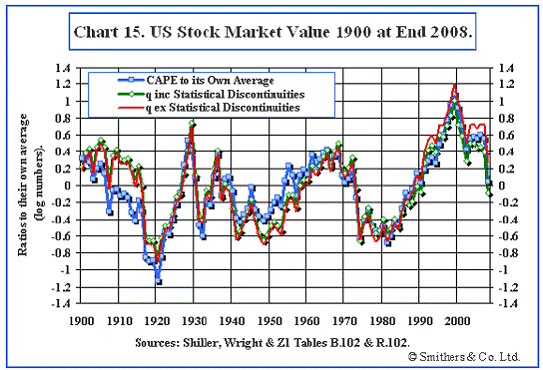
"The good news so far is that the stock market got down to pretty much fair value or even, possibly, a tickle below it, at its March bottom. But now it has gone up… we probably have a market which is, roughly, 40% overpriced. In order to assess value, it is necessary either to calculate the level at which the EPS would be if profits were neither depressed nor elevated, or to use a metric of value which does not depend on profits.

The cyclically adjusted P/E (
CAPE) normalizes EPS by averaging them over 10 years. It thus follows the first of those two possible methods. Using even longer time periods has advantages, particularly as EPS have been exceptionally volatile in recent years— and using longer time periods raises the current measured degree of overvaluation. The other methodology we use measures stock market value without reference to profits: the q ratio. It compares the market capitalization of companies with their net worth, also adjusted to current prices. The validity of both of these approaches can be tested and is robust under testing— and they produce results that agree. Currently, both q and CAPE are saying that the U.S. stock market is about 40% overvalued."

In the chart below, the current data point would be about 0.4, not as extreme as we observed in 1929, 2000, or 2007 of course, but equal to or beyond what we've observed at virtually every other market peak in history. This aligns well with our own analysis, where as I've noted in recent weeks, the S&P 500 is priced to deliver one of the weakest 10-year total returns in history except for the (ultimately disappointing) period since the mid-1990's.


Click Here, or on the image, to see a larger, undistorted image.


One of the fascinating aspects of the past few months is the lack of equilibrium thinking with respect to what happened to the trillions of dollars in government money that has been spent to defend the bondholders of mismanaged financial companies. Almost by definition, money given to corporations will show up most quickly as improvements in corporate earnings, and then slightly later, as executive compensation. A few pieces came across my desk last week, hailing the ability of the corporate sector to bounce back from the recent economic downturn even though revenues have continued to suffer and employment has been steeply cut. Why is this a surprise? Where else could the money have gone? Labor compensation? It is truly mind-numbing that a moment after a temporary surge of trillions of dollars, borrowed and tossed out of a helicopter (though to [[well connected: normxxx]] specific corporations and private beneficiaries), analysts would hail a subsequent improvement in corporate results as evidence of "resilience."

What matters is sustainability, and unfortunately, it is clear that credit continues to collapse. Banks are contracting their loan portfolios at a record rate, according to the latest FDIC Quarterly Banking Profile. Even so, new delinquencies continue to accelerate faster than loan loss reserves. Tier 1 capital looked quite good last quarter, as one would expect from the combination of a large new issuance of bank securities, combined with an easing of accounting rules to allow "substantial discretion" with respect to credit losses. The list of problem institutions is still rising exponentially. Overall, earnings and capital ratios have enjoyed a reprieve in the past couple of quarters, but delinquencies have not, and all evidence points to an acceleration as we move into 2010.

Urgent Policy Implications

From a policy standpoint, it is effectively too late to forestall further foreclosures absent explicit losses to creditors. The best policy option now is to make sure that the second wave does not result in a debasement of the U.S. dollar. The way to do that is to require three things:

First, the FDIC should be given regulatory authority to take non-bank financials into conservatorship the way they should have been able to do with Bear Stearns and Lehman. If this authority had existed in 2008, Bear's bondholders would not now stand to get 100% of their money back, with interest, as they presently do, and Lehman's disorganized liquidation would have been completely unnecessary. As I've noted before, the problem with Lehman was not that it went bankrupt, but that it went bankrupt in a disorganized way. If the FDIC had authority over insolvent non-bank financials and bank holding companies, it could wipe out equity and an appropriate amount of bondholder capital, and sell the fully-functioning residual to an acquirer, as is typically done with failing banks, without any loss to depositors or customers.

Second, bank capital requirements should be altered to require a substantial portion of bank debt to be of a form that automatically converts to equity in the event of capital inadequacy. This would force losses onto bondholders, rather than onto taxpayers. This policy adjustment is urgent— we have perhaps a few months to get this right.

Finally, Congress should be clear that government funds will be available only to protect the interests of depositors, not bondholders. Specifically, any funds provided by the government should be contingent on the ability to exert a senior claim to bondholders in the event of subsequent bankruptcy, even if a category is created to allow those funds to be counted as "capital" for purposes of satisfying capital requirements prior to such bankruptcy. Government-provided capital should be subordinate only to depositor claims, if equity and bondholder capital ultimately proves insufficient to meet those obligations.

Since early 2008, beginning with the provision of non-recourse funding in the Bear Stearns debacle, the Federal Reserve and the Treasury have repeatedly allocated or implicitly obligated public funds to defend the bondholders of mismanaged financial companies. This has included the outright and non-recourse purchase of nearly a trillion dollars in mortgage securities that have no explicit guarantee by the U.S. government. By purchasing these securities outright (rather than through a well-defined repurchase agreement), the Fed is effectively obligating the U.S. government to either guarantee them or to absorb any future losses.

Aside from the fraction of bailout funding that was specifically allocated by Congress through legislation, these actions represent an unconstitutional breach into enumerated spending powers that are the domain of the elected members of Congress alone. The issue here is not whether the Fed should be independent from political influence. The issue is the constitutionality of the Fed's actions. The discretion that it has exerted over the past two years crosses the line into prerogatives reserved for Congress. That line needs to be clarified sooner rather than later.

Emphatically, the trillions of dollars spent over the past year were not in the interest of protecting bank depositors or the general public. They went to protect bank bondholders. Instead of taking appropriate losses on those bonds (which financed reckless mortgage lending), those bonds are happily priced near their face value, for the benefit of private individuals, thanks to an equivalent issuance of U.S. Treasury debt. But that's not enough. Outside of a very narrow set of institutions that are subject to compensation limits, just watch how much of the public's money— which benefitted several major investment banks following a very direct route— gets allocated to Wall Street bonuses in the next few weeks.

Market Climate

As of last week, the Market Climate for stocks remained characterized by unfavorable valuations and mixed market action. The market remains significantly overbought on an intermediate-term basis, and we've seen increasing divergences from breadth, small and mid-cap stocks, trading volume, and other internals, which have lagged the most recent advance in the S&P 500 and other cap-weighted indices.

The prospect of a debt-repayment "standstill" from Dubai prompted some weakness in foreign markets that spilled over to the U.S. on Friday. This was interesting given that David Faber reported the issue on CNBC on Wednesday, to no reaction. Importantly, the payment difficulties do not stem from oil revenues, but largely from tourism and financial activity, as those are Dubai's chief industries (Dubai is home to the tallest building and the largest man-made islands in the world, for example). From that standpoint, it is difficult to imagine much in the way of contagion as a result of Dubai's difficulties.

Whatever shock the market will get from left field is likely to come from larger financial or geopolitical risks. The market for credit default swaps bears watching, but thus far we haven't observed spikes to indicate that something major is imminent. Unfortunately, as I noted earlier, investors have earned an "F" for vigilance in recent years, so our lead time on new difficulties may be shorter than we might like.

In any event, I'm pleased with the overall behavior of our stock holdings, and I expect that we'll have plenty of opportunity to increase our exposure to market fluctuations at more appropriate valuations. Presently, we've got a small amount of exposure to market fluctuations, but not enough to cause any material difficulties if the market experiences some trouble. The largest source of day-to-day fluctuations remains the difference in performance between the stocks we hold long and the indices we use to hedge. That source of risk has also been the primary contributor to returns over the life of the Fund.

In bonds, the Market Climate was characterized last week by moderately unfavorable yield levels and generally favorable yield pressures. We saw a good example of how the market is inclined to respond to fresh credit concerns last week, with upward pressure on the U.S. dollar and U.S. Treasuries, and downward pressure on foreign currencies and commodities. While I continue to believe that the dollar faces substantial risk of further erosion in its exchange value, as well as a near doubling of the CPI over the coming decade or so (both reflecting the massive increase in U.S. government liabilities in recent years), those prospects are not likely to emerge until risk-aversion about credit default materially abates. Credit concerns typically create a spike in demand for default-free assets such as U.S. government liabilities, so even though there is a much larger float than is likely to be sustained over time without inflation as the ultimate outcome. Credit concerns tend to support the value of these liabilities and hence mute immediate inflation pressures (essentially, monetary velocity declines as these liabilities are sought as a default-free store of value).

Prospectuses for the Hussman Strategic Growth Fund and the Hussman Strategic Total Return Fund, as well as Fund reports and other information, are available by clicking "The Funds".

An End For Greece… and the EMU!?!

Greece Defies Europe As EMU Crisis Turns Deadly Serious
Euroland's Revolt Has Begun. Greece Has Become The First Country On The Distressed Fringes Of Europe's Monetary Union To Defy Brussels And Reject The Dark Age 'Leech-Cure' Of Wage Deflation.


By Ambrose Evans-Pritchard | 13 December 2009
See also related articles by Ambrose Evans-Pritchard at Telegraph.co.uk


George Papanderou, the Greek prime minister, faces potential riots if he cuts spending to address the deficit

While premier George Papandreou offered pro forma assurances at Friday's EU summit that Greece would "not default" on its €298bn (£268bn) debt, his words to reporters afterwards had a different flavour. "Salaried workers will not pay for this situation: we will not proceed with wage freezes or cuts. We did not come to power to tear down the social state," he said. Were we to believe that a country in the grip anarchist riots and prey to hard-Left unions would risk its democracy to please Brussels?

Mr Papandreou has good reason to throw the gauntlet at Europe's feet. Greece is being told to adopt an IMF-style austerity package, without the devaluation so central to IMF plans. The prescription is ruinous and patently self-defeating. Public debt is already 113% of GDP. The Commission says it will reach 125% by late 2010. It may top 140% by 2012.

If Greece were to impose the draconian pay cuts under way in Ireland (5% for lower state workers, rising to 20% for bosses), it would deepen depression and cause tax revenues to collapse further. It is already too late for such crude policies. Greece is past the tipping point of a 'compound debt' spiral.

Ireland may just pull it off. It starts with lower debt. It has flexible labour markets, and has shown a Scandinavian discipline. Mr Papandreou faces circumstances more akin to those of Argentine leaders in 2001, when they tried to cut wages in the mistaken belief that ditching the dollar-peg would prove calamitous. Buenos Aires erupted in riots. The police lost control, killing 27 people. President De la Rua was rescued from the Casa Rosada by an air force helicopter. The peg collapsed, setting in train the biggest sovereign default in history.

Economists waited for the sky to fall. It refused to do so. Argentina achieved Chinese-style growth for half a decade: 8.8% in 2003, 9% in 2004, 9.2% in 2005, 8.5% in 2006, and 8.7% in 2007. London bankers were soon lining up to lend money (our pension funds?) to the Argentine state— despite the 70% haircut suffered by earlier creditors. [[And who can forget the generally positive results to Russia following its default?: normxxx]]

In theory, Greece could do the same: restore its currency, devalue, pass a law switching internal euro debt into drachmas, and "restructure" foreign contracts. This is the "kitchen-sink" option. Such action would allow Greece to break out of its death loop. Bondholders would scream, but then they should have delved deeper into the inner workings of EMU. RBS said the UK and Ireland have most exposure, with 23% of Greek debt between them (mostly for global clients). The French hold 11%, Italians 6%.

Remember, Athens holds the whip hand over Brussels, not the other way round. Greek exit from EMU would be dangerous. Quite apart from the instant contagion effects across Club Med and Eastern Europe, it would puncture the aura of 'manifest destiny' that has driven EU integration for half a century. I don't wish to suggest that Mr Papandreou— an EU insider— is thinking in quite such terms. Full membership of the EU system is imperative for a country dangling off the bottom of Balkans, all too close to its Seljuk nemesis. But Mr Papandreou cannot comply with the EU's deflation diktat.

No doubt, EU institutions will rustle up a rescue. RBS says action by the European Central Bank may be "days away". While the ECB may not bail out states, it may buy Greek bonds in the open market. EU states may club together to keep Greece afloat with loans for a while. That solves nothing. It increases Greece's debt, drawing out the agony. What Greece needs— unless it leaves EMU— is a permanent subsidy from the North. Spain and Portugal will need help too.

The danger point for Greece will come when the Pfennig drops in Berlin that EMU divergence between North and South has widened to such a point that the system will break up unless— either Germany tolerates inflation of 4% or 5% to prevent Club Med tipping into debt deflation OR it 'pays' welfare transfers to the South (not loans) equal to East German subsidies after reunification.

Before we blame Greece for making a hash of the euro, let us not forget how we got here. EMU lured Club Med into a trap. Interest rates were too low for Greece, Portugal, Spain, and Ireland, causing them all to be engulfed in a destructive property and wage boom. The ECB was complicit. It breached its inflation and M3 money targets repeatedly in order to nurse Germany through its slump. ECB rates were 2% until December 2005. This was poison for overheating Southern states.

The deeper truth that few in Euroland are willing to discuss is that EMU is inherently dysfunctional— for Greece, for Germany, for everybody.

.

Greece Tests The Limit Of Sovereign Debt As It Grinds Towards Slump
Greece Is Disturbingly Close To A Debt Compound Spiral. It Is The First Developed Country On Either Side Of The Atlantic To Push Unfunded Welfare Largesse To The Limits Of Market Tolerance.


By Ambrose Evans-Pritchard | 22 November 2009


Greece's economic malaise contributed to riots in Athens last December

Euro membership blocks every plausible way out of the crisis, other than EU beggary. This is what happens when a facile political elite signs up to a currency union for reasons of prestige or to snatch windfall gains without understanding the terms of its Faustian contract. When the European Central Bank's Jean-Claude Trichet said last week that certain 'sinners' on the edges of the eurozone were "very close to losing their credibility", everybody knew he meant Greece.

The interest spread between 10-year Greek bonds and German bunds has jumped to 178 basis points. Greek debt has decoupled from Italian debt. Athens can no longer hide behind others in EMU's soft South. "As far as the bond vigilantes are concerned, the Bat-Signal is up for Greece," said Francesco Garzarelli in a Goldman Sachs client note, Tremors at the EMU Periphery.

The newly-elected Hellenic Socialists (PASOK) of George Papandreou confess that the budget deficit will be more than 12% of GDP this year, four times the original claim of the last lot. After campaigning on extra spending, it will have to do the exact opposite. "We need to save the country from bankruptcy," he said.

Good luck. Communist-led shipyard workers have already clashed violently with police. Some 200 anarchists were arrested in Athens last week after they torched streets of cars in a tear gas battle. Mr Papandreou has mooted a pay freeze for state workers earning more than €2,000 a month. This has already set off an internal party revolt. "There is enormous denial," said Lars Christensen, emerging markets chief at Danske Bank. "They don't seem to understand that very serious austerity measures are needed. It is a striking contrast with Ireland," he said.

Brussels says Greece's public debt will rise from 99% of GDP in 2008 to 135% by 2011, without drastic cuts. Athens has been shortening debt maturities to trim costs, storing up a roll-over crisis next year. Some €18bn comes due in the second quarter of 2010 (IMF).

Modern economies have reached such debt levels before, and survived, but never in the circumstances facing Greece. "They can't devalue: they can't print money," said Mr Christensen.

The tourist trade is withering, down 20% last season by revenue. (Turkey's was up.) It is hard to pin down how much is a currency effect, but clearly Greece has priced itself out of the Club Med market. Wages rose a staggering 12% in the 2008-2009 pay-round alone (IMF data), suicidal in a 'Teutonic' currency union. Greece has slipped to 71st in the competitiveness index of the World Economic Forum, behind Egypt and Botswana.

Greece has long been skating on thin ice. The current account deficit hit 14.5% of GDP in 2008. External debt has reached 144% (IMF). Eurozone creditors— German banks?— hold €200bn of Greek debt. A warning from Bank of Greece that lenders must wean themselves off the ECB's emergency funding has brought matters to a head. Default insurance on Greek debt jumped 40 basis points last week.

Greek banks have borrowed €40bn from the ECB at 1%, playing the "yield curve" by purchasing state bonds. This EU subsidy has made up for losses on property, shipping, and Balkan woes. The banks insist that they are in rude good health. EFG Eurobank has halved reliance on ECB funding. "Greek banks are very liquid: we maintain billions in extra liquidity," it said. Yet markets are wary. Recession has come late to Greece, but will bite deep in 2010. It takes three years for defaults to peak once the cycle turns.

David Marsh, author of The Euro: The Politics of The New Global Currency, said the danger for EMU laggards is that the ECB will begin to tighten before they are out of trouble. It is German recovery that threatens to stretch the North-South divide towards breaking point. [[…just as it was the German slump that started the whole EMU down the slippery slope of 'easy' money…: normxxx]] Athens squandered its euro 'windfall'. For a decade, EMU let Greece borrow at almost the same cost as Germany. It was a heaven-sent chance to whittle down debt. Instead, the country dug itself deeper into a hole by running budget deficits near 5% of GDP at the top of the boom.

Like Labour under Brown, idiot leaders mistook a bubble for their own skill. But the consequences in EMU are more dreadful. Austerity may prove self-defeating, without the cure of devaluation. Greece risks grinding deeper into slump. The EU can paper over this by transfering large sums of money to Greece. But will Berlin, Paris— and London, also on the hook— feel obliged to bail out a country that has so flagrantly violated the 'rules of the club', not least by holding Eastern Europe's EU entry to ransom over Cyprus? That is neither forgotten, nor forgiven.

During the panic last February, German finance minister Peer Steinbruck promised 'to rescue' any eurozone state in dire trouble. He is no longer in office. The pledge was, in any case, a bounced 'political' cheque even when he wrote it. Greece can assume nothing.

Friday, December 11, 2009

Interview With US Economic Recovery Advisory Board Chair Paul Volcker

Interview With Us Economic Recovery Advisory Board Chair Paul Volcker
America Must 'Reassert Stability And Leadership'


Interview conducted by Gabor Steingart, Spiegel | 12 December 2009


The financial crisis has led to a decline in American economic supremacy. Here, two traders taking a break on Wall Street in March.
Paul Volcker, 82, is one of US President Barack Obama's leading economic advisors. SPIEGEL spoke with him about the economic challeges facing the US, whether new taxes are needed to address public debt and how America can return to a position of economic leadership.
Paul Volcker, center, was chairman of the Federal Reserve under Presidents Jimmy Carter and Ronald Reagan. President Barack Obama chose him to chair the newly formed Economic Recovery Advisory Board.

SPIEGEL: Mr. Volcker, you grew up during the Great Depression. What sort sort of childhood memories do you have from those difficult times?

Volcker: Well, my memories are quite limited. My father had a stable job. He was a city manager at that time. We weren't wealthy, just middle class living in a growing suburb of New York, and that was not in the middle of depressed America. I know that my mother at that time did not let me take a part time job and she often said that other people needed the job more than I did.

SPIEGEL: Can the current situation be compared with the Great Depression?

Volcker: I remember there were people, beggars and tramps as we called them, who wanted to be fed. So it's true, today we also have people who are relying on food stamps and other payments but we are a long way from the Great Depression. We are in a serious, great recession. Today we have 10 percent unemployment, but at that time it was more like 20 or 25 percent. That's a big difference. You had mass unemployment.

SPIEGEL: But even though there are still more people being fired than hired, the Chairman of the Federal Reserve Ben Bernanke is saying that the recession is technically over. Do you agree with him?

Volcker: You know, people get very technical about these things. We had a quarter of increased growth but I don't think we are out of the woods.

SPIEGEL: You expect a backlash?

Volcker: The recovery is quite slow and I expect it to continue to be pretty slow and restrained for a variety of reasons and the possibility of a relapse can't be entirely discounted. I'm not predicting it but I think we have to be careful.

SPIEGEL: What is the difference between this deep recession and all the other recessions we have seen since World War II?

Volcker: What complicates this situation, as compared to the ordinary garden variety recession, is that we have this financial collapse on top of an economic disequilibrium. Too much consumption and too little investment, too many imports and too few exports. We have not been on a sustainable economic track and that has to be changed. But those changes don't come overnight, they don't come in a quarter, they don't come in a year. You can begin them but that is a process that takes time. If we don't make that adjustment and if we again pump up consumption, we will just walk into another crisis.

SPIEGEL: As chairman of the Economic Recovery Advisory Board, you advise President Barack Obama on how to prevent such a recurrence. Is he following your guidance?

Volcker: We have various working groups that work on and make recommendations on particular problems like retirement programs and social security. We made some recommendations on financial reforms which were not accepted, but that is part of the game. The president is more eloquent than I can be on these issues. Getting it done as compared to talking about it is a problem, but we have some suggestions along that line.

SPIEGEL: The US has not yet instituted any kind of reform policy. What we see is the government and the Federal Reserve pouring money into the economy. If one looks beyond that money, one sees that the economy is in fact still shrinking.

Volcker: What should I say? That's right. We have not yet achieved self-reinforcing recovery. We are heavily dependent upon government support so far. We are on a government support system, both in the financial markets and in the economy.

SPIEGEL: To get the recovery to the point where it is right now has cost a lot of money. National debt will probably reach $12 trillion in 2019. Just serving the debt costs $17 billion a year— at least according to this year's forecast. That's difficult to sustain.

Volcker: You've got to deal with the deficit and you've got to deal with it in a timely way. Right now, with the unemployment rate still very high, excess capacity is still evident, and the economy is dependent on government money as we said. We are not going to successfully attack the deficit right now but we have got to prepare for attacking it.

SPIEGEL: Should Americans prepare themselves for a tax increase?

Volcker: Not at the moment, but I think we would have to think about it. The present tax system historically has transferred about 18 to 19 percent of the GNP to the government. And we are going to come out of all this with an expenditure relationship to GNP very substantially above that. We either have to cut expenditures and that means reducing entitlements and certainly defense expenditures by an amount that may not be possible. If you can do it, fine. If we can't do it, then we have to think about taxes.

SPIEGEL: What kind of taxes do you have in mind?

Volcker: Maybe we should talk about energy taxes, which could be a big revenue producer.

SPIEGEL: The Harvard Professor Niall Ferguson has written a Newsweek cover story where he essentially argues that America is in great danger due to steep debt, slow growth and high spending. Do you think it is overblown?

Volcker: The challenge is real. That is the kind of threat that we want to deal with and reassert stability and leadership. I grew up in an environment in which the United States was leading, was a pole of strength.

SPIEGEL: At that time, America was the biggest exporter in the world and not the biggest importer. The America you are referring to was the biggest lender in the world and not its biggest borrower.

Volcker: That is correct. And we don't perhaps have to get all the way back there, but we have to get back in an area where there is confidence in the stability and the authority of the United States. I think we can do that but we have a challenge, we have gotten a wake-up call. There is concern in our recovery advisory group about how to rebuild the competitiveness of the United States, which inevitably means rebuilding, in part, the manufacturing sector of the economy.

SPIEGEL: What part of the manufacturing sector do you envision?

Volcker: I think there are a lot of opportunities in the so-called green economy for taking leadership. On the technical side, I mean technology development, research development, the US is doing ok, but when it comes to manufacturing some of this stuff, somehow the Germans do it all!

SPIEGEL: And a lot of Americans try to blame the Germans for this, saying that we are depending too heavily on the export industry.

Volcker: I must say, I admire Germany in this situation even with its high costs. In some ways, I think the labor cost is higher in Germany than it is in the United States but you can somehow maintain that export edge. You are dedicated to exporting, we are dedicated to financial engineering and it hasn't worked out too well. I wish we had fewer 'financial' engineers and more 'mechanical' engineers. Tell me the secret of how the Germans keep this going.

SPIEGEL: Maybe the reason is that the Germans don't trust the American boom and bust economy with its dedication to fast money.

Volcker: I think part of it is the psychological. The young, ambitious Germans realize that export industry and heavy engineering is the German competitive advantage. The best Americans don't even think about that. We have the Silicon Valley and that whole kind of high tech industry is still our strength but we need something broader than that too.

SPIEGEL: Outsourcing and off-shoring have been the key words of the last decades. You don't think that the times of "made in America" are over forever?

Volcker: That has been the mentality and we have to change that somehow. I think it's self-correcting in part. The glamour of going to Wall Street is not as great today as it was a few years ago.

SPIEGEL: Are you sure? The Wall Street businesses are doing well. The big bonuses are back.

Volcker: It's amazing how quickly some people want to forget about the trouble and go back to business as usual. We face a real challenge in dealing with that feeling that the crisis is over. The need for reform is obviously not over. It's hard to deny that we need some forward looking financial reform.

SPIEGEL: In Germany, the government, but also the Bundesbank, is still waiting for a clear American approach toward that goal.

Volcker: I grew up in a world in which American leadership was important and, I thought, constructive. It's more difficult now because we are not as relatively strong as we used to be. If you are right in saying that somebody is waiting for our voice, I hope we can speak clearly.

SPIEGEL: You have been clear about your ideas. Do you really believe we have to break up the big banks in order to create a more sustainable financial system?

Volcker: Well, breaking them up is difficult. I would prefer to say, let's just slice them up. I don't want them to get heavily involved in capital market activities so my view is: Hedge funds, no. Equity funds, no. Proprietary trading, no. Trading in commodities, no. And that in itself would reduce the size of the big banks. So you get some reduction in size. Equally important, you make them more manageable and easier to deal with if they do get in trouble.

SPIEGEL: Banking should become boring again?

Volcker: Banking will never be boring. Banking is a risky business. They are going to have plenty of activity. They can do underwriting. They can do securitization. They can do a lot of lending. They can do merger and acquisition advice. They can do investment management. These are all client activities. What I don't want them doing is piling on top of that risky capital market business. That also leads to conflicts of interest.

SPIEGEL: But the American government seems to have lost some eagerness in setting a tougher regime of rules and regulations to control Wall Street. Everything is being watered down. Why?

Volcker: I will do the best I can to fight any tendency to water it down. What we need is broad international consensus to make things happen.

SPIEGEL: Your old German friend, the former Chancellor Helmut Schmidt, is already on your side. He is now speaking about the current economic system as a kind of predator capitalism which must be tamed.

Volcker: I'm glad he is speaking out. I am a great admirer of Helmut Schmidt. He was very straightforward and kind of brutally outspoken in a way, to which many people reacted adversely.

SPIEGEL: Are you thinking of a particular situation?

Volcker: The famous incident happened in 1979 shortly after I became Chairman of the Federal Reserve Bank…

SPIEGEL: …and the inflation in the US had reached 12 percent.

Volcker: I was flying with the Secretary of Treasury to a meeting in Belgrade but for some reason an arrangement had been made, Helmut probably suggested it, that we stop in Hamburg on the way to Belgrade to hold a meeting. The meeting was mostly Helmut speaking for an hour about how "you Americans" have got to do something about inflation. My Secretary of Treasury was kind of taken back by the force of it all, but it was fine with me since I had been planning the same kind of policy.

SPIEGEL: During your tenure as chairman of the Federal Reserve, the bank was always part of the solution. Today with the Fed's policy of easy money, many experts see it as part of the problem.

Volcker: Given the difficulty of the economic situation and the large amount of money being spent to support the economy, The Fed is receiving the brunt of the criticism. Some support for the economy was certainly necessary, but the mere fact that in this situation emergency measures were necessary should not dictate a liberal approach in the future.

SPIEGEL: Lawmakers on Capitol Hill are thinking about tougher controls over the Federal Reserve.

Volcker: I think the loss of independence and authority of the Federal Reserve would be a very serious matter for the United States. Not just in terms of monetary policy but in terms of our place in the world. People look to strong, credible institutions and I think the Federal Reserve has been such an institution. If that's lost or too hamstrung by legislation I think we will regret it.

SPIEGEL: But is the Fed still the same kind of institution as during your tenure as chairman? Or is it now more of a governmental instrument? The Fed is managing the TARP program and is also buying government bonds.

Volcker: In some sense the Federal Reserve is always an instrument of the government. It is a government body but it is independent within government. But you are right in the sense that part of the concern is that they have involved themselves quantitatively in entering markets and in that process, you are supporting some markets and not others. That is an area in which the Federal Reserve has never wanted to get into and one that most central banks don't want to get into. If you are going to maintain your independence you have to avoid that. To intervene in particular sectors of the market is not the proper role for the central bank over time. It could be justified only by extreme emergency.

SPIEGEL: So what do you expect in the very near future?

Volcker: As an American, I have to be an optimist. But we have got a big challenge and we have to face up to it. And as you know, there is a lot of concern about the dysfunction of the political system.

SPIEGEL: So it is becoming harder to be an optimist?

Volcker: It's a challenge.

SPIEGEL: Mr. Volcker, thank you very much for this conversation.

Thursday, December 10, 2009

If This Is Recovery…

If This Is Recovery…

By John Mauldin | 13 November 2009

If This is Recovery, Where Are the Taxes?
Last Business Standing
Stimulus, What Stimulus?
The Reality of Unemployment
Let the Good Times Roll
The Quick Double-Dip Scenario

No one goes into Wal-Mart and asks to pay extra sales tax. Thus sales taxes are reasonable barometers for retail sales. This week we look at how taxes are doing in a period of economic 'recovery'. Then we turn our eyes to a very interesting (and sobering) analysis of possible future unemployment rates. This is [[in the nature of: normxxx]] an antidote to the 'happy-face analysis' of employment numbers you get from establishment economists. There will be a lot of charts and tables, so this letter may print a little longer, but I think you will find it very interesting.

If This is Recovery, Where Are the Taxes?

I keep reading about surveys that show that retail sales are up. But as noted above, no one pays extra sales taxes, or decides they need to pay more income taxes. The surest way to measure retail sales is sales taxes. Want to know how incomes are doing? Look at income tax receipts. Let's look at sales taxes first.

First off, I can find no single source of recent sales tax information. It is all one-off, but it is consistent. Sales taxes in my home state of Texas are down 12.8% year-over-year, and we're in the fifth straight month of decreases of 11% or more. Projections are for sales taxes to continue to decline into 2010.

There is a very revealing study by the Pew Center on state taxes, called "Beyond California". Everyone knows how bad California is. The Pew Center looks at how the rest of the states are doing, and focuses on 10 states that also have severe problems. Sales tax receipts are down 14% in Arizona, and state income taxes are down 32%.

On average, revenues are down almost 12%. Oregon has seen their revenues collapse a stunning 19%. New York is down 17%, with a deficit of 32%. Illinois has a projected deficit of 47% of its budget, second only to California with 49%. You can see how your state fares here.

The Liscio Report notes that all states had negative year-over-year sales tax collections in October, and the weighted average decrease was 10.2%, further down from a negative 7.2% in September. Sales at Wal-Mart stores slipped by 0.4% in the third quarter. Actual government figures show that retail sales were down 1.5% in September from the previous month and 5.8% year-over-year. So how do we keep seeing headlines about retail sales being up, as unemployment keeps rising?

Remember that such reports are usually based on surveys, and generally cover mid-sized and up retailers, leaving out smaller businesses. Further, if you are a retail chain that has closed 10% of its stores [[and/or has seen 10% or so of its competition disappear: normxxx]], the remaining stores should in theory benefit from getting new and your loyal old customers into them.

Last Business Standing

Yesterday I was with an associate, and I hesitated in asking them how their business was doing, because I knew things had been tough at the beginning of the year. But I did ask, and they said sales were up over the last months and business was looking better. Surprised, I asked them what made the difference. "Ah," they said, "less competition. Our competitors have gone out of business."

Best Buy and other electronic retailers had to benefit from Circuit City disappearing. That is Schumpeter's creative destruction at work. Not very good for total employment, but it does help the profitability of the survivors.

So, if things are so bad, how did we have 3.5% growth in the third quarter? First, things are not as bad as they were in the past year. We are in fact getting close to an economic bottom, at least for now. Second, the 3.5% number is a preliminary estimate. A study by Goldman Sachs suggests that the number will be revised down by at least 0.5% and maybe as much as 1%.

Why? The estimate does not really take into account how poorly small businesses are performing. If you look at small-business indexes and compare them to historical GDP numbers, you get the smaller number mentioned above. And since at least 2% of the GDP was from the stimulus package (Cash for Clunkers, houses, tax cuts), the economy on its own was flat. That begs the question, what happens when the stimulus runs out?

And the answer is that we won't know for some time, as the stimulus is just getting ramped up. "According to CBO estimates, only 21% of [the stimulus] spending will occur in 2009; another 38% will come in 2010, and 22% in 2011. After that, its effect will dissipate quickly". (The Liscio Report) But David Rosenberg notes that what the federal government is giving, the states are taking away. The Pew Study shows that at least nine other states are in appalling shape, so it is no wonder that David writes:
Stimulus, What Stimulus?

"Fully nine states are in fiscal distress and only two have balanced budgets. States like Michigan are planning
20% budget cuts for the coming year. Indiana is planning a 10% spending cut in light of a 7.4% YoY revenue decline. How can the economy really be out of recession if government revenues are still deflating?

"The states are filling around
40% of their fiscal gaps with the federal stimulus (so much for spending on "shovel ready" infrastructure projects). Even after the fiscal help from Washington, the state governments will still face a projected deficit of $142 billion for 2011 (versus $113 billion in 2010). All in, the restraint in the state and local government sector is estimated to drain a full percentage point from U.S. GDP growth in 2010 and more than fully offset the stimulative efforts from Washington. The U.S. economy is more likely to post growth of little more than 2% next year, rather than the 5% currently being discounted by the equity market."

The Reality of Unemployment

All this is, of course, going to put continued pressure on employment. As I noted last week, the number of unemployed actually soared by 558,000, to 15.7 million, as measured by the household survey, not the 190,000 you read about in the mainstream media. Sadly, unemployment is continuing to rise by significant amounts.

In August, I did an interview with CNBC from Leen's Fishing Lodge in Maine. The unemployment numbers had just come out. I did a back-of-the-napkin estimate that we would need about 15 million new jobs over the next five years just to get back to where we were when the recession started.

That works out to a need for about 125,000 new jobs each month to handle new workers coming into the market (which comes to a total of 7.5 million over five years), plus the 8 million and rising jobs we've lost already. That is a daunting number. It amounts to 250,000 new jobs a month every month for five years. And we are still losing more than that number a month, let alone adding the needed 250,000.

Look at the chart below. It shows the establishment survey employment figures for the last ten years. Only once, in 1999, did we actually add over 250,000 jobs a month for a whole year. And that was during the internet boom.


Click Here, or on the image, to see a larger, undistorted image.


Sadly, the private sector has shed [[a net of: normxxx]] over 300,000 jobs since 1999. Think about that. We have had a decade where there have been no new jobs added by the private sector. Real incomes are roughly where they were, and the stock market is down. Talk about a lost decade.

I love it when someone does the really heavy lifting for me, and my friend Mike Shedlock of Sitka Pacific Capital Management has done a wonderful job of taking that speculation of mine and putting it into a spreadsheet. That helps us get a real handle on what unemployment is likely to look like for the next ten years. I am going to make use of his basic analysis and then modify some of his assumptions in the spreadsheet he provided me, in order to think about different scenarios.

All three scenarios are based on assumptions, so let's see what Mish started with. There is a wealth of data available from the Bureau of Labor Statistics and the Census Bureau. According to the Census Bureau Population Estimates we are going to add about 2.5 million working-age (16 years old and up) citizens a year, from now until 2020. The numbers varies slightly year to year. Mish used an estimate of the average, summing up the buckets from 16 to 100+ for the years in question and rounding the result.

You can go to the BLS site and look at Table A-1. This table shows the civilian noninstitutional population (those over 16 not in prisons), the participation rate (those who are working and/or want to work), the unemployment rate, the number employed, those not in the labor force, and those who want a job. Those are starting numbers for the charts below.

For those interested, you can read Mish's very full (and quite detailed) analysis at his blog site. But let's look at his assumptions:


  • Job losses are likely to continue for a minimum of another year.

  • When job gains start, they will be very slow at first, then pick up.

  • An extremely generous monthly job gain stat over the course of the year would be 150,000 jobs.

  • A falling participation rate (boomers retiring) will continue to mask reported unemployment.

  • Starting in 2013 the labor pool will start decreasing because of Boomer demographics.

  • The noninstitutional population will rise by 2.5 million workers a year.

The spreadsheet below needs a little explanation. Let's start with the assumptions. Mike starts with current working-age population and adds 2.5 million people a year. He assumes that Boomers will retire at 65 (something which all the surveys say is not going to happen). And his last estimate is what the unemployment numbers will be. Everything else is based on those assumptions, which leads to the first column, or the expected unemployment number.

By the way, we know that everyone will want to make different assumptions. I am going to create three scenarios, but you can go to Mike's blog and at the bottom of the post is a link to the actual spreadsheet. Have fun. Now, let's look at my scenario 1.


Click Here, or on the image, to see a larger, undistorted image.


This assumes there is no double-dip recession, and jobs roughly rise along the same lines as the last recovery. Actually, Mish is far more optimistic, as in the very first chart you will notice that job losses were negative in the first year after the end of the recession and flat the second year. Mish has jobs rising by 120,000 next year and 600,000 the second year (2011), and then a fairly robust recovery. Below is the graph of the unemployment numbers under such a scenario.

Notice that unemployment stays at or above 11% for three years. Pessimistic? Mainstream and usually very optimistic Mark Zandi predicted this week that unemployment would rise to 11% by the middle of next year, right in line with this scenario. Also note that total jobs rise by 14 million over ten years. Hardly doom and gloom. Again, that assumes Boomers all retire on time and there is no double-dip recession.

Let the Good Times Roll

What would it take to get back to 5% unemployment? I played with the spreadsheet and came up with the following numbers, which get us below 5% by 2020. I assume no recessions for the next ten years, and 2 million new jobs a year after 2011, which I start off with almost 1.5 million jobs. Of course, we have never done that, but let's be optimistic.


Click Here, or on the image, to see a larger, undistorted image.


And the graph below shows the unemployment numbers for the 'Good Times Scenario'.

Want to get to 5% within five years? Add 3 million jobs a year starting now. With no housing recovery, a smaller auto industry, and financial firms getting leaner [[and fewer: normxxx]].


The Quick Double-Dip Scenario

When I called the last two recessions about a year before they happened, it was not all that hard. We had inverted yield curves, falling leading indicators, and a lot of other data that pretty much pointed to a recession. Believing that we had a housing bubble and a looming credit crisis also helped my conviction in calling the last recession.

I think we are in for a double-dip recession in 2011, yet I readily admit there will be little if any statistical evidence in advance this time. This is more of an instinct call. I have serious doubts that we can have what amounts to the largest tax increase of all time in what will be a very weak (albeit growing) economy, without putting us back into recession. And Speaker Pelosi thinks it is a smart thing to add another 5.4% surtax on what will already be a rising capital gains and dividend tax.

Taxing small businesses, and that is what the tax increase amounts to, is a very bad idea in a weak economy. Small businesses are where the job growth comes from. Taking money from productive businesses and giving it to government is a fundamentally flawed concept.

Now, if they decide to postpone the tax increase, or phase it in slowly, then maybe we avoid the double dip. But right now it doesn't look like that will be the case. So, let's quickly see what a double-dip scenario might look like. Let's be optimistic and assume we only lose another 1.2 million jobs in the next recession, since we have already lost so many in this one (8 million and counting).

And then the economy comes roaring back in 2012 with 1.5 million jobs and continues to grow rather smartly for the rest of the decade. No further recession. We absorb the tax increases and move on with our economic lives. Unemployment under such a scenario would rise to just under 13% and stay above 10% for 8 years. Take a look at the chart and graph.


Click Here, or on the image, to see a larger, undistorted image.


Think 13% is too dire? This week David Rosenberg said unemployment would rise to between 12-13%. The former Merrill Lynch economist was one of the few mainstream economists who called the recession and the credit crisis. The so-called "Blue Chip" economists told us at the beginning of 2008 that unemployment would peak out at 6%. While Rosie is not optimistic of late, he has a rather solid record of being right.

We are at ~10.2% unemployment today. The economy lost jobs for 21 months after the end of the last recession. That would easily take us into 2011. Another million lost jobs will take us well over 11% and close to 12% (remember, you have to add in the increasing population), even without my double-dip scenario.

The letter is getting long and it's getting late, so let me close with a few thoughts.

First, 12% unemployment is horrendous by American standards. But Spain is now at 20%, and much of Europe has been in the 10% range for years. Second, Americans are not used to the concept of 12% unemployment or 10% rates for extended periods. That is going to cause a serious backlash across the political spectrum. Couple that with the discomfort over $1.5-trillion deficits and there could be some serious political changes in the coming years. I think the message will be more anti-incumbent than one party or the other.

Third, the only way out of this morass is to create an environment where small business can thrive. As I've noted for the last several weeks in this letter, government spending does not increase GDP over time. It is a temporary, nonproductive stimulus. It takes private investment to create jobs and increase productivity. Over the next few months, I will write more about how to do that.