Saturday, March 6, 2010

Peak Energy? Again? Cause Of The '08 Crash?

Have We Reached An Inflection Point In Economics History?

By Chris Nelder | 22 June 2009

A fierce debate now rages among economists, investors, pundits and the puppetmasters of fiscal policy: What’s next, inflation or deflation? Has the most massive money-printing spree in history successfully stimulated the global economy and put it back on an upward course with rising inflation? Or are we still in a global downturn, temporarily masked by the stimulus, with prices, wages and employment still falling?

The comforting gain in the major stock market indexes since the March, 2009 lows has given renewed confidence to the "green shoots" trumpeters who still dominate the airwaves and the press.

But grayer and wiser heads in the investing community— like Dave Rosenberg, John Mauldin, Nouriel Roubini, Gary Shilling, Peter Schiff, and Dave Cohen— have a more bearish view. The financial sector must now 'deleverage', they argue, which means liquidating assets, repaying debt, saving instead of borrowing, and contracting in general. In their view, the process will take years, not months, and what we have seen since March '09 is a classic bear market rally.

As my colleague Steve Christ pointed out recently, U.S. household net worth has fallen by well over $1 trillion, and household wealth is down around 20% from its 2007 peak. Commercial real estate is contracting painfully, with prices plunging and vacancies and defaults soaring. Meanwhile, consumer credit defaults are still rising, even as the end of the home buyers' tax incentive has snuffed out the resurgence in home-buying.

Liquidity in the credit markets remains a problem as well. Banks simply aren’t lending out the Fed’s forced injection of fantasy capital. Indeed, they have been entirely intent on paying it back as quickly as the Fed will let them, on the heels of secondary stock offerings and other measures they have taken to raise capital and reduce exposure. (For a personal anecdote, I called Discover card some time ago to take advantage of a recent 1.8% promotional offer on balance transfers they had sent me, and was told that they aren’t accepting any more balance transfers right now, from anybody, period.)

On the whole, I think the case for continuing deflation and contraction is well made. [[But see Puncturing Deflation Myths: normxxx]]

Commodity Inflation

At the same time, food and energy prices have been rising rapidly. Oil has rocketed from the low $40s to the low $70s in just four months, a roughly 71% gain. Soybeans rose about 50% over the same period, with most other grains gaining similarly. Normally, this would suggest inflationary fears, and indeed it has apparently drawn hedge fund money off the sidelines, out of bonds, and back into energy and commodities. (Energy analyst Dave Cohen did a great study of speculation in the current commodity cycle in "Bad Signs, New Bubbles.")

I don’t want to make too much of the commodity resurgence, however. The market continues to price oil inversely to the dollar, and the dollar’s fall in 2009 was echoed almost perfectly by oil prices, until this year, when the price of oil in January tended to drop again with the rise in the value of the dollar:

See http://stockcharts.com/h-sc/ui?s=$XOI:$USD

The dollar’s decline can be viewed as the proper result of printing trillions of dollars out of thin air, without new assets to back it— the inflationary thesis. [[But, of course, since almost "everyone is doing it", the dollar is likely to be stable to rising for 2010.: normxxx]]

Indeflation

On the whole 2009 looked a great deal like 2008 across the energy and commodities sector, with the same sort of inflation. But there is an important difference: The economy and the consumer grew sick, very sick in 2009. Gasoline at $3 was a nuisance in 2008, but in 2009 it really hurt. Perhaps we should be zooming out on this picture, and considering the 'affordability' of oil. Consider this 60-year chart from the blog of "Mr. Excessive," which tells quite a different story:

The 'affordability' of oil, as measured by the S&P500, peaked in 1999, and has been in decline ever since. Oil prices began rising sharply at that time, as the early effects of peak oil began to be seen. Global conventional oil production has been flat since 2005, despite a tripling of prices. [[But the discovery and supplies of natural gas has exploded— largely thanks to new techniques and knowledge.: normxxx]]

So is it to be inflation or deflation?

My pal Gregor Macdonald argued this question elegantly on his blog in April, 2009 and in a later conversation asserted, I think rightly, that it’s not an either-or question. In fact, we’re seeing inflation (of prices) and deflation (of assets) simultaneously. Investor guru Doug Fabian has termed this "indeflation" and Izabella Kaminska of FT Alphaville has called it "compartflation."

Instead of just looking at the dollar and inflation, we should consider that, as former International Petroleum Exchange head Chris Cook argued on The Oil Drum, energy is the only real currency. Our fiat money is but a distorted representation of it, and that energy is declining in real terms as oil and coal all become progressively harder to extract and/or of lower energy content.

Are We At An Inflection Point?

We now appear to be bumping our heads against an invisible ceiling, where the decline in real energy meets our pain tolerance for higher prices. When gasoline hit $4 in 2008, it produced real 'demand destruction' because people simply couldn’t afford it with their evaporating dollars. Likewise, the spike in natural gas and coal prices ultimately translated into such high prices for basic building materials like cement and steel that demand was curtailed.

It now seems possible that we have reached an inflection point in economic history, where the price at which energy is high enough to sustain new production is the same price at which things become 'too expensive', leaving us no option but to downsize.

Academics including Charles Hall, Cutler Cleveland, and Howard Odum have explored the relationship between primary energy and economic growth exhaustively. Hall and his graduate student David Murphy graphically depict where we are now as follows:


Source: Murphy, D. and C. A. S. Hall (in press). "Year in Review— EROI or Energy Return On (Energy) Invested." Ecological Economics

Until we understand this key point, we are going to continue to go through wrenching cycles such as we experienced in 2008. Spiking energy and commodity prices lead to destruction of the economy, which then gathers itself at a lower overall level until prices spike again, and back around the wheel we go. Even as energy use declines, the ceiling will get lower and lower, and it will take more and more money to buy the same things.

No amount of tinkering with monetary policy can change that. Unlike money, BTUs can’t be printed out of thin air. Unfortunately, neither the Fed nor Congress seems to have learned this lesson. The Fed still thinks that tweaking interest rates, buying bonds, forcing banks to keep the fantasy money, changing the "rules of the game" and the like can somehow ease us into a manageable 'recovery' [[i.e., to those old 2007 highs.: normxxx]].

Suffice to say that I still have very low expectations that our national leadership will offer any tangible, effective methods to reduce our consumption of petroleum significantly. I certainly do not see them coming to grips with the near-certainty that by 2012, the world’s oil supply will go into terminal and relentless decline. [[Which simply means that we will pay more for scarcer and more expensively obtained oil until we reach a new (and rising) equilibria— and until the more expensive sources (shale oil, tar sands, very deep sea oil) can be tapped in abundance (and our new abundance of natural gas can be fitted into the energy picture.): normxxx]]

On the international scene, finance ministers for the Group of Eight (G8) expressed 'concern' over the influx of capital into the commodity sector after their meeting last weekend. In a communiqué issued in 2009, the group stated,
"Excess volatility of commodity prices poses risks to growth. We will consider ways to improve the functioning and transparency of global commodity markets, including considering IOSCO [the International Organisation of Securities Commissions] work on commodity derivative markets."
Ministers have asked the International Monetary Fund (IMF) and the International Energy Agency (IEA) to suggest new ways to monitor and regulate the oil markets, in an effort to limit speculation and dampen future volatility.

If done very carefully [[and apolitically? : normxxx]], such an effort could moderate the boom-bust cycles ahead, and give the world a crucial measure of slack in which we can sustain the long term investment horizon needed to transition to a 'renewable' energy infrastructure. If done hastily or badly [[or largely to satisfy political constituents: normxxx]], it could starve the energy markets of capital, or cause other unintended and probably worse effects.

I think that as it is now constituted, the market is inadequately equipped to face this inflection point of 'indeflation', and history is no longer a useful guide. We’re entering uncharted territory with the risk of peak oil still priced at approximately zero.

So what does all this mean for investors?

First, long-term investing in a 'diversified portfolio of stocks' is probably not going to be a good strategy for a long time to come (if ever); it’s time to play defense and look for low-risk yield. Second, it means that investing in oil and commodities will continue to be the name of the game for many years, but investors must watch the signs I have identified here carefully to know when it’s time to dive in and when it's time to jump out, as we churn through these cycles under a dropping ceiling. And third, it means that we all need to learn to live at a lower level, eliminate debt, build savings, and buckle up for a long and bumpy ride.

Until next time,


Chris

ß§

Normxxx    
______________

The contents of any third-party letters/reports above do not necessarily reflect the opinions or viewpoint of normxxx. They are provided for informational/educational purposes only.

The content of any message or post by normxxx anywhere on this site is not to be construed as constituting market or investment advice. Such is intended for educational purposes only. Individuals should always consult with their own advisors for specific investment advice.

Chinese Miracle?

China: No Shortcut To Greatness

By Vitaliy N. Katsenelson | 6 March 2010

Denver, Colorado— The Chinese economy must be getting out of control, because the Chinese government is doing the unthinkable: It is desperately trying to put the brakes on the economy. When you pump a stimulus package that represents 14% of GDP through a fire hose into an economy, which was already on shaky bubble foundation, in a very short time you'll have some serious unintended consequences— you'll get super bubbles. To understand what's taking place in China today, we need to rewind the clock about a decade.

At that time the Chinese government chose a policy of growth at any cost. To achieve that, it kept its currency (the renminbi) at artificially low levels against the dollar— this helped already cheap Chinese-made goods become even cheaper than its competitors'. The US and global consumers were eager to buy them. China turned into a significant exporter to the US.

Normally, if free-market economic forces were at work, the renminbi would have appreciated and the US dollar would have declined. However, if China let its currency appreciate, its exports would have become more expensive and the demand for Chinese products would have declined, and its economy wouldn't have grown at 10% a year. But China isn't your local democracy; it needed to grow at any cost. So instead, through the government-controlled banking system, China accumulated a couple of trillion dollars of foreign reserves in US dollars and euros.

This had an unintended consequence: It helped keep US interest rates at very low levels, and lent a friendly hand in the financing of a huge consumption binge by the US consumer (ie, China's largest customer). The more China sold to the US, the more dollars it accumulated, and thus the more US Treasuries it bought, driving our interest rates down. The US consumer was in turn happy to leverage its future (through the "always" appreciating asset, its home) and delighted to consume cheap Chinese-made goods.

This symbiotic match made in heaven between China and the US consumer worked great as long as housing prices kept rising and the financial machine kept multiplying dollars. But all good things come to an end, and great things come to an end with a bang. The financial meltdown erupted upon us and, well, you know how that story played out.

So now let's fast-forward a year. Today the global economy is stabilizing. But the US consumers of Chinese-made goods are now deleveraging, unemployment is high, US banks aren't lending.

Despite this, the Chinese export-based economy has clocked growth of 8.7% in 2009. The rest of the world looks at the Chinese growth miracle with envy; it seems that China has got economics figured out. But don't hurry to trade your democracy for an authoritarian system. The Chinese grass is not as green as it appears.

First, one shouldn't believe all the economic numbers that are put out by the Chinese government. This is the government that magically managed to report 6% to 8% GDP growth in the midst of the financial crisis, when its exports were down more than 25%, tonnage of goods shipped through its railroads was down by double digits, and its electricity consumption was falling like a rock. Second, China will do anything to grow its economy, as the alternatives will lead to political unrest.

A lot of peasants moved to the cities in search of higher-paying jobs during the go-go times. Because China lacks the social safety net of the developed world, unemployed people aren't just inconvenienced by the loss of their jobs, they starve (this explains the high savings rate in China) and hungry people don't just complain, they riot. Once you look at what's taking place in the Chinese economy through that lens, the decisions of its leaders start making sense, or at least become understandable.

Unlike Western democracies, where central banks can pump a lot of money into the financial system but can't force banks to lend or consumers and corporations to spend, China can achieve both at lightning speed. The Chinese government controls the banks, thus it can make them lend, and it can force state-owned enterprises (one-third of the economy) to borrow and to spend. Also, China can spend infrastructure project money very fast— if a school or hospital is in the way of a road the government wants to build, it becomes a casualty for the greater good [[no arguments: normxxx]].

China has spent a tremendous amount of money on infrastructure over the last decade and there are definitely long-term benefits to having better highways, fast railroads, more hospitals, etc. But government is horrible at allocating large amounts of capital, especially at the speed it was done in China. Political decisions (driven by the goal of full employment) are often uneconomical, and corruption and cronyism result in projects that destroy value. [[If government building of infrastructure could support a vibrant economy, then Japan would be experiencing an economic boom which had lasted for 20 years— instead of the reverse!: normxxx]]

Infrastructure and real estate projects are where you get your biggest bang for the buck if your goal is to maintain employment, because they require a lot of unskilled labor; and this is where in the past a lot of Chinese money was spent. This also explains why the Chinese keep building skyscrapers even though the adjacent ones are still vacant. Though Chinese economic growth in the past was very high, more recently the quality of growth has been low.

For example, in an echo of past Chinese government asset-allocation decisions, China built the largest shopping mall in the world, the South China Mall, which is still 99% vacant years after construction. China also built a whole city, Ordos, in Inner Mongolia, on spec for one million residents who never appeared. The inefficiencies are also evident in industrial overcapacity.

According to Pivot Capital, Chinese excess capacity in cement is greater than the consumption of the US, Japan, and India combined. Also, Chinese idle production of steel is greater than the production capacity of Japan and South Korea combined. Similarly disturbing statistics are true for many other industrial commodities.

The enormous stimulus has amplified problems that already existed to financial-crisis levels. China is a less shiny but far more drastic version of Dubai. There has been speculation that the Chinese consumer will pick up the demand slack for the US and European consumers who are deleveraging and buying fewer Chinese-made goods. This may happen, but it will take decades. The US and European consumers are two-thirds of much larger economies. The Chinese consumer is only one-third of the Chinese economy.

We look at China and are mesmerized by its 1.3 billion people, its achievements of the last decade, its recent economic resiliency, and its ability to achieve spectacular results on the fly. But we have to remember that economic bubbles are usually just a good thing taken too far.

This was the case with railroads in the US in the late 19th century: The railroads were supposed to change the landscape of the US, and they did, but that didn't prevent a lot of them from going out of business first. The Internet was supposed to change how we communicate, and it did, but in the process it generated a tremendous bubble, followed by the loss of wealth for many. The Chinese economy is no exception. Its long-term future may be bright, but in the short run we've got a bubble on our hands.

Everyone wants a shortcut to greatness, but there isn't one. It would be great if an economic 'cycle' only existed in a singular, half-wave form, and the only movement we had in the economy was one of happy expansion. If there were no full (economic) cycles, there would be no painful recessions.

But as heaven couldn't exist without hell, or capitalism without failure, economic expansion can't exist without recession. China has been trying to bend the laws of economics, and with the control it exerts over its economy it may seem, at least for a short while, that the laws of economics work differently in China. But this is only a temporary mirage, which must be followed by huge pain and drastic consequences. No, there is no shortcut to greatness— not in politics, not in personal life, and certainly not in economics.

ß§

.

China Could Fall Into A Great Depression

By Dr. Steve Sjuggerud | 17 February 2010

Is it possible? Could China be on the brink of a Great Depression? Most experts would say, "No way". They would point to China's trillions of U.S. dollars in reserves as their Exhibit A and say, "Case closed."

Countries use reserves to back their liabilities like their currencies. Think of it like having a huge balance in your savings account. If you've got all that cash, you're not likely going under, right? But one expert recently made an interesting case for a potential Great Depression in China, even with its trillions of dollars of reserves.
"Twice before in history, a country has, under similar circumstances, run up foreign reserves of the same magnitude," says Michael Pettis, a former Wall Streeter and Columbia professor who now teaches finance in China. "Both cases turned out badly for long investors, and brilliantly for anyone dumb enough to have [bet against the markets]."

The two cases where countries rang up reserves of a similar magnitude to China are the U.S. in the 1920s and Japan in the 1980s. Pettis says, in both cases, the high reserves "were symptoms of terrible underlying imbalances" in those countries. So those reserves were ultimately "useless" in protecting those countries from a bust.
The U.S. and Japan stories are similar. The U.S. in the 1920s and Japan in the 1980s had "sharply undervalued currencies, rapid urbanization, [[cheap credit: normxxx]] and rapid growth in worker productivity," according to Pettis. Both of those great booms were followed by massive busts. Stock markets fell 80% from peak to trough. Japan's stock market peaked around 40,000 in 1989 [[on the wave of cheap credit and massive increases in exports and and manufacturing capacity.: normxxx]] Today, over 20 years later, it hovers around 10,000. The U.S. crashed in 1929, and didn't recover until World War II. [[The stock market didn't fully recover until around 1954.: normxxx]][[Zounds! Does sound a bit like China, doesn't it?: normxxx]]

China is seeing the same things the U.S. and Japan saw during their boom years. The booms ended up fueling the creation of too much credit… This led to excess capacity… which then created the "lost decades" for the U.S. and Japan. China could easily end up down the same road.

To be clear, Pettis isn't predicting a depression in China. He says, "The fact that the U.S. and Japan had terrible decades following periods during which they had amassed levels of reserves that China has subsequently matched does not necessarily mean that China too must have a lost decade or two". He's simply warning about ignoring "obvious historical precedents".

As an investor, whenever the crowd all believes one thing, I look for the opposite case. If there's a strong argument to be made in the opposite direction, there's usually little downside and significant upside in betting against the crowd. The consensus opinion is that China is at no risk of collapse because of its great hoard of reserves. But Michael Pettis' story of the imbalances in the U.S. in the 1920s and Japan in the 1980s is thought provoking.

Is a Chinese depression coming? Michael Pettis shows us that it sure is possible.

Normxxx    
______________

The contents of any third-party letters/reports above do not necessarily reflect the opinions or viewpoint of normxxx. They are provided for informational/educational purposes only.

The content of any message or post by normxxx anywhere on this site is not to be construed as constituting market or investment advice. Such is intended for educational purposes only. Individuals should always consult with their own advisors for specific investment advice.
Don't Bet On A Recovery

Don't Bet On A Recovery

By Peter Schiff | 2 March 2010

Westport, Connecticut— It is astounding how many economists, government officials, and Wall Street strategists construe the current economic conditions as evidence of a bona fide recovery. It is a testament to the power of the rose-colored glasses handed out by our nation's leading universities that such a feeling could be widely held despite the clear and present danger that compounds daily. The myopia leads us to enact policies that actually exacerbate our problems. The "remedies" are postponing, perhaps indefinitely, a true recovery.

The oracles who have described the nature of this imminent recovery do so based on their conviction that consumer spending is slowly returning to levels that existed prior to the recession. New data released today seems to support this view, with consumer spending up 0.5% in January. However, missing from their analysis is any plausible explanation as to how consumers will be able to sustain such spending given the plunge in income and credit, and the lack of available savings [[including the major form of savings that has sustained them prior to 2007— housing equity: normxxx]]. In fact, the same January spending report showed that personal income increased by only 0.1%, while the savings rate slowed to the smallest since 2008.

I would challenge those who fantasize about a 'consumer-led' recovery to describe where the spending money will come from. Most consumers are tapped out, millions are unemployed, and home equity has been wiped out. The only reasonable thing for them to do is to pay down debt and sock away as much money as possible to rebuild their savings. [[Indeed, it's the only avenue available to them, given the newer, stringent credit 'rules' and accompanying credit crackdown.: normxxx]]

Beyond the question of "how" the spending could be achieved, is the deeper question of "why" such activity should be sought at all. Excessive spending, fueled by an insane housing bubble and catalyzed by reckless monetary and fiscal policy, was the reason that our current recession became unavoidable. Why would we want to go down that road again?

During the run up to the crash, excess spending had created economic distortions that have yet to be resolved. Too many resources, including land, labor, and capital, were devoted to servicing an unsustainable economic model in which Americans borrowed money to buy homes, products and services they really could not afford. In many cases consumer behavior was influenced by overly optimistic assumptions regarding real estate related riches.

However, now that the real estate bubble has burst, Americans are coming to terms with a more sober reality. Many have cut up their credit cards, reduced their spending, and have taken to squirreling away as much money as they can. This change in behavior should necessitate a dramatic shift in the labor market as workers move away from jobs associated with consumer spending and toward jobs associated with real production, primarily for exportable goods.

The problem is that monetary and fiscal policy designed to 're-inflate' the burst spending bubble is preventing this transition from taking place. As a result we are not creating the jobs we need to replace the ones we have lost in mortgage servicing, home improvement, and real estate sales (which we never really needed to begin with). As these jobless remain unable to find alternative employment, our economy will continue to languish.

Some will argue that the new jobs created by government stimulus spending will provide the additional purchasing power necessary to revitalize consumer spending. There are two problems with this expectation. First, those jobs being "created" by the government are outnumbered by those being destroyed by government domination of resources. Second, even if it were possible for job growth to return, having hopefully learned from their mistakes, workers will be far more frugal with their paychecks than they were in the past. [[And, if not, the banks and other lending institutions will be.: normxxx]]

Others hope that rising real estate prices will give consumers more confidence to spend. The reality is that housing prices are still too high and will likely fall still further. But even if they did rise, consumers will still be reluctant to resume their shopping spree [[especially by putting their homes at risk via secondary mortgages: normxxx]]. Moreover, home equity extraction loans, which just a few years ago turned houses into ATMs, are now much harder to come by. When it comes to spending, it's not just about confidence: it's about cash.

The only possible way consumers can spend is if the government gives them the money. However, since the government cannot legitimately give money to one American without first taking it from another, the most likely means of doling out cash will be to run it off the printing presses. That, in a nutshell, is our government's plan for economic recovery.

Print a bunch of money and give it to consumers to spend. This is not a plan for recovery but a recipe for disaster. Those betting that this program can succeed in putting together a healthy and sustainable economy simply do not understand the nature of their wager. The smart money is going the other way.

ß§

Normxxx    
______________

The contents of any third-party letters/reports above do not necessarily reflect the opinions or viewpoint of normxxx. They are provided for informational/educational purposes only.

The content of any message or post by normxxx anywhere on this site is not to be construed as constituting market or investment advice. Such is intended for educational purposes only. Individuals should always consult with their own advisors for specific investment advice.

Friday, March 5, 2010

Why The Rally Can't Be Sustained

Why The Rally Can't Be Sustained

[ Normxxx Here:  WARNING: The Comstock brothers are pretty much permabears; but as usual are generally spot on with regard to the negatives.  ]

By Comstock Partners: | 5 March 2010

In our view the strong rally off last year's March low is a contra-cyclical move within a secular bear market that started in March 2000. We have been undergoing a major credit crisis, followed by severe decline in income, a collapse in asset prices and record debt. A number of detailed studies have shown that economic recoveries following such events are of short duration and extremely weak at best.

Despite massive efforts at stimulation, we see no reason why the outcome this time will be any different, and the evidence so far supports this view. The economy is going through a process of deleveraging debt that is creating strong headwinds against a self-sustaining recovery. The major drivers of previous economic recoveries in the post-war period have been housing and consumer spending that was spurred by easy credit conditions. Those drivers are just not working this time around.

Despite the herculean efforts of the Fed and the White House, credit still remains tight [[and bank lending contiues to decrease.: normxxx]]. Bank loans are down 27% from a year earlier while consumer credit is down 4%, the most since World War II. Although the monetary base has soared over the last 15 months, M2 money supply is down 0.3% and MZM money supply is down 4.2% annualized over the last three months. The strong growth of GDP in the 4th quarter was mostly due to a return to more normal inventory levels while real final sales remained weak.

Consumer spending has picked up a bit, but only in comparison to the extremely low level of a year earlier. In the period ahead consumers will continue to be restricted by high unemployment, tight credit conditions, sub-par wage increases, lower net worth [[especially in housing: normxxx]] and the need to raise savings rates and pay off debt [[eg, pay to maintain a 'standard of living' well in excess of unemployment benefits, pay for college tuition, prepare for retirement: normxxx]]. A number of factors that helped growth in the past year will no longer be operative in the year ahead.

The cash for clunkers program temporarily spurred auto sales, which have reverted back to sluggish sales levels. The housing credit for first-time home buyers goosed housing demand for a while, but the extension of the program does not seem to be having nearly the same effect, and, in any event, ends on April 30th. Furthermore, the Fed's $1.25 trillion program to purchase mortgages ends on March 31st. As we pointed out in our comment two weeks ago, economic momentum already seems to have peaked in the 4th quarter, as a number of recent indicators have come in under expectations.

In addition we don't think the sovereign debt problems have ended with Greece any more than we thought the subprime loan problems ended with Bear Stearns. It remains to be seen whether Greece can carry out its promises of austerity and there is no need for us to dwell on the now well-publicized budding financial crises in the rest of the EU's Southern tier. As we previously pointed out, the debt problems have not gone away, but have been in the process of being shifted from the private to the public [[welfare for the rich: normxxx]].

Some may wonder why we continue to emphasize the global financial and economic problems and what this has to do with the US stock market. In our view this has everything to do with the stock market. The entire rally has been based on the belief that we will undergo a V-shaped recovery and that modern governments just will not allow the kind of unraveling that has followed all other major credit crises. However, governments can only try to halt the malaise by increasing their own debt and running up huge budget deficits that cannot be sustained. In the U.S. we are already seeing the backlash as the public, while still demanding that the government somehow create more jobs, is also rebelling against the prospect of ever-increasing deficits.

Therefore if, as we believe, the market is discounting events that will not happen, the disappointment will be severe— and in a market increasingly dominated by trend players, the rush for the exits can be something to behold. The market peaked on January 19th at 1150 intraday on the S&P 500, declined to 1044 and now has bounced back to 1135. In our view this is all part of a topping formation that will be followed by a substantial decline in the period ahead.

ß§

Normxxx    
______________

The contents of any third-party letters/reports above do not necessarily reflect the opinions or viewpoint of normxxx. They are provided for informational/educational purposes only.

The content of any message or post by normxxx anywhere on this site is not to be construed as constituting market or investment advice. Such is intended for educational purposes only. Individuals should always consult with their own advisors for specific investment advice.

Thursday, March 4, 2010

Who's Really To Blame For The Global Crisis?

Who's Really To Blame For The Global Crisis?
'Complicit' Points Finger Beyond Wall Street


By David Callaway, Marketwatch | 4 March 2010

SAN FRANCISCO (MarketWatch)— The short list of who's to blame for the global financial crisis grows longer with each Congressional hearing, as the collective fear that gripped the financial markets a year ago slowly yields to a natural desire in society to find a scapegoat to pin it on. Alan Greenspan, Ben Bernanke, Henry Paulson, Timothy Geithner, Dick Fuld and Lloyd Blankfein have all come under fire for stoking the financial bubble that burst in late 2007 from Wall Street to London and Riyadh to Reykjavik. Like Enron's Ken Lay and Wall Street's Ivan Boesky before them, they are convenient, flesh-and-blood targets for baying politicians and people to blame for a series of unprecedented events that nobody— least of all them— can still completely explain.

A new book out seeks to lend some much-needed perspective to the crisis, and place it in the proper historical context of generational outbursts of collective madness, such as the Dutch tulip craze in the 17th century, or our own Internet stock frenzy a decade ago. "Complicit: How Greed and Collusion Made the Credit Crisis Unstoppable," by Mark Gilbert, comes out on Feb. 10. Gilbert is a journalist for Bloomberg News, a longtime friend and former colleague of mine when I worked at Bloomberg in London in the mid-1990s. He's London bureau chief now, but when I met him he covered the European bond market, and for my money he knows more about the global fixed-income and derivatives markets than any journalist on the planet.

The very globalization that bound markets together and was supposed to make them more transparent and less risky instead obscured a series of inter-related warnings and red flags that could have prevented the crisis if recognized. One of the original Bloomberg reporters in Europe when the news service began growing there in the early 1990s, Gilbert one day realized he had served a decade under Mike Bloomberg when he researched a story about a 10-year bond that had come due and noticed his byline on the story when it was first sold.

Missed Warnings

In "Complicit," published by Bloomberg Press, Gilbert uses his expertise in markets and in international reporting to paint a unique portrait of how the bubble in derivatives grew before almost shutting down entire global markets in September 2008, and why nobody noticed until it was too late. In short, the very globalization that bound markets together and was supposed to make them more transparent and less risky instead obscured a series of inter-related warnings and red flags that could have prevented the crisis if recognized. And everybody, from regulators to bankers to politicians to good old American home buyers, was so busy making money that they chose not even to bother to look.

"The credit crunch wasn't caused so much by a confederacy of dunces, as by a silent majority of the well-rewarded," Gilbert writes in the introduction. It's not only the bankers who were greedy, but Gilbert shows how [[a deliberate: normxxx]] lack of regulation and a misguided attempt to keep global interest rates low by central banks turned the financial industry into a money-spinning circus. Using Bloomberg's well-established "show don't tell" editorial philosophy of providing evidence of something rather than just saying it, Gilbert weaves a plot across international markets that Dan Brown or Robert Ludlum would be impressed with.

He shows— not tells— how China's rise led to a flood of cheap goods across the world that lowered prices, almost killing inflation and allowing banks to cut interest rates to almost nothing. [[Only the working poor suffered— lost jobs and capped wages— but who cares about them?: normxxx]]He shows how this led to an explosion in free credit, which caused the mad rush for derivative products. He shows how credit rating agencies jacked up their ratings to drive the stampede onward, and how the conflicted practice of financial firms paying the ratings agencies for the ratings made things worse, asking the reader, "you wouldn't trust a restaurant that paid for its Zagat rating?"

He lists the warnings signs that were missed, from the collapse of hedge fund Amaranth in September 2006, to Ecuador's 2007 warning that it might default on foreign debt, to a surprise rise in interest rates in India in the spring of 2007, to the American subprime lending crisis. He describes with great color the panic at a London hedge fund conference on the day in February 2007 when the Chinese stock market fell 9% in a single session, effectively starting the crisis, though nobody would realize it for months.

Making Menace

As the warnings mounted, the derivatives industry was turned on its head. Bankers, "like sharks who have to keep moving to stay alive," churned out more and more risky products. In June 2006, Dutch bank ABN Amro created the CPDO, or constant proportion debt obligation, a derivative tied to high-rated debt that was supposed to change the world with a "heads you win, tails you don't lose" promise. Instead, Gilbert wrote, they carried the "whiff of a Nigerian banking scam," and even Wall Street gave up on them within a year.

"In the process, banks manufactured financial menace, rather than attempting to mitigate existing dangers," he wrote. "That became the principle activity hallmark of the derivatives industry, storing up trouble for the future". He shows how Wall Street bankers, rather than recognizing the crisis and "circling the wagons," in late 2007, turned on each other, making it worse as one by one they attacked Bear Stearns, Lehman Brothers, Merrill Lynch, Bank of America (BAC), and Citigroup (C).

Sprinkled throughout the book are a series of charts, presumably taken off the Bloomberg system, that go even further to show the size of the derivatives bubble and the impact of its collapse. One particular chart, of the total market value of all the world's stock markets, shows the doubling in value from 2005 through 2007, and the near vertical plunge markets took in the fourth quarter of 2008, wiping out three years of growth as the Dow Jones Industrial Average fell 400, 500, 600 points a day for several weeks.

Long-Term Appeal

Readers looking for color, amusing anecdotes and stories of tension among some of the players in the crisis will be disappointed. There are no frantic, late-night phone calls, foul-mouthed executives yelling at each other, or Treasury secretaries puking in between meetings because of the pressure, as some of the other books about the crisis have described. Instead, readers are presented with a "just the facts" case for how the worst financial bubble since the Great Depression was allowed to build for several years under everybody's noses and how, when it finally blew, it took everybody by surprise.

This is not a tell-all book for the gossip columns. It's for students of the crisis and anybody else who really wants to know how it all went down and where. As such, it will have appeal to readers long after Blankfein has left Goldman Sachs, Geithner is no longer Treasury Secretary, and the next generation on Wall Street begins making its own mistakes. Yet considering how just a year out from the crisis, banks are already taking big risks again and are again overpaying their staffs, it's probably better to read it right away.

**************************************

Amazon Review By Ellen P. Lafleche-Christian

There aren't many people who can say they've sailed through this latest financial blip unscathed. Most of us have been impacted in some way or another. Many of us have looked for someone to blame the credit crisis on. Mark Gilbert thinks we're all to blame either by active participation or by being bystanders.

The securities industry grew with leaps and bounds over the past few years and society as a whole reaped the rewards of freely available credit at super-low interest rates. The global financial authorities like the government, the banks and the money managers all looked the other way while lining their pockets. The list of those to blame doesn't stop there.

Realtors freely took advantage of the increase in home buying and appraised houses at fictitious levels. Banks and credit unions lent money to people who had no hope of paying back their mortgages. Homeowners bought properties at rates they knew they wouldn't be able to afford to repay [[betting instead on the 'capital gains' they expected to reap when the properties 'appreciated': normxxx]]. The average price of a U.S. single family home doubled in the period from 1989 to 2003 from $113,000 to $229,000.

In 2006, at the same time the US housing marketed rocketed, the global derivatives market grew at the fastest pace on record. The total outstanding amount grew by 40% to an amazing $415 trillion according to Gilbert. [[That figure reached $683 trillion by June, 2008 and is today still over $700 trillion! : normxxx]]This uncheck growth could only continue as long as people kept ignorning the warning signs of a coming collapse. In 2006, some markets began to make the connection and the impact of years of risky financial decisions began to be felt.

Mark Gilbert offers an in depth explanation of how this credit crisis grew to the point where it was felt around the world. He explains how each segment of the market was involved in the crisis and backs up his findings with facts, figures and percentages. If you want to understand how this became a crisis so that you can be aware of the warning signs if it happens again, I highly recommend this informative read.

ß§

Normxxx    
______________

The contents of any third-party letters/reports above do not necessarily reflect the opinions or viewpoint of normxxx. They are provided for informational/educational purposes only.

The content of any message or post by normxxx anywhere on this site is not to be construed as constituting market or investment advice. Such is intended for educational purposes only. Individuals should always consult with their own advisors for specific investment advice.

Europe's Original Sin

Europe's Original Sin
National Leaders Ignored Greece's Soaring Debt For Years


[ Normxxx Here:  The bottom line is, hardly a single country in the entire euro monetary union has ever abided by any of the rules. Instead, each country has run bigger deficits and maintained ever-larger debts. The result is a paper currency backed by nothing— not any kind of a political union and not a group of prosperous and healthy economies. The result will certainly be a disaster as each of the countries in the union continues to try to live at the expense of its neighbors.  ]

By Charles Forelle and Stephen Fidler | 4 March 2010

Europeans are blaming financial transactions arranged by Wall Street for bringing Greece to the brink of needing a bailout. But a close look at the country's finances over the nearly 10 years since it adopted the euro shows not only that Greece was the principal author of its debt problems, but also that fellow European governments repeatedly turned a blind eye to its flouting of rules. Though the European Commission and the U.S. Federal Reserve are examining a controversial 2001 swap arranged with Goldman Sachs Group Inc., Greece's own budget moves, in clear breach of European Union rules, dwarfed the effect of such deals.

Predicaments of the sort Greece is facing— years of overspending, leaving bond investors worried the country can't pay back its debts— weren't supposed to happen in the euro zone. Early on, countries made a pact aimed at preventing a free-spending state from undermining the common currency. The pact required countries adopting the euro to limit annual budget deficits to 3% of gross domestic product, and total government debt to 60% of GDP.

But an examination of budget reports to the EU shows Greece hasn't met the deficit rule in any year except 2006. It has never been within 30 percentage points of the debt ceiling. Greece has revised its deficit figures, always upward, every year since 1997— often considerably. Several times, the final figure was quadruple what was first reported. Late last year, the Greek government set in motion its current crisis by increasing its 2009 budget-deficit estimate, initially 3.7% of GDP, to nearly 13% of GDP.

Those revisions far exceed the impact of controversial derivative transactions Greece used to help mask the size of its debt and deficit numbers. The 2001 currency-swap deal arranged by Goldman trimmed Greece's deficit by about a 10th of a percentage point of GDP for that year. By comparison, Greece failed to book €1.6 billion ($2.2 billion) of military expenses in 2001— 10 times what was saved with the swap, according to Eurostat, the EU's statistics authority.

The Greek problem has shown that EU financial institutions don't have enough teeth or expertise to rein in renegade member states, said Jean-Pierre Jouyet, chairman of France's stock-market watchdog and former chief of staff to a president of the European Commission, Jacques Delors. "We need new tools to manage these disequilibriums, because a pact without sanctions is not enough," said Mr. Jouyet.

Constantine Papadopoulos, secretary-general for international economic affairs at the Greek foreign ministry, said Greece entered the euro zone legitimately. "The notion that Greece 'cheated' to get into the euro zone is one of those notions that has stuck in people's minds in Europe and, being the well-crafted piece of propaganda that it is, is extremely difficult to reverse," he said. Mr. Papadopoulos, a member of the now-ruling Socialist party, said most of the revisions took place because an incoming New Democracy government in 2004 retrospectively revised the way it dealt with military spending.

That, he said, had an impact on the recorded budget deficit for the past years of the Socialist government. But Eurostat deemed those revisions necessary, since Greece had "widely underestimated" its military spending. The Aegean country wasn't alone in breaking the euro zone's rules: A majority of other euro-zone members also failed to meet the debt and deficit requirements at least once over several years, the reports show.

The euro's launch, with 11 founding members in 1999 and Greece joining 18 months later, amounted to a deliberate political gesture by European leaders: Membership in the fledgling currency should be as broad as possible. Italy and Belgium were allowed in with the first group despite well exceeding the debt threshold— a decision that spurred some controversy. Bringing in Greece, the ancient "cradle of democracy," was symbolically important. In any case, by the late 1990s Greece was being billed as a great economic turnaround story and few eyebrows were raised.

Greece's current crisis has weakened the euro and sown concerns about the debt levels of some other European countries. It shows Europe's political ambitions for a broad euro are clashing with economic realities. And it also suggests Greece's economic success was partly a mirage created by misreported economic statistics.

This is a consequence of a weakness that economists and historians say was built into the common currency at birth: the lack of a coordinated fiscal policy to go with monetary union. From the beginning, the euro has been replete with unresolved tensions, says David Marsh, author of "The Euro," a 2009 book chronicling the birth of the currency. The currency union was seen by some politicians as a way to pull the EU toward political union; others, mainly in Germany, emphasized the need for fiscal and monetary rectitude.

Once a country is in the currency, little can be done to a wayward member because the euro's architects built in no real means of enforcement. That's in part because of a compromise made in a 1996 European summit in Dublin that placed the decision whether to levy fines on errant governments with other EU governments. That was a victory for Jacques Chirac, then French president, over German Chancellor Helmut Kohl, who wanted the fines to be automatic. Since then no country has been fined.

Willem Buiter, chief economist at Citigroup and a former member of the Monetary Policy Committee of the Bank of England, described the 1996 agreement aimed at enforcing the debt and deficit rules as "…a paper tiger. It is ineffective because, while it created the illusion that there were sticks and carrots capable of changing the fiscal behavior of the member states, "…in reality there were neither," he wrote in a new research report.

The lax attitude to fiscal rules began early. Eager to get the euro in place in the late 1990s, EU leaders decided 1997 would be the key year. If everyone could meet the targets for that year, the currency could be launched.

The 60% debt goal was simply out of reach— Belgium, for instance, had debt equaling 131% of GDP in 1995. The countries agreed excess debt was acceptable, so long as it appeared to be shrinking. (The euro zone as a whole has never met the 60% debt limit.)

Instead, Europe tried to stand firm on the annual deficits. That triggered a busy year of one-off boosts to government coffers. Countries sold mobile-phone spectrum licenses. France got a payment of more than €5 billion for assuming future pension obligations from the soon-to-be-privatized France Télécom. Germany tried, but failed, to revalue its gold reserves.

Buoyed by these maneuvers— and helped by the tech boom— 11 of the 12 countries made the 3% goal for 1997. With much fanfare, the euro was born as the clock ticked from 1998 to 1999, though notes and coins didn't begin circulating for another three years. With much less fanfare, countries later revised their numbers: Of the original 11 entrants that qualified on the basis of their 1997 data, three— Spain, France and Portugal— later revised their 1997 deficit figures to above 3%. France's budget revision, to 3.3%, wasn't made until 2007.

Greece didn't make the first wave. Its 4.0% deficit in 1997 missed by too much. Even then, technocrats doubted Greek statistics. But in late 1999, eager to keep the euro zone on track, the EU overlooked those concerns. The figures for 1998 appeared better, and European governments agreed that Greece had met the fiscal goals.

They cited a cut in its deficit to 2.5% of GDP in 1998 and a projection of 1.9% for 1999, and saluted Greece for reducing its debt. "The deficit was below the Treaty reference value in 1998 and is expected to remain so in 1999 and decline further in the medium term," the governments proclaimed in December 1999. None of that turned out to be true.

In March 2000, Eurostat said a new accounting standard pushed Greece's 1998 deficit up to 3.2%. Later, in a 2004 report, Eurostat added nearly €2 billion to the original 1998 deficit— largely because Greece had wrongly deemed subsidies to state entities as equity purchases, a device Portugal would later use. In the end, the 1998 figure stood at 4.3%, well above the euro-zone entry criterion.

It got worse. Eurostat found that Greece barely recorded any expenditure on military equipment for years, routinely overestimated tax collections, didn't record hospital costs in the state health system, and counted EU subsidies to private entities in Greece as government revenue. In the face of an economic downturn, others joined the Greeks.

France and Germany breached the deficit limit in 2002, 2003 and 2004, setting the example that even the bloc's economic powerhouses didn't have to play by the rules. In 2003, the Netherlands and Italy did too. "When Germany and France got into difficulty, there was not a strong reaction from the European Union," says Jean-Luc Dehaene, a former Belgian prime minister.

Finance ministers decided on the response, and "they tend to make a political decision," he says. Of the 12 early members of the euro, all but Belgium, Luxembourg and Finland have overrun the budget rule at least once. Finally, under political pressure, the norms were softened in 2005 to allow the deficit limit to be breached in an economic downturn.

That was after the tragicomic tale of Greece's 2003 deficit. In March 2004, Greece reported that its 2003 deficit had been €2.6 billion, or 1.7% of GDP. Eurostat put in a footnote calling the figure "provisional," but it was still well below the euro-zone average of 2.7%. Any Greek celebration was short-lived. Two months later, under pressure from Eurostat, Greece put out new figures.

The 2003 deficit was now 3.2%, thanks in part to overestimated tax receipts and EU subsidies. Four months after that, it was up to 4.6%: Greece had failed to include some military expenses, overestimated a social-security surplus, and low-balled its interest expenses. Another revision in March 2005 kicked it up to 5.2%. Later that year, it became 5.7%. What had been reported 18 months earlier as an €2.6 billion deficit was now €8.8 billion.

In short, says Vassilis Monastiriotis of the London School of Economics, Greece "failed to internalize the logic of the euro zone— which is fiscal discipline."

Printed in The Wall Street Journal, page A1

Wednesday, March 3, 2010

Will The US Devalue The Dollar?

Will The US Devalue The Dollar?

By Darryl Robert Schoon | 3 March 2010

The ability to wage war on credit gave the West an insurmountable advantage over the East. The West's credit, however, has now turned to debt and the West has lost its advantage. But the return to parity will not be easy.

The three hundred year economic expansion[!?!] fueled by debt-based capital markets is coming to an end and with it, the hegemony of the West over the East. During that period, debt-based paper money propelled first England then the US to world dominion because of the ability to wage war on credit and to print money ad infinitum. [[But that was NOT true as recently as 1971, when we (and the world) finally totally abandoned any tie to gold.: normxxx]] That era is now ending because the critical balance between credit-driven expansion and debt-driven contraction has now shifted significantly in favor of the latter; and in 2010, both East and West now find themselves on the edge of a growing deflationary sinkhole created by the sequential collapse of two large US bubbles, the dot.com and US real estate bubbles.

The US caused the 1930s deflationary depression and is again the cause of the current contraction. Although similarities exist between the two, the differences between them insure a far more consequential outcome today than in the 1930s. Global demand is again falling as credit contracts, a sign that debt-driven deflation is back but, today, there is an additional danger as well.

Since 1971, because of the US default on its gold obligations, money no longer possesses intrinsic value and the consequences will soon become apparent. [[Actually, the value of money is not determined by what it is 'based on', but on its scarcity: its value declines as its availability increases (usually as the result of the Fed 'printing' more); its value increases as it becomes scarcer (eg, by the Fed soaking up money through the sale of USTs). Since credit has assumed much of the role of 'money', the current rapid, inexorable contraction of credit is the principal force acting to increase the value of the USD despite BB's heroic efforts to print more…: normxxx]] Deflationary depressions and a collapse in the value of fiat money [[hyperinflation: normxxx]] have happened before but never simultaneously. Soon, they will. We are in what Stephen Roach, Chairman of Morgan Stanley Asia, calls the 'end-game', the resolution of past monetary excesses and imbalances, excesses and imbalances that reached never-before-seen heights in the last decade. The long awaited day of reckoning has arrived. [[Sounds like Armageddon! : normxxx]]

The Problem

Capitalism cannot function unless its constantly compounding debt is serviced and[[/or periodicaly: normxxx]] paid down. Today, the US, the world's largest debtor, can no longer pay what it owes except by rolling its debt forward and borrowing more, what the late economist Hyman Minsky called ponzi-financing, financing common in the final stages of mature capitalist systems. The amount of outstanding US debt has now reached levels that can never be paid off.

…the United States government and its agencies have, by far, the largest pile-up of interest-bearing debts ($15.6 trillion), the largest accumulation of unsecured obligations (over $60 trillion), the largest yearly deficit ($1.6 trillion), and the greatest indebtedness to the rest of the world ($4.8 trillion).
-Martin D. Weiss, www.moneyandmarkets.com

The unpayable levels of US debt are not just the problem of the US. Because the US dollar is the lynchpin of today's [world] fiat money system, US debt is everyone's problem. The US dollar is the world reserve currency and a default by the US will have far-reaching consequences, especially in China, its largest creditor.

Inflate, Devalue And Tax

Bill Gross, co-founder of PIMCO, the world's largest bond fund and an expert in matters of debt, wrote in 2006, the way a reserve currency nation [such as the US] gets out from under the burden of excessive liabilities is to "inflate, devalue, and tax". Inflation destroys the value/cost of liabilities by eroding the value of money. Debts are paid back with inflated currencies, a process which benefits the debtor and injures the creditor. This is why reserve currency nations usually inflate their way out of debt by printing what they owe.

Devaluation is another option afforded reserve currency nations. By devaluing the value of their currency, the value of what they owe falls relative to other currencies. Again, the benefit is to the debtor at the expense of the creditor. Taxation is another option but is no longer available to the US, as its liabilities are now far too high. It would be like forcing the elderly and morbidly obese to engage in strenuous exercise to regain youth. Of the three, inflating away debt is by far the preferred option— but it is one the US can no longer choose.

Managing Director and Chief US Economist at Morgan Stanley, Richard Berner, recently discussed the reasons in We Can't Inflate Our Way Out, February 24, 2010. It's tempting to think that the US can inflate its way out of its fiscal problems. A faster, sustained increase in prices would erode the real value of past debt, and higher future inflation would— other things equal— reduce the real resources needed to service and pay back the promises we are making today.

However, inflating away US debt won't work because, as Richard Berner points out, nearly half of federal outlays are [now] linked to inflation, meaning that increments to debt would [also] rise with inflation. Inducing monetary inflation would also raise aggregate US debt resulting in a self-defeating cycle of higher prices and higher debt. However, there is also another more fundamental reason why inflating away US debt won't work, to wit: Inflation is almost impossible to induce during severe deflationary contractions.

[ Normxxx Here:  Not so; in 1933, FDR succeeded brilliantly in inducing inflation. And, it went a long way to solving the economic crisis (unemployment was cut by a third— until 1937). But then, in 1936, FDR decided to 'balance the budget' (to honor a campaign pledge of 1932) and, simultaneously, the Fed raised banking reserve requirements substantially (probably because it feared an acceleration of the inflation). These actions together produced another crash in 1937.  ]

Fed Chairman Ben Bernanke understands this difficulty quite well. Bernanke's late mentor, Milton Friedman, theorized that the Great Depression could have been prevented by sufficient [[and sufficiently early: normxxx]] monetary stimulus. So, in 2008, faced with the possibility of another deflationary depression, Bernanke put Friedman's theory to the test. It failed.


Unfortunately, when tested, Friedman's theory didn't work. Despite Bernanke's massive monetary expansion, existing global credit is still 'disappearing' and lending [continues to contract] . The Telegraph, UK reported on February 17, 2010: "…lending has fallen by over $100bn (£63.8bn) since January, plummeting at an annual rate of 16%. Since the credit crisis began, $740bn of bank credit has evaporated. This is a record 10% decline," [analyst David Rosenberg of Gluskin Sheff was quoted as saying]. The article continues: "The M3 broad money supply— watched by monetarists as a leading indicator of trouble a year ahead— has been contracting at a rate of 5.6% over the last three months."

Inflating away debt is virtually impossible in the presence of deflation, but if US monetary expansion is sufficiently large, it could result in the 'hyperinflation' of the US money supply, which would destroy both US debt and the US economy as well.

Devaluing The US Dollar

Devaluation is the US' only remaining option. But, on February 25th, Comstock Partners' special report, The Cycle of Deflation, Impediments to Debt Relief, pointed out the major impediment to a US devaluation to reduce debt— China.

"…there is a stumbling block to the normal competitive devaluations that typically take place. In the past, a country that incurred too much debt just did what they could to devalue their currency in order to export their way out of the dilemma by exporting their goods and services to their trading partners. …[But]The Chinese have linked their currency to ours, so as we debase our currency, one of our major trading partner's currency is also declining and China becomes the major beneficiary of the debasement of our dollar." [Comstock Partners]

The China peg to the US dollar thus prevents the US from altering its trade deficit by currency devaluation, but it does not prevent the US from devaluing the dollar for other reasons. [[But exactly how do we devalue a floating reserve currency if, in effect, all other countries (and especially China) devalue with us on the same terms!?! If we divide all elements of an equation by the same fixed amount— all of the relationships remain exactly the same! : normxxx]]If the US does devalue the dollar, it will not be to reduce debt— it will be to maintain its advantage over the world in general and China in particular[!?!]?

Yesterday Japan Today China

In 1985, when Japan was challenging the US for economic dominance the Japanese economy was in danger of overheating and Japan signaled the US its intent to raise interest rates. The US responded by threatening Japan with trade sanctions, cutting off Japan from US markets. During the 1980s, the US badly needed Japanese savings to fuel Reagan's multi-trillion dollar debt-based military buildup; and if Japanese rates were raised, Japanese savings would stay at home.

Threats of US trade sanctions forced Japan to keep interest rates low but at a perhaps fatal cost to Japan. Low interest rates combined with inflows of burgeoning trade profits ignited a speculative frenzy in stocks [[and real estate: normxxx]] causing the then largest [asset] bubble in history. When the bubble collapsed in 1990, Japan fell into a deflationary trap from which it has never fully emerged.

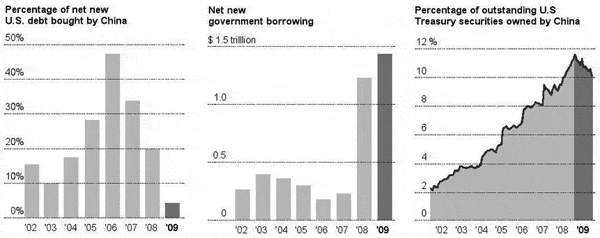
Today, US dominance is again being challenged, this time by China. While it is not possible to know what the US will do, it is naïve to believe the US will do nothing; but whatever happens, US debt and the US dollar will be affected. China has now significantly reduced its buying of US debt leaving the US with growing deficits and a virtual boycott by China of new US IOUs. This will impact future US/China relations.

The tentative but mutual benefits of the past are being replaced by self-interest as US spending and consequent debt is increasingly perceived as being out of control by China. That perception is correct. Since the 1980s, America's focus has been on borrowing more, not spending less and the implications are clear.


Click Here, or on the image, to see a larger, undistorted image.

U.S. government borrowing, percentage of outstanding U.S. Treasuries owned by China (2002-2009)
-Sources: US Treasury, Haver Analytics, New York Times


With China moving away from increasingly risky US debt, the US is now far more likely to treat China as a challenger than as a needed creditor; and, while devaluing the US dollar would have minimal impact on overall US debt, it would have a significant impact on China[!?!] In December 2009, total foreign holdings of US government debt equaled $3.29 trillion. With total US obligations now close to $100 trillion, a 30% devaluation of the US dollar would impact only that debt held by foreigners— but the losses to China would be significant.

China currently owns at least $1.7 billion in US dollar denominated securities; and, if the US devalued the dollar by 30%, China's losses on its investments would be in excess of $500 million. As stated earlier, it is not possible to know what the US will do. But since WWII geopolitical considerations have always outweighed economic factors in US policy decisions and there is little reason to expect this to change— even as the end-game approaches.

The End Game And Sovereign Default

The US is trapped. Caught between rising expenditures and the need to borrow more, outstanding US debt is incapable of ever being repaid and should the credit rating of the US ever reflect its actual state, sovereign default, not devaluation would be the result. [[Even default is not possible so long as the rest of the world are net buyers of USTs! : normxxx]] In 2008, Kenneth Rogoff and Carmen Reinhart in This Time Is Different: A Panoramic View of Eight Centuries of Financial Crisis reviewed the history of sovereign defaults concluding the then dearth of defaults was in actuality a warning of more to come. They were right.

Rogoff and Reinhart mistakenly described the US as a "default virgin", belonging to a small group of nations that had never defaulted. But on February 26th Rogoff said that the US had, in fact, defaulted during the Great Depression by changing the price of gold from $20 to $35 per ounce. While technically a default, the US action was actually a currency devaluation. The real default occurred in 1973 when the US officially reneged on its gold obligations under Bretton-Woods, leaving other nations holding US paper dollars that could no longer be converted to gold.

Professor Antal Fekete noted the significance of that default when he wrote in 2008, "Thirty-five years ago gold, symbol of permanence, was chased out from the Monetary Garden of Eden, replaced by the floating, irredeemable dollar as the 'pillar' of the international monetary system". That's right: a floating pillar. The gold demonetization exercise was a farce. It was designed as a fig leaf to cover up the ugly default of the U.S. government on its gold-redeemable rights obligations to foreigners.

The word 'default' itself was made taboo even though it punctured big holes in the balance sheet of every central bank of the world, as dollar-denominated assets sank in value in terms of anything but the dollar itself. As the end-game progresses, it is impossible to know what the US will do. It is likely the US doesn't know itself. What the US does know is that it is now trapped by increasing levels of mounting debt from which there is no easy exit.

No Exit

What if— to put it simply— you couldn't get out of a debt crisis by creating more debt?
-Bill Gross, PIMCO, March 2010


The question, "What if you couldn't get out of a debt crisis by creating more debt"? will, in fact, be answered in some way by Mr. Gross himself. As Managing Director of PIMCO, the world's largest bond fund, Mr. Gross is in the business of buying debt and betting on the outcome, an avocation that increasingly resembles Russian roulette. Spreads on sovereign debt are rising and credit default swaps reflect the higher premiums being charged to protect against sovereign default.

Investors such as Mr. Gross compare risk to reward in regards to debt and when the reward is believed to compensate for the risk, the bond is bought and the bet is placed. As we enter the end-game, the odds, as in Russian roulette, exponentially increase making previous yield curves irrelevant. The trigger event may be Greece, Spain, the UK, the US, Latvia, Japan, China or [just about any] other nation. But, one thing is certain, when someone takes a bullet, all bets will be off. No one can cover what can't be covered.

The End Game And Hungary

Professor Antal E. Fekete grew up in Hungary during the most virulent period of hyperinflation in the world. Perhaps the experience made the good professor more sensitive than most about the possibility of its reoccurrence in America but he is not alone in believing so. The possibility of a US hyperinflation was raised by Professor Laurance Kotlikoff in the July/August 2006 Review, published by the St. Louis Federal Reserve Bank: "…the United States has experienced high rates of inflation in the past and appears to be running the same type of fiscal policies that engendered hyperinflations in 20 countries over the past century".

Since Professor Kotlikoff wrote those words, US monetary expansion has far exceeded [anything that] preceded it; and, what follows may be more predictable than we want to know. From March 25-29, in Szombathely, Hungary, Professor Fekete will present a seminar on the unfolding financial crisis. Mr. Sandeep Jaitly, along with Professor Fekete will discuss how 'the basis' can be used to predict movements in the price of gold and silver.


Mr. Jaitly is the publisher of The 'Gold Basis Service' a monthly subscription newsletter that describes movements in 'the basis' and 'co-basis' along with predictions for the coming month for gold and silver. I will also be in attendance, speaking on capitalism's journey to the East and its mixed reception. The end-game is in progress and I have found few more knowledgeable about its origins and progress than Professor Fekete. I have always believed the financial crisis to be part of a far greater shift involving more than money and power, although both will be affected.

Yin and yang, the universal polarities, are rebalancing. The return to parity will not be easy. Buy gold, buy silver, have faith.

ß§

Normxxx    
______________

The contents of any third-party letters/reports above do not necessarily reflect the opinions or viewpoint of normxxx. They are provided for informational/educational purposes only.

The content of any message or post by normxxx anywhere on this site is not to be construed as constituting market or investment advice. Such is intended for educational purposes only. Individuals should always consult with their own advisors for specific investment advice.