Tuesday, May 26, 2009

The Second Crash

The Second Crash: On The Way And Unstoppable

By Doug Hornig | 1 June 2009

Tuesday, October 9, 2007 started as a nice day in New York City. A lovely early fall day, with the temperature still a balmy 80° at 2:00 in the morning. By evening, though, the temperature had dropped twenty degrees, the clouds had rolled in, there was thunder and rain. As with the weather, there were some hints of trouble here and there on Wall Street. But all in all, things could not have seemed better. Little did we know, the stormy end of 10/9/07 signaled a very large bubble that had just popped.

That was the day when the Dow Jones Industrial Average hit its historic peak. From there, it was all downhill— slowly but steadily at first, and then violently after last August— until the Dow bottomed (for now) on March 9 of this year. Over that span, the index lost 54% of its value.

It's been a crushing blow to just about everyone. But it's already being referred to as the crash. As if the unpleasantness were now all behind us. More likely, in the future it will be seen as, simply, the first crash. Don't believe it? In a moment you will, when you see the scariest graph of the year.

But let's quickly recall what's already happened. During the late, great housing boom, interest rates were at microscopic levels, while bankers were encouraged to grant home loans on little more than a wink and a nudge. In order to inflate their balance sheets, those bankers resorted to all sorts of gimmicky, adjustable rate mortgages (ARMs), whose common feature was an interest rate that would eventually reset. That is, it would balloon somewhere down the road. And those most likely to come quickly to grief were the riskiest borrowers, who held loans known as "subprime".

"But not to worry," borrowers were told. "Betting on ever-rising home prices is the safest wager in the whole wide world. If you have problems with cash flow when the ARM resets, your house will be worth a lot more, so you can simply sell it and walk away with a nice chunk of change in your pocket." Uh-huh.

The bankers themselves were a little more concerned about the deterioration of their portfolios. They took out insurance in the form of credit default swaps (CDSs). These were a brand-new invention in world financial history, allowing mortgages to be sold and resold until they were leveraged 20 times over. They became the shakiest part of a huge global derivatives market, with a nominal value in the tens of trillions of dollars.

For a while, this Ponzi scheme even worked. But then, as they had to, the ARMs began resetting, and there were defaults. Then more of them. Because at the same time, the housing market was cooling off and the economy was stalling out. More and more people were trapped in a situation where they owed more on their home than they could sell it for. Many simply mailed their keys to the bank and moved on.

All of this wreaked havoc in the derivatives market. Sellers of these exotic packages could no longer establish what they were worth. Buyers couldn't determine a fair price and so stopped buying. As the ripples spread through the world financial system, trust disappeared and liquidity dried up.

Now consider that the base cause for all that dislocation was the subprime sector. And how big is that? Not very. Subprime mortgages account for only about 15% of all home loans. Their influence has been way out of proportion to their numbers, because of derivatives. Here's the good news: the subprime meltdown has about run its course. These loans were resetting en masse in 2007 and the first eight months of '08. Now they're pretty much done.

And the bad news? No one in the mainstream media seems to be asking what should be a pretty obvious question: What about loans other than subprime? Truth is, the banks didn't just trick up their subprime loans. ARMs were the order of the day— across the board.

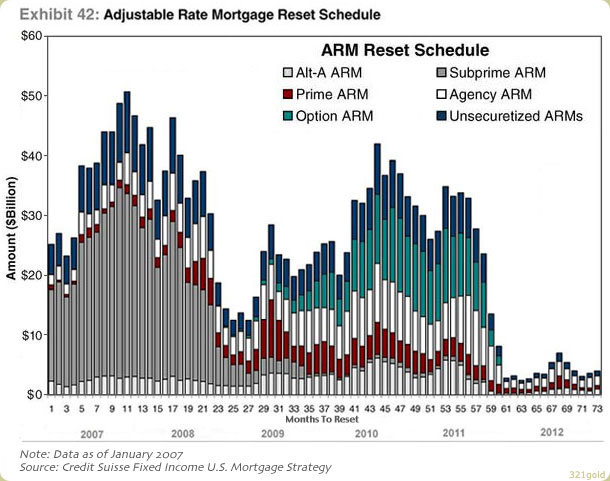
Now, here's that frightening graph we referred to earlier.


Click Here, or on the image, to see a larger, undistorted image.


Take a good, long look. You can see that from the beginning of 2007 through September of 2008, subprime loans (the gray bars above) were resetting like crazy. Those are the ones people were walking away from, sending a shockwave from defaults and foreclosures smack into the middle of the economy. Now they're gone.

The ARM market got very quiet between December 2008 and March 2009, hitting a low that won't be seen again until November of 2011. Small wonder a few "green shoots" have poked their heads above ground. But in April, resets began to increase and will reach an intermediate peak in June. After that, they tail off a little, going basically flat for the next ten months.

It's not until May of 2010 that the next wave really hits. From there to October of 2011, the resets will be coming fast and furious. That's 18 months of further turmoil in the housing market, and the beginning is still nearly a year away! (Although the months in between are likely to be no picnic, either.)

While it isn't subprime ARMs that are resetting this time, neither are they prime loans. Those eligible for prime loans wisely tended to stay away from ARMs in the first place, as indicated by the relatively small space they take up on each bar. No, the next to go are Alt-As (the white bars), Option ARMs (green) and Unsecuritized ARMs (blue). Alt-As are loans to the folks who are a small step up from subprime. Unsecuritized loans are a 50-50 proposition; either the borrowers were good enough that they weren't thrown into the CDS pool, or they were so risky no one would insure them.

Those two are bad enough. But Option ARMs are the real black sheep, loans with choices on how large a payment the borrower will make. The options include interest-only or, worse, a minimum payment that is less than interest-only, leading to "negative amortization"— a loan balance that continually gets bigger, not smaller. Imagine what happens with those when the piper calls.

Once the carnage begins, will it be as bad as the subprime crisis? That's the $64K question. Perhaps not. For one thing, subprime loans were a much larger chunk of the market when they started going south. For another, there's been a lot of refinancing as interest rates dropped; that should help ease the default rate. And the government has massively intervened, with measures designed to prop up those who would otherwise lose their homes.

On the other hand, we're in a severe recession, which wasn't the case when the subprime crisis started. More people will be unable to meet payments. And the housing market has continued to decline, pressuring both marginal homeowners and banks that can't sell foreclosed properties. Is the stock market's next 10/9/07 on the way? Yes. Which day will it be? That's unknowable. It could be in a week, or not for another year.

But make no mistake about it, the second crash is coming. It can't be prevented, no matter what desperate measures Obama and his hapless financial advisors come up with. All we can hope for is that, with a little luck, it won't be as severe as the first one. But it will last longer. We aren't even in the middle of the woods yet, much less on the way out. The order of the day is to be very defensive. There will be few safe havens, but they do exist.

Tuesday, May 19, 2009

Me, Lord Marlboro And The Dow!?

Me, Lord Marlboro And The Dow!?

By Jeffrey Saut | 18 May 2009

Reminding us of the current equity market is an anecdote about the Sport of Kings that took place in London:

An American race horse owner, while parading his entry in the paddock just before the event, fed the horse what appeared to be a white tablet. Noticed and challenged by an English track official, Lord Marlboro, the American was informed that his horse would have to be disqualified. Protesting vehemently that he only gave the horse a sugar cube, the owner popped one into his mouth and offered Lord Marlboro a cube as proof. The English official tasted and swallowed the cube. He agreed with the owner that it was a harmless sugar cube and waived the disqualification. Just before the race horse was to enter the gate, the American signaled his jockey, instructing him to keep his horse clear of trouble near the start and try for the lead early since his horse was sure to win. "In fact," he told the jockey, "Only two have a chance to beat our horse." "What two?" asked the jockey? The American owner replied… "Me and Lord Marlboro!" …Anonymous

We recalled the "Me and Lord Marlboro" quip as we watched the running of the Preakness over the weekend. Evidently, someone fed Rachel Alexandra the proverbial "sugar cube" as she won the Preakness by beating "Mine That Bird" to become the first filly to win said event since 1924. Likewise, someone must have fed the D-J Industrial Average (DJIA/8268.64) a similar "sugar cube" 10 weeks ago, as the major averages have "galloped" from a generational oversold reading into the longest "buying stampede" of my lifetime.

Indeed, the stampede is now legend at 48 sessions without anything more than a one— to three-session pause/correction. Surprisingly, however, despite all the snorting, cheerleading, and animal spirits, the last tranche of index positions we sold in mid-April are virtually no higher now than they were back then. And, ladies and gentlemen, that is as it should be, for history shows that if a stampede is able to extend for more than the typical 17 - 25 sessions, the "momentum peak" tends to come between the 25th and 30th session; it is extremely rare for a stampede to extend for more than 30 sessions. In this case it appears the momentum peak came on April 17th with the S&P 500 at 876. Currently, the S&P 500 (SPX/882.88) resides only 6 points above that level.

Accordingly, we have counseled for caution over the past four weeks; and despite our renewed "hate mail" (for being too cautious), we don’t think a whole lot of money has been made since the April 17th momentum peak, which just so happened to be session 29 in the stampede. That said, as often repeated in these missives, we can find NO instance where the equity markets spring from such a generational oversold reading into a straight-up six-week buying stampede and then come right back down and test, or break, the previous reaction price low, in anything less than 12 weeks (three months). It is just the nature of the beast in that most participants "missed" the lows, have been sitting with too much cash, and are 'forced' by the performance derby to commit that cash, which is why the "dips" are being bought.

Indeed, ISI’s survey of hedge funds shows that their net exposure to equities is still well below benchmarks. And that is why the pauses/corrections have been shallow and fleeting. Three months [along] into the skein, however, the environment could change, setting up the potential for a "June Swoon". That would also be in keeping with the astute Dines Letter that observes, "April has been a month with a pivotal reversal of the March trend 67% of the time since 1963; and, at least a semi-important TOP has been reached in virtually every April or May since then". And don’t look now, but the early May "highs" felt pretty toppy to us.

So far any downside correction, since the early March lows, has been contained to between 5% and 6.4%. That suggests any correction of more than 6.4% could imply more of a correction than any we have seen since the demonic S&P 500 low of 666. Measuring from the May 8th closing high of 929.23, a greater than 6.4% price decline yields a "failsafe point" of slightly below 870 on the SPX. If that level is violated, it would suggest a decline to at least 830 (the 50-DMA is near 832) and maybe more. Moreover, last Wednesday’s "wilt" (-184 DJIA) was a 90% Downside Day, meaning that more than 90% of Downside vs. Upside Volume, as well as Downside vs. Upside total points lost, were both skewed more than 90% to the downside.

So what does all of this mean on a short/intermediate term basis? Well, after nine weeks of straight-up rally for the NASDAQ, the tech heavy NASDAQ (1680.64) took a breather last week. This is noteworthy because other than the Financials, the Techs have been the market leaders. Further, as the good folks at Bespoke Investment Group write, "The most noticeable difference about (last) week’s sell-off is that it is the first decline in years that wasn’t due to ‘troubles’ in the financials."

They go on to observe, "In fact, even though the S&P Financial sector has declined by 13% since May 8th, default risk has also had its biggest decline in months. During prior market selloffs, our CDS Index (Credit Default Swaps) has spiked sharply (higher) on fears of systemic problems. Now, that’s not the case, as our CDS index is near its lows of the year."

Inferentially, at least to us, last week’s action set up the potential for a more enduring decline than that which we seen since the March lows. Accordingly, we think participants should reduce/hedge their exposure to early-cyclicals, which have outperformed since our "buy ‘em" call of March 2nd. We also think those freed up funds should be shifted to agricultural investments.

In past missives we have mentioned numerous investment vehicles, which have rallied nicely, such as 9%-yielding Archer Daniels Midland convertible preferred "A" shares (ADM, A/$33.54), and 6%-yielding Bunge’s convertible preferred (BGEPF/$78.00) both of which are followed on a research basis by our affiliates. We continue to embrace the agricultural theme and have added the exchange-traded fund (ETF) iPath AIG Live Stock Total Return Index (COW/$30.02), as well as 3%-yielding Claymore Clear Global Timber Index (CUT/$13.06), to stocks for your consideration.

Congressman Waxman appears willing to give away credits to industries in support of the "climate change" bill. This should be a positive for electric utilities. While we don’t like the utilities right here for numerous reasons, their dividend yields and geographic positioning make some of them worthy of consideration.

Our caution on the utilities stems from the interest rate complex, where the 30-year Treasury bond has broken down in the charts (read: higher interest rates), leaving the yield above 4% for the first time since November 2008. Indeed, on April 29th the long bond broke below its 200-day moving average (DMA), thus completing what looks to be a massive top formation. Surprisingly, because higher interest rates should be supportive of a firmer U.S. dollar, the Dollar Index has also broken down and continues to reside below its respective 200-DMA.

Meanwhile, gold has traced out what appears to be a giant reverse head-and-shoulders bottom in the charts; and, we remain bullish. To be sure, bonds, the dollar, copper, and crude oil remain supportive of the "reflation trade". We have been bullish on crude oil since its mid-January "price lows," believing crude oil was making a bottom. We are still bullish, but would note that after its rally from those mid-$30s "price lows" in January, to its recent high of around $60, crude is now extremely overbought in the near-term. Consequently, we would be more cautious on crude oil stock positions; and, would actually consider hedging some of those positions to protect their gains.

The call for this week: I am leaving for Europe this coming Friday to see institutional accounts and do some seminars. Consequently, while I will continue to do verbal comments for the balance of this week, there will be no Monday letter for the next two weeks. Hopefully, I will have some insights from my travels upon returning. Nevertheless, last week felt like a trend change to me with the S&P 500 (equal weighted) losing more than 8%, the Russell 2000 surrendering some 7%, and the D-J Transports shedding nearly 9%.

Moreover, Thursday was a 90% Downside Day. As the Lowry’s service notes, "A likely key factor in determining the extent of a market pullback in the weeks ahead would be the occurrence of additional 90% Down Days. Thus far, in the rally since mid March, 90% Down Days have been isolated events, quickly followed by a renewed uptrend. However, a series of 90% Down Days could indicate the sort of sustained, heavy selling consistent with a deeper and more sustained market set back". And, as the always insightful Helene Meisler writes, "Keep your eyes on the Russell 2000 since it is the only index that has rallied back to the underside (or just about) of its broken channel line. A failure here would confirm my view that we’re in the midst of a correction."

Monday, May 18, 2009

Great Depressions Are So Methodical

Institutional Advisors: Great Depressions Are So Methodical
Click here for a link to ORIGINAL article:

By Bob Hoye | 16 May 2009

My Recent Presentation To The CMRE

Clearly, the title of this address puts me firmly in the bear camp. Just as clearly, the possibility of another great depression is highly controversial, particularly when such magnificent efforts are being made to restore the prosperity of a financial mania, which have always been ephemeral. Perhaps my credentials should be reviewed. Everything I needed to know about the markets I learned on the old and notorious Vancouver Stock Exchange. For example, in a world of extravagant claims from big government, big academe and big Wall Street the old definition of a promotion is useful: "In the beginning the promoter has the vision and the public has the money. At the end of the promotion the public has the vision and the promoter has the money."

In 2006 to 2007 the public had the vision that policymakers could depreciate the dollar forever and were positioned accordingly. And for a moment the promoters looked brilliant as everyone thought they were wealthy. Moreover, as with any promotion the bigger it is— the bigger the crash.

There are two failures going on. The most obvious is in the financial markets and the other is in interventionist economics. The latter failure is in theory as well as in practice, and can be described as the greatest intellectual failure since the Vatican insisted that the solar system revolved around the earth, more particularly, Rome. Until recently, too many believed that the financial world revolved around the Federal Open Market Committee.

Last year's disaster fit the pattern of the 1929 fall crash with remarkable fidelity. Such a crash was obvious and as the train wreck in the credit markets continued through the summer of 2008 the Fed continued its recklessness. But with some marketing skills, the objective of "stimulus" changed from keeping the boom going to the absurd notion that bailing out one insolvency, Bear Stearns, would revive the boom. As usual with a bubble, it was not just one bank that had been imprudent— most had been.

The establishment missing this recurring event was bad enough but there is another clanger and that is the hopeless notion of a 'national' economy. Even in ancient times, Cicero knew that the prosperity of Rome was vulnerable to the credit conditions in the Middle East. In this regard, Mother Nature has again been providing some harsh lessons, and history suggests that she and Mister Margin will ultimately be successful in teaching markets 101 to many policymakers.

In the meantime, coming out of the classic fall crash, orthodox investments such as commodities, stocks and bonds were expected to rebound out until April-May. Until this hooked up, the typical GDP forecast was tentative in looking for the recovery to begin "by mid-2010", but our "model" needed forecasts of the recovery starting much sooner. Then, thanks to the "Green Shoots" that began to appear with the rebound in March, confidence was gradually restored in high places such that the miracle of recovery [was anticipated to] happen sooner. The higher the stock market gets, the more popular this idea becomes.

And this gets us to another lesson from the old Vancouver Stock Exchange. "So long as the price is going up— the public can believe the most absurd story." This has been the best explanation of why Wall Street, the supposed bastion of capitalism, focused on every utterance from central planners in a central bank. Then when the price breaks, the vision disappears along with liquidity.

The Next Phase Of [Violent] Contraction Has Been Expected To Start After Mid-Year.

For participants, post-bubble bear markets have been sudden and severe. The 1929 example ran for three years and the post 1873 example lasted for five years. The latter has been the best guide for our recent mania and its bust, but this will be expanded [on shortly] as it is worth reviewing the excuses offered by many in not anticipating that short-dated interest rates as well as gold would plunge in a classic fall crash. This was the pattern with the 1929 and 1873 crashes and knowledge of such a plunge in short rates should have ended conventional wisdom that a Fed rate cut would have prevented crashes from 1929 to 2008. [[As, it didn't prevent them happening then.: normxxx]]

The quickest sign of a gold bug forecast going wrong are exaggerated claims of "Conspiracy!". On the other hand, Wall Street strategists described their latest disappointment as a "Black Swan" event, and therefore 'unpredictable'. That has been a 'cheap out' as each transition from boom to bust has been quite methodical [as will be outlined shortly]. Others called it a "Minsky Moment". Minsky accurately described the mechanism of a crash but, being a Keynesian, he also wrote that "apt intervention" could keep the economy on a successful path.

Actually, financial conditions had already reached the 'perfect' "Keynesian Moment". As we all know, Keynes said "If you save five shillings you put a man out of work for a day." As part of the greatest mania in history, the savings rate plunged to zero— Keynesian perfection had finally been accomplished. Many in the Street, but only a few economists, knew this was dangerous.

Econometric modelers, who still believe in the powers of regression equations, have long had their out, which has been "Exogeneinous", and in one memorable paper of 1983 there was "Super-Exogeneity". This arrived in May 2007 when the yield curve reversed from inverted to steepening. Our research expected it to occur around June. By July of that fateful year, there was enough deterioration to conclude that "This is the biggest train wreck in financial history". It is not over.

Although crashes are grisly events, they share a common response from the establishment. No matter how shocking, bloody, expensive, ruinous or just plain shattering a crash is— within a week, there is no one in the Street who didn't see it coming. As ironical as this is, there is a critical link from the stock market to the economy.

In the usual business cycle, the peak in stock speculation typically leads the peak in the economy by about a year. On the previous example [of a typical recession], stocks set their high in March 2000, and the NBER set the start of that recession in March 2001. Using their determination this has been the case for most cycles back to 1854. But, at the conclusion of each Great bubble in financial and tangible assets, things become abnormal. The failure in the financial markets and the economy beginning in 2007 have been virtually simultaneous.

As we all know, in 1929 the recession started in August, but the Dow made its high in September. In 1873 the bear started in September, and the recession in October. This time around, the stock market high was in October 2007 and this recession started in December of 2007. Close enough to fit the post-bubble model, with implications that financial history is now in the early stages of another Great Depression.

This painful event is being confirmed by the behaviour of politicians and policymakers. After traveling around claiming credit for the boom, politicians panic [when the bust arrives] and then find ready scapegoats. Remember the "Goldilocks" celebration of 'perfect management' of interest rates, money supply and the economy?

Well, all five great bubbles from the first in 1720 to the infamous 1929 have been accompanied by such boasting. Then, it is followed by what can best be described as frenzies of recriminatory regulation. If the political path continues— protectionism— will follow. One of the worst such examples was called, in its time, the 'Tariff of Abominations'.

But, this is enough of such dismal events— it is time to mine the irony for further amusement and enlightenment. The clash between the establishment and financial history is rich with irony. Beyond that, financial history itself [[of which everyone in the financial community is conveniently ignorant: normxxx]] should be considered as an impartial "due diligence" on every 'grand scheme' promoted during a financial mania by the private sector as well as by policymakers. Let's use a good old fashioned term— our policymakers have been 'financial adventurers'.

One of the richest ironies occurred with the 1873 mania and its collapse. With the typical strains developing in the credit markets during a speculative summer, the leading New York newspaper editorialized:

"…but while the Secretary of the Treasury plays the role of banker for the entire United States it is difficult to conceive of any condition of circumstances which he cannot control. Power has been centralized in him to an extent not enjoyed by the Governor of the Bank of England. He can issue the paper representatives of gold, and count it as much as the yellow metal itself. [He has] a greater influence than is possessed by all the banking institutions of New York."

In so many words, because the treasury secretary was outstanding and had the benefit of 'unlimited issue' of a fiat currency— nothing could go wrong. Which it did: the initial bear market lasted for five years and the initial recession ran a year longer. The pattern of severe recessions and poor recoveries continued such that in 1884 leading economists began to call it "The Great Depression," that endured from the 1873 bubble until 1895. [[So, our Great Depression of 1929-39 was merely a feebler second!: normxxx]]

An index of farm land value in England fell almost every year from 1873 to 1895. Of course, academic economists were fascinated and for a couple of decades wondered how such a dislocation could have happened, or even worse, discussed how it could have been prevented. Ironically, this debate continued until as late as 1939 when another Great Depression had been belatedly discovered.

Naturally the long depression was blamed upon the old and unstable Treasury System, and at the height of the "Roaring Twenties" John Moody summed it up with:

"The Federal Reserve Law has demonstrated its thorough practicality, and thus secured the general confidence of business interests. The old breeder of financial panics, the National Banking Law, which had been a menace to American progress for two decades, has now been replaced by a modern scientific system which embodies an elastic currency and an orderly control of the money markets."

The probability of a depression has been discussed in the media. It seems that both sides have yet to provide adequate research, with the establishment's response limited to a classic non sequitur. "This is nothing like the Great Depression, where we had 25% unemployment". …being just the most recent example. A sounder research would compare unemployment numbers from the first year after the crash. In 1930 the number was around 8%, and whuile noting that there could be some difference in methodology, today's number is an 8 percenter. [[Actually, using similar methodology as then, the present number is easily over 16%.: normxxx]]

Will it get to 25 percent? This remains to be seen, but unemployment in the private sector will be the worst since the last great depression. By way of a wrap we will take it from the top.

In late 2007, Gregory Mankiw, boasted that the US had a "dream team" of economists as advisors and, as with all claims at the top of the five previous bubbles, "Nothing could go wrong". And even if things went only a little wrong there were the "safety nets" that Krugman claimed would prevent serious deterioration. Our view on Keynesian safety nets has always been that in a bust they would be about as useless as a hardhat in a crowbar storm.

In the post-1929 bust policymakers were realistic enough to know that the boom caused the bust. The SEC was established to prevent another hazardous 1929 mania. One of the promoters of the SEC boasted that the SEC would put a "Cop at the corner of Wall and Broad Streets". Without much doubt the SEC has failed to live up to its billing. The discovery of malfeasance always accompanies the discovery of malinvestment.

Of course, the other Act passed to prevent another 1929 mania was Glass-Steagal, which separated commercial banking from the evils of Wall Street. This was taken off the books in 1999 as too many banks were ignoring it to participate in the high-tech frenzy. Has this happened before? I'm glad I asked the question.

With the financial violence of the South Sea Company in 1720, the House of Commons passed the "Anti-Bubble" Act, which was taken off the books in 1771— just in time for the full expression of the 1772 bubble. As with the climax of the 1720 bubble the Great Depression ran for some twenty years. This was also the case for the bubbles that blew out in 1825, 1873, and 1929. [[On that last, I suppose, if you discount the war years in the US.: normxxx]]

This ominous sequence of financial excess and consequent disaster brings us to 2007, which will soon have the connotation of "1929", as the world experiences the sixth Great Depression. Quite likely, the only offsetting event could be the collapse of interventionist policymaking, that would eventually be seen as a blessing.

The title of this address, "Great Depressions Are So Methodical" is intended to be ironical, but some may be startled by the audacity of the statement. Actually it is the only conclusion that one could make after a thorough review of economic history. The real audacity is in the claims of charismatic economists that their personal revelations can provide one continuous throb of happy motoring. As Hayek said— Keynes, as a young scholar, was absolutely ignorant of financial or economic history. Only someone who was ineffably ignorant of financial history would claim that it can be altered arbitrarily.

The next Oscar in audacity goes to Paul Samuelson, who, in the 1960s, boasted that the business recession had been eliminated. Right! And yet another such example was recently provided by Gregory Mankiw when he condemned the "old" Fed with "When you look at the mistakes of the 1920s and 1930s, they were clearly amateurish".

Any impartial review of market history would conclude that the "Roaring Twenties" and the [subsequent] contraction was the way financial history works— after all it was the fifth such example. It is worth recalling that at the height of the 1929 mania John Moody had condemned the "old" Treasury System while reciting that the "new" Fed was the perfect instrument of policy.

Mankiw then bragged "It is hard to imagine that happening again— we understand the business cycle better". The Harvard professor topped this late in 2007 with: "The truth is that Fed governors, together with their crack staff of Ph.D economists, are as close to an economic dream team as we are ever likely to see."

Now it is time to get into the [Methodical] way Great Depressions have [always] worked. All six have started with soaring prices for tangible and financial assets that, typically, run against an inverted yield curve for some 12 to 16 months. Then, when the curve reverses [again] to steepening, it is the most critical indicator that the credit contraction [has begun]. This time around, the sixteen-month count ran to June 2007 and the curve reversed by the end of May. Our presentations in that fateful month stated that "the greatest train wreck in the history of credit" had begun. Deterioration through July prompted the advice that most bank stocks were a nice "widows and orphans" short.

Beyond the raw power of speculation, one of the key features is that each mania has been accompanied by a remarkable decline in real long interest rates, sometimes to zero, and sometimes to minus. In our case the decline was to around minus 1.5% in January and the [subsequent] increase so far has been 5 percentage points. In the five previous examples, the typical increase has been 12 percentage points, which has been Mother Nature's way of correcting untempered expansion of credit. And— in our times— untempered policymaking.

Lower-grade corporate bonds have already suffered an increase of some 25 percentage points, which suggests that the 12 point potential for treasuries is [still] possible. There is another important distinction. At the peak of a Great bubble, the stock market peaks virtually at the same time as the business cycle.

In 1873, the stock market blew out in September and the recession started in that October. As noted above, a fiat currency with the potential of 'unlimited issue' was not proof against yet another Great Depression. In 1929 stocks peaked in September and the economy peaked in August. This time around stocks set their high in October, 2007 and according to the NBER, the recession started in that December.

Since 1937 the average length of [a typical] recession has been ten months, with six in the order of 8 months. This one has run for 17 months, which breaks a long-standing pattern. Following 1873, the initial recession lasted 65 months, and following 1929, it ran for 43 months. NBER data starts in 1854 and these were the longest recessions, with no others in this league. This one has the potential of being a long one.

That is a lot of history; but what is happening in the markets right now? Well, perhaps the Green Shoots have finally encompassed chairman Bernanke. On May 5, Bernanke observed that the "broad rally in equity prices" is indicating that "economic activity will pick up later in the year".

At the height of the similar rebound to April-May of 1930, Barron's wrote that the "will to speculate was just as speculative as ever" and that it would be "difficult to quench the fires of enthusiasm". Prompted by the animated stock rally, the Harvard Economic Society, with more gravitas, concluded that it "augured" a recovery by late in the year. As we all know this did not last. What we should understand is that it is the dynamics of a crash that sets up the exciting rebound. Not policymakers. [[Indeed, what Bob Hoye is saying is that all of the international efforts, by CBs, banks, and governments, have so far been utterly futile and the "crash" is playing out exactly as it has on the previous five occasions. : normxxx]]

Let's look at a classic fall crash, which we expected. The pattern is interesting. The 1929 crash amounted to 48%. The decline to the low in November 2008 was 47%, and within this the hit to October 27 amounted to 42%. In 1929 the initial plunge amounted to 40% to October 29. The rebound was to November 4, in both examples, with 2008 gaining 17% and 1929 gaining 12%. The final slump into each November was 22% and 23%. Is it important to identify it as 1929 or 2008?

Our historical model expected the crash and the rebound, as well as the nature of the establishment's utterances. Another usual event is a frenzy of recriminatory regulation— all supposedly new, but delivered without knowing that their counterparts over the centuries have made the same futile gestures. More irony, today's excitement in the markets and the conviction of "success" in policymaking circles are simply key further steps on the path to a Great Depression.

As disconcerting as this may be, it is worth reviewing another cliché of policymaking, which is the notion that lowering administered rates will restore the momentum of a boom. Massive declines in short rates, such as Treasury Bills, have occurred in [each] post-bubble crash. In 1873 the senior bank rate plunged from 9% to 2.5%, as the stock market crashed. In the 1929 example the fed discount rate plunged from 6% to 1.5%, as the stock market crashed.

This is getting a little heavy. Not so long ago, but in another world, financially speaking, when an economist would change a forecast on GDP from 3% to 3.25% it was only done to display a sense of humor. Now policy wonks seriously debate whether the Fed target rate should be zero or ¼ percent. It is patently absurd to debate [how small] the rate should be or whether ¼ percent, more or less, would have any effect on financial markets, based on past history.

It won't, because we are in a world of financial violence that is not random [or singular], and [certainly] not due to the Fed making the 'perfect' rate cut [or taking other extraordinary, heretofore unthinkable actions]. Instead it is a natural [building up and bursting forth] of private speculation, as well as a chronic experiment in policy by 'financial adventurers'— to accurately use a Victorian term.

Another term goes back to the 1600s, when what is now called Holland was the commercial and financial center of the world. The Dutch described the good times as associated with "easy" credit and the consequence as "diseased" credit. I'm sure that all in this room would agree with the accuracy of the latter description. Diseased credit.

What can be done about it? Nothing— since the 1500s the literature is complete with many comments that someone, or some agency can "set" interest rates— either high or low depending upon the personal concerns of the writer. Misselden in the 1618 to 1622 crash earnestly believed that throwing credit at a credit contraction would make it go away. (Despite all of this history, Keynes and his disciples cannot be accused of plagiarism.)

What's next?

Virtually, all of the "good stuff" likely to be 'revived' into May has been accomplished. This includes investments such as commodities, junk-bonds and stocks, as well as positive statements from the establishment. Both technical and sentiment measures on the stock market are at "tilt" levels.

Because it is up at the right time, the conclusion is that the down will come in on time as well. This would be the next step on the path towards another Great Depression. Of course, there is no guarantee that events will continue on the path. But, then there is no guarantee that it won't. Best to consider the odds.

  M O R E. . .

Normxxx    
______________

The contents of any third-party letters/reports above do not necessarily reflect the opinions or viewpoint of normxxx. They are provided for informational/educational purposes only.

The content of any message or post by normxxx anywhere on this site is not to be construed as constituting market or investment advice. Such is intended for educational purposes only. Individuals should always consult with their own advisors for specific investment advice.
Saturday, May 16, 2009

The $33,000,000,000,000 Question

The $33,000,000,000,000 Question


It has long been my contention that we are entering an extraordinary period of time in which using historical analogies to plot market behavior is going to become increasingly problematical. In short, the analogies, the past performance if you will, all break down because the underlying economic backdrop is unlike anything we have ever seen. It makes managing money and portfolio planning particularly challenging. Traditional asset management techniques just simply may not work. Buy and hope strategies may be particularly difficult to navigate.
[[In physics, this is known as a 'singularity', aka, a 'Black Hole'. : normxxx]]

Part of the reason we are so challenged in our outlook is that we are experiencing a deleveraging on a scale in the world that is absolutely breath-taking in its scope. And to balance that, governments are going to have to issue massive amounts of sovereign debt to deal with their deficits. But who will buy it, and at what price? And in which currency? This week's Outside the Box gives us some very basic data points that illustrate the challenge very well. But the problem is that even though we can see the challenge, it is not clear what the final outcome will be, other than stressful volatility as the markets react.

This week's OTB is by my good friends and business partners in London,
Niels Jensen and his team at Absolute Return Partners. I have worked closely with Niels for years and have found him to be one of the more savvy observers of the markets I know. You can see more of his work at www.arpllp.com and contact them at info@arpllp.com.

John Mauldin, Editor
Outside the Box

The $33,000,000,000,000 Question

by Niels C. Jensen, The Absolute Return Letter | May, 2009

"Never in the history of the world has there been a situation so bad that the government can't make it worse." — Unknown

Is The Crisis Really Over?

Commercial paper spreads have come down dramatically. Libor rates are (hmm— almost) back to normal. Even high yield spreads are narrowing. It certainly appears as if the credit crisis is well and truly over or, at the very least, the light which most of us think we can see at the end of the tunnel is no longer that of an oncoming freight train.

No wonder equities are currently enjoying one of their best spells ever. And while equities continue to go up and up, most of us are left scratching our heads. Is this the real thing or will it go down in history as 'just' another bear market rally? Not so long ago, the entire financial system stared Armageddon in the face. Now, only a few months later, equity markets behave as if all the worries of yesterday have been washed away. How is that possible?

The Great Bank Illusion

The current bull market began in earnest in the second week of March, but what really got everyone going were the surprisingly good Q1 US bank earnings which were reported during the first half of April. Most commentators interpreted the numbers as the clearest piece of evidence yet that we are now firmly on the road to recovery.

Of course US banks made good money in Q1. The environment created for them is the equivalent of the US government reducing the cost of goods to zero for its embattled car manufacturers and then going on to buy— courtesy of the US tax payer— a couple of million cars that nobody really needs. Even Detroit would make money given those conditions!

Liquidity Is Trapped

The problem for the rest of us is that the banks are not sharing the candy they have been handed. Much of the liquidity created by the central banks remains trapped in the financial sector (see chart 1). Quite simply, the 'multiplier' is not doing its job, as many [[insolvent?: normxxx]] banks prefer to hoard cash rather than increase lending at this juncture.

This is both good and bad news at the same time. Good because it implies that we probably do not have to worry too much about the inflationary effect of the aggressive monetary easing currently taking place; bad because it means that the economy is not going to kick back to life as quickly as everyone would like— and expect.


Meanwhile investors are growing cautiously optimistic about the GDP outlook for the second half of the year with many now forecasting modest growth— at least in the United States. Only a fool would suggest that GDP would shrink by 5-10% per quarter in perpetuity, as has been the case over the past two quarters. The economic slowdown is now decelerating and, as I pointed out last month, there are good reasons why we may see a temporary lift in economic activity later this year, but it will almost certainly prove transitory.

We Are Still In A Bear Market

The dangerous conclusion to draw from the experience of the past few weeks is that all is now well and dandy and it is time to load up on stocks again. I cannot emphasize it strongly enough: The bull market of March-May 2009 is almost certainly a bear market rally— as one of my partners pointed out the other day, NYSE saw four 20%+ rallies between 1929 and 1932 (see chart 2). Bear market rallies can be extremely powerful and hence deceiving.

The problems are not over yet. Not by a long stretch. It will take longer than 18 months [[and a lot more grief: normxxx]] to unwind the excesses of the past 25 years. Analysts at Morgan Stanley reckon that the 15 largest banks— which among them have shrunk their balance sheets by about $3,600 billion so far in this crisis— will shed another $2,000 billion in 20091. If you do not share my pessimism, please take a quick look at chart 3 below. The US financial sector debt load (as a % of GDP) is now 117%. In the early days of the great bull market in 1982, the same number was 22%. Households are not much better off with total household debt now at 96% of GDP vs. 47% in 1982.


Further Write-Offs To Come

The IMF reckons that both European and US banks— but in particular the European ones— are well behind the curve in terms of recognizing their credit crunch related losses. According to the IMF, there is at least another $1,500 billion to come. So when the US banks reported 'surprisingly good' numbers for Q1 it was certainly not because the economy had suddenly and miraculously revived itself, but because some of the oldest tricks in the book were used to gloss over much bigger problems2.


As the recession bites into the lives of ordinary people, banks will face losses not only on sub-prime mortgages but on all loan products. As you can see from chart 4, sub-prime is indeed a small fraction of the total loan book for the US banking sector.


Delinquencies Are On The Rise

And that is precisely what is beginning to happen as illustrated in chart 5. Delinquencies are now on the rise on all mortgage products; however, whereas sub-prime started to deteriorate as early as 2007, it is only recently that delinquencies related to Alt-A and adjustable rate mortgages have taken off, and prime and jumbo loans are only just now starting to suffer.


These are all temporary problems, though, however bad they may appear. By far my biggest concern at the moment is the enormity of the debt problem facing most OECD countries. In the March issue of the Absolute Return Letter I referred to an important study conducted by Carmen Reinhart and Kenneth Rogoff back in December of last year3 which I would like to re-visit (see chart 6).

Banking Crises Run And Run

Reinhart and Rogoff studied every banking crisis of the past generation and made some startling observations. One in particular caught my attention. It has to do with the subsequent rise in government debt which, according to Reinhart and Rogoff, has been "…a defining characteristic of the aftermath of banking crises for over a century". According to the authors, governments inevitably underestimate the ultimate cost of a banking crisis, because the indirect costs (such as falling tax revenue in subsequent years) end up much higher than predicted.

The IMF estimates that the cost of the current crisis to the United States will eventually reach 34% of GDP or close to $5 trillion. However, the Obama administration, through its various implicit and explicit guarantees, is already using a number closer to $9 trillion4. And Reinhart and Rogoff's historical average of 86% of GDP implies an ultimate cost of over $12 trillion!


The IMF Is Too Optimistic

I have a lot of respect for all the good work being produced by the people at the IMF; however, they are sometimes too politically correct for my taste; maybe too afraid of stepping on someone's toes. So when they go public, as they did recently, with an estimate of how much the current crisis would ultimately cost, their projection will more than likely prove hopelessly inadequate.

The true cost is important, because [[(eventually): normxxx]]it has to be financed through new bond issuance, and it is my thesis that the sheer size of this tsunami will eventually overwhelm the world's bond markets. As you can see from chart 7, using the official IMF estimates, the twelve most industrialised of the world's G20 countries (in my book known as the Dirty Dozen) will have to issue about $10 trillion worth of new bonds to cover the cost of the current crisis.


The Final Cost Will Be Enormous

However, if you (like me) believe that IMF underestimates the true cost of this crisis, Reinhart and Rogoff offer a more realistic approach (see chart 8). Using their least costly case study (Malaysia 1997) as our best case scenario, the true cost comes to $15 trillion. If one uses the average of 86% instead, the cost jumps to a whopping $33 trillion. I didn't even bother to produce a worst case scenario— it all got too depressing!


I need to put the $33 trillion into perspective, because it is so big that it is almost incomprehensible. According to Wikipedia (see chart 9), total private wealth across the world today is about $37 trillion less the losses incurred in 2007-09, so the real number is probably closer to $30 trillion now. Total global savings (loosely adjusted for the big losses in 2008) are probably somewhere in the region of $100 trillion. In other words, financing this crisis could absorb one-third of total global savings. No wonder Gordon Brown looks tired!


Where do we find the money?

Obviously, governments may buy a portion of these bonds themselves, but they cannot afford more than a fraction of the total unless they want to challenge Mugabe (of Zimbabwe) as the ultimate master of illusion. Neither should investors hold out for sovereign wealth funds to do the dirty work. As is clear from chart 9, the total amount of wealth accumulated in these funds is pocket money when compared to the projected bond issuance over the next few years.

Hence it comes down to the price at which governments can attract sufficient demand from people like you and me. One of two things may happen. Either this crisis will ignite such a bout of deflation that investors will happily own government bonds yielding 2-3% or the deflation scare goes away ultimately, the global economy recovers, and bond investors demand much higher yields for taking sovereign risk. I am not yet sure which scenario will prevail, but I do know that both are quite bad for equities longer term. Take your profits!

Niels C. Jensen

1 "Doomsday is on hold but banks will still feel further pain", The Financial Times, 30th April, 2009.

2 In particular one US accounting rule change (FASB rule 160) explains a large part of Q1 profits.

3
"The Aftermath of Financial Crisis", Carmen Reinhart & Kenneth Rogoff, December 2009.
[[Or, see "This Time is Different: Eight Centuries of Financial Folly" : normxxx]]

4 http://zerohedge.blogspot.com/2009/04/bail-out-for-dummies-part-1.html

Thursday, May 14, 2009

How You'll Know The Market Has Bottomed

Here's How You'll Know The Stock Market Has Bottomed
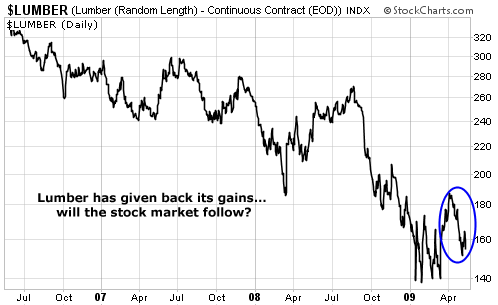
Lumber Has Given Back Its Gains… Will The Stock Market Follow?


By Tom Dyson | 24 December 2008

Don carries a tape measure on his belt. A yellow pencil lives behind his ear. And to get from one end of his yard to the other, he drives a forklift truck… Don entered the lumber business in 1979. In his 30-year career in the lumber-distribution business, he has worked for both the huge national lumber distributors and the small regional suppliers. He's also worked through two major construction busts… in 1979-81 and 1990-91. Today, Don is general manager of a $100 million lumberyard based near Orlando, Florida.

I figure, if we're going to see evidence of inflation, it's going to show up first in building products. This was the first industry to crater back in 2005. It should be the first industry to complete the cycle.

The government thinks the falling real estate market is driving the recession and the credit crunch. If it can get the real estate market rising again, it thinks it'll be able to beat deflation and solve all our problems. Any signs of life in the real estate market will "validate" the Fed's strategy and generate a burst of optimism in the stock market.

So, the people in charge have decided that if they can "fix" the real estate market, then everything else will "fix itself". The Fed has aimed its printing press directly at the real estate market. It will buy $500 billion of mortgages using freshly created dollars. The government has focused many of its other plans on the real estate market, too… like its demand for the banks to have a temporary moratorium on foreclosures (now lapsed) and Obama's $50 billion mortgage and foreclosure rescue plan.

In other words, the U.S. real estate market is seen as the pivot in the whole economic mess we're in right now. So, if you can figure out what's happening in real estate, you can figure out everything else. And, the best leading indicator of real estate is lumber. About two thirds of American demand for lumber comes from the homebuilding and remodeling industries… so its price is highly sensitive to strength and weakness in construction.

Every month, Don tells me what he thinks is going on in the industry and updates me on the prices of lumber, sheet wall, concrete sidings, and other building products. These prices come straight from the manufacturers. Prices peaked in October 2005. Since then, many materials have fallen in price over 50%. I just got Don's latest e-mail last week. It's shocking how prices have jumped…
  • Plywood rose 9.9%.

  • Pine lumber was up 5.8% to 15.7%.

  • Most metal connectors were up 5% to 20%.

  • Truss prices fell only 2.9%, but the strength in pine will push those prices upward in January.

  • Molding prices were up 12.5% to 13.6%. Door prices were mixed.

  • Concrete siding was up 9.4%, and vinyl trims were up 4.8%.

  • Vinyl siding trim was up 14.5% with a reduction of manufacturers.

(Some prices declined, too. Roll foundation plastic fell 6.7%, rebar dropped 3.4%, spruce lumber gave up 15%, studs fell 10%, and drywall products all fell between 6.7% and 9%.

Don creates a Whole House Commodity Price Index with this information. It's the price of materials to build a 2,250 square-foot wood-frame house. It doesn't include labor, decor, plumbing, electrical, or mechanical materials. In November, Don's Whole House Commodity Index was up 1% percent, to $23,773. "Every major supplier in drywall, roofing, insulation, insulation board, steel studs, cement board, and most of the miscellaneous building material categories have announced increases in cost from 7%-10%," says Don.

It's still too early to make conclusions from Don's pricing data (which should be used to confirm the earlier trend in lumber prices). I suspect many companies realize they'll go out of business if they keep selling their products at a loss. So they've raised their prices out of desperation. In other words, these price increases aren't necessarily a reflection of increased demand— they're a sign of capitulation in the building materials industry… and we're about to see some major bankruptcies.

Let's give Don's building prices three more months. If they stick, it's a sign the Fed's strategy just might be starting to work. And that should mark a bottom for stocks. [[Note: That would have been March, 2009! : normxxx]] But, if building prices don't continue rising, we'll be in for more deflation.

Good investing,

Tom

.

The World's Most Important Commodity

By Tom Dyson | 18 February 2009

By watching the price of Don's Whole House Commodity Price Index for home building materials, you'll know when the recession is ending… before anyone else. You'll know if Obama's stimulus plan is having any effect. You'll know when the construction industry is about to start hiring again or when the banks are about to start lending again. And you'll be able to tell your neighbors when house prices are going to rise again.

Around the office, we say copper has a PhD in economics because it predicts recessions and booms. We call it "Dr. Copper." But Don's Index is a much more valuable indicator for right now, and no one's paying attention to it. Let me explain.

Take the timeline of the current crisis as an example. The lumber price reacted before any other market: Lumber prices peaked in May 2004. The Bloomberg Homebuilders Index didn't peak until July 2005. Don's Index peaked in October 2005. The Case-Shiller U.S. home price index peaked in July 2006. The credit crunch started in February 2007, when New Century Financial collapsed. The S&P 500 peaked in October 2007. [[And, finally, the complete collapse of the credit market occured when Lehman Bros. filed for bankruptcy on 15 September 2008. : normxxx]]

When the recovery comes, I expect it'll show up first in the lumber price, too… Right now, lumber is down 66% from its 2004 all-time high. A standard railcar load of lumber sells for $17,050— the same price it was selling for in 1973. Looking at the monthly chart, there's still no sign of an uptrend… but I can report the lumber price has risen 12% in the last three weeks, up from 1969 prices.


The lumber price holds the key for investors right now. Make sure you keep an eye on it.

Good investing,

Tom

P.S. You can get this chart of lumber prices on StockCharts. Just type in the symbol $LUMBER.

.

This Indicator Says Home Prices Are Nearing A Bottom

By Tom Dyson | 6 April 2009

I ride my bike to work, always taking the same route. I pass the same 100 or so houses every day. This week, I noticed two new properties have come on the market. One of these houses is on the beach. The owner has posted a large billboard on the curb. "Foreclosure Sale," it announces. "Online Auction."

Every week I see new for-sale signs along my route. This is the first auction notice I've seen. And although it's an ugly, worn-out old house, it's on prime beachfront property. Most Americans gauge real estate using the same process I use on my bike. They talk to their neighbors, they notice for-sale postings along their street, and they watch local news reports.

From this "bicycle-seat view," it appears to the average American that the bear market in real estate in still in full swing and getting worse by the week. Here's the thing: Trying to predict trends in the real estate market by watching house prices is like trying to predict the stock market by watching CNBC. It doesn't work.

Houses are illiquid assets. It can take months for homeowners to accept their houses have fallen in value and lower their prices appropriately. Many potential sellers have mortgages larger than the value of their homes. They can't sell. Banks have it even worse. It takes an average 15 months for a bank to sell a property after the first missed mortgage payment. Many foreclosures haven't hit the market yet.

House prices are what economists would call a "lagging indicator". [[Actually, changes in local housing inventory are a good inverse precursor of changes in housing prices.: normxxx]] They are slow to react to new trends in the market. For forecasting purposes, they are useless.

To judge what's really going on in real estate, you need a leading indicator, such as the price of lumber. The lumber market is a small, illiquid market, so it's sensitive to any changes in supply and demand. In the last cycle, for example, lumber prices peaked in May 2004… two years ahead of house prices. If house prices are going to turn up, you'll see it first in the lumber price… and that's what's happening right now.

In the last three weeks, the lumber price has soared 29%… after making a "quadruple bottom" at $140 a contract. Last week, it broke out to a new high for the year. This is incredible strength in a market you'd think would be dying. But, if this trend withers, expect lower house prices ahead… On the other hand, if it continues, expect a bottom in home prices within the next 18 months.


.

This Indicator Holds the Key for Investors

By Tom Dyson | 15 May 2009

To predict the stock market, I watch lumber. To store lumber, you need a large climate-controlled warehouse with a railroad spur. Even then, it could still spoil within six months, destroying your entire investment. Because lumber loses its value quickly and it's expensive to store, the investment public at large does not participate in the lumber market. The costs are too high.

The mills use "just-in-time" manufacturing principles to keep inventories to the bare minimum. By producing only what they can sell immediately, they avoid wastage. Lumber customers do the same thing. They only buy what they need that week.

There is a lumber exchange in Chicago where you can trade lumber futures. It's a "professionals only" industrial matchmaking service. If you're a homebuilder and you need lumber for a current construction project, the lumber exchange works fine for you. But if you're an investor looking to hold lumber for a year or more, you'll get ripped off.

First, you'll pay huge storage costs. The market builds these costs into the futures price. Second, there's almost zero trading volume once you get beyond the next three months, so you'll pay a massive premium for illiquidity. For example, right now, if you want to buy lumber into the future— say a contract that expires one year from now— you'll have to pay a 38% premium over the price of lumber delivered next week.

These costs keep the riff-raff out of the market. This is why I love to watch lumber. The price of lumber is set entirely by commercial money responding to real business conditions. There's no public speculation to muddy the water and generate confusing signals.

Take the 2008 credit crisis as an example. The lumber price was the first to signal a bear market was coming, in May 2004. Here's a chart of lumber going back three years. As you can see, lumber bounced like everything else earlier this year, but has not been able to hold its gains.


I take this as a message from the homebuilders and the giant logging companies that the real estate market is getting worse again. And if that's the case, it might be time for stocks to take a breather, too.

Good investing,

Tom

Wednesday, May 13, 2009

Pipeline MLPs; Arbitrage opportunities in the oil patch

techiedan: Ah yes, Wish. And that would be me...and I presume, you! How long can this go on? Beats me, but I'm going to enjoy it while it does!

Indefinitely; although the actual payouts are highly dependent on what oil sells for (there is likely to be little diminution of actual pipeline activity, but their take is in part determined by the price of oil or gas). Normally, these pay around 10%; the current higher return is due to everyone expecting the payout to drop and the current difficulty of rolling over loans originally slated for pipeline expansion, etc. Avoid those MLPs with big debt loads.

Arbitrage opportunities in the oil patch

by Justin Perucki, Morningstar | 18 Mar 09

We believe we've found a potentially lower-risk return booster.

A few weeks ago, Magellan Midstream Partners MMP announced they are acquiring their general partner (GP) Magellan Midstream Holdings MGG . The transaction is an all-unit offering at a 25% premium based on the previous day's close. The 25% premium coincidentally is the same premium MarkWest Energy Partners (MWE) paid to acquire its GP last year. There are a number of GPs that are publicly traded, and the Magellan transaction led us to investigate the pipeline space for investment ideas. We believe we've found a low-risk medium-reward investment opportunity.

First, some quick background: due to a 1980s-era tax law, energy-related infrastructure entities are allowed to be formed as master limited partnerships, or MLPs. An MLP is similar to a REIT or an S-Corp. MLPs pay no corporate taxes. Instead, taxes are the unitholders' responsibility. MLPs are highly cash-generative enterprises with somewhat limited reinvestment opportunities. As a result, they distribute a large percentage of their cash flows to unitholders.

An MLP usually has a general partner, or GP, that manages its operations. The GP usually takes a 2% cut of the cash flow before it is distributed to limited partner (LP) unitholders. In addition, GPs usually hold incentive distribution rights (IDRs), which entitle them to an increasing cut of the cash flow depending on the LP per-unit distributions— in other words, they are MLPs on steroids. Something to watch for as a GP owner is the sustainability of the distribution, as the IDRs work both directions (i.e., if LP per-unit distributions fall, GP distributions fall even faster).

Many GPs are publicly traded, including Buckeye GP BGH , NuStar GP Holdings NSH , Enterprise GP Holdings EPE , Energy Transfer Equity ETE , and Magellan, to name a few. Because of IDRs, GPs should trade at a premium. In other words, their yields should be lower than their corresponding LPs— as long as you believe that cash flows will rise over time. Therefore, when this relationship is violated, you may be presented with an arbitrage opportunity: buy the GP and short the LP. Theoretically, the faster the growth, the larger the yield differential should be.

However, there is not a large price discrepancy between a number of publicly traded GPs and LPs. This lack of differentiation partially drove the Magellan and MarkWest transactions we mentioned earlier.

Morningstar's head pipeline analyst Jason Stevens points out that these transactions are beneficial to the LP: they eliminate incentive distributions, which reduces the entity's cash cost of capital and increases the potential rate of distribution increases. They also slash duplicative overhead expenses from operating two different entities. Finally, they help remove any uncertainty surrounding the carried interest debate.

Our favorite name to execute a similar transaction is the NuStar complex— the GP NSH and LP NS . The key factors are as follows: The distribution coverage ratio is strong, at 1.25 times. Because the LP will likely be issuing shares to consummate such a deal, having sufficient cash flow to pay the additional distributions is critical.

There's no debt at the GP level. At first glance, Energy Transfer looks like an even more likely candidate to eradicate the discount of its GP shares— ETE— given ETE trades at a discount to the LP ETP. However, ETE has a debt load that would either have to be assumed by ETP or paid off. The debt can't be assumed because it would limit ETP's distributable cash flow, and it can't be paid off because ETP doesn't have the cash lying around. The clean balance sheet of NSH thus makes a takeout more feasible.

Chairman Bill Greehey is notorious for taking advantage of mispriced assets. For example, as CEO of Valero VLO he rolled up small independent refineries during the dog days of the 1990s. He initiated the spin-off of NuStar from its former parent Valero. We don't think this is a large driver of a takeout, but it adds to our confidence.

Another attraction we have with NuStar is its overall business model, which has historically enjoyed stable cash flows. The most attractive part is its interstate refined product pipelines. These pipelines have consistent volumes and are able to raise pricing annually based on the PPI. However, if there's a decline in PPI, NuStar would be required to reduce its fees, which may occur in 2009.

A greater concern would be a drop in volumes. We have already seen a significant drop in refined product demand last year— 4% for gasoline, 5% for diesel, and 6% for jet fuel. With the economy completely rolling over and unemployment rising, we should see further demand destruction in 2009. However, gasoline prices have fallen significantly, which should stem declines.

One aspect of this trade that we like is that the GP doesn't need to be taken out to win. If the LP can increase distributions, GP unitholders will benefit due to the IDRs. The company, however, is planning to rein in distribution increases over the near term in light of the economic weakness.

We view this trade as relatively low-risk with medium reward. As long as distributions are not cut, your cash carry is simply the yield spread between the GP and LP units— about 1% (for purposes of structuring this transaction, you'll short NS and long NSH at equal dollar amounts). However, you must also account for the opportunity cost of your capital. If you plan to park your money in a money market fund, the opportunity cost of your capital is relatively low, at maybe 1%-2%. However, if you see other attractive opportunities in the market, this cost can be very high. For simplicity's sake, let's just call it 10%— the theoretical "long-run" return profile of the stock market. Therefore, the total cost to you in this case is about 10% + 1% = 11%.

The return profile is also relatively simple. If future transactions follow the Magellan Midstream model, you stand to gain 25%. The sooner a potential transaction happens, the higher the annualized returns. If the deal happens in exactly one year, at a 25% premium, annualized cash returns are 24% (25% - 1% cash carry), and annualized excess returns would be 25% - 11% = 14%. If it happens in three months, the annualized cash returns are 96%, and the annualized excess returns are 56%. These are not hit-it-out-of-the-park numbers, but it's not bad at all for a low-risk transaction.

Alternatively, distribution growth can resume, in which case the yield differentials should return to semi-historical levels. Over the last two years, NSH's yields were on average about 2%-3% lower than NS's. If one year from now the yield spread climbs to 2.5%, this trade should return about 20% in cash and 9% in excess of total costs.

Investors considering this trade should also be mindful of the tax implications of investing in MLPs. Given the anticipated shorter holding period of this investment, we don't believe tax carrying costs will be significant.

Warren Buffett, in a shareholder letter written 20 years ago, mentioned he uses "...arbitrage as an alternative to holding short-term cash equivalents...At such times, arbitrage sometimes promises much greater returns than Treasury bills and equally important, cools any temptation we may have to relax our standards for long-term investments." Given the uncertainty in the market and near 0% short-term interest rates, we think this opportunity is not a bad place to park some cash.

Why The Banks Still Aren’t Fixed

Money & Business: Why The Banks Still Aren’t Fixed

By Rick Newman | 13 May 2009

How the Job Numbers Complicate Obama’s Agenda

The stress tests are done. The results are 'better than feared'. Bank stocks are up. A few large lenders, such as Capital One, US Bancorp, and BB&T, are even preparing to repay billions in federal bailout money. Sounds like the bank crisis is solved!

Except for everything that could still go wrong. "Yes, everyone passed the stress test, but it was a questionable test to begin with," writes Charles Rotblut of Zacks Investment Research. "Foreclosures are still rising, credit card defaults will get worse, and, despite all of the analysis, nobody still knows how to value those toxic assets."

[See 6 stress-test surprises.]

The Federal Reserve, in fact, thinks the loss rate on loans at the 19 biggest banks could end up even worse than during the Great Depression. That doesn't sound like we're out of the woods. That sounds like we're trudging deeper in. Here are the biggest challenges the banks still face.

Huge losses. The Fed estimates that the 19 biggest banks could lose up to $600 billion over the next two years. There are so many billions flooding out of Washington these days that perhaps that number doesn't seem all that large. It is. To put it in perspective, the 19 banks have lost a mere $400 billion over the past 18 months, yet that's been enough to drive Citigroup and Bank of America to the 'brink' of insolvency, severely disrupt the credit markets, and trigger a deep recession that would be a depression in the absence of vast amounts of government aid.

[See 5 signs the bailouts are getting better.]

With the economy as fragile as it is, additional bank losses that are 50 percent worse than what the banks have already endured will continue to threaten the solvency of some banks. And the Fed's loss estimates are lower than many others. There's a lot of pain still to come.

Massive defaults. For most of the past 50 years, the loss rate on all bank loans has stayed well under 2 percent. The Fed estimates that over the next two years the loss rate could reach 9.1 percent. You know all those historical comparisons that end with "the worst since the Great Depression"? Well, 9.1 percent would be EVEN WORSE than during the 1930s. Still looking forward to a soft landing or a 'quick' recovery?

The Fed projects that the median loss rate could hit 8 percent on mortgages [[that is, half of the losses will be greater than 8 percent : normxxx]], 10.6 percent on commercial real estate loans, and 22.3 percent on credit card loans [[and that's hardly 'worst case': normxxx]]. A number of banks that made riskier loans face loss rates that are much higher. Banks can't just absorb losses of that magnitude and 'briskly bounce back'. To survive, they'll have to sell assets, hoard cash, curtail lending, and simply wait it out. None of that generates economic growth.

[See more companies likely to fail this year.]

Wounded giants. The stress tests accomplished some important things, and one of them was giving healthy banks a pathway to repaying their government loans and getting back to business as usual. Unfortunately, some of the biggest banks are still in intensive care. Here are the four banks to watch: Citigroup, Bank of America, Wells Fargo, and GMAC. They account for half of all the assets of the 19 banks tested and 86 percent of the capital that the combined banks need to raise.

And they've already received about $133 billion in government aid, more than 60 percent of all the bailout money injected into banks. In other words, the nation's biggest financial companies are still in precarious shape, which will impede their ability to lend for months or years to come and simply soak up capital that would otherwise go to healthy firms. In the best case, that will continue to be a major drag on the economy.

[See the best and worst bailed-out banks.]

Those stubborn toxic assets. By pronouncing the banks healthy enough to muddle along, the Fed has in effect given a reprieve to banks that might have been on the verge of more dramatic action. That could affect the government's public-private investment partnership, or PPIP, Treasury Secretary Tim Geithner's plan to create a market for money-losing mortgage-backed securities and other troubled assets that have become cement shoes threatening to submerge many banks.

With home values [still] plunging and foreclosures skyrocketing, the value of securities linked to mortgages has been in free fall. Banks could sell such securities for perhaps 30 cents on the dollar, but booking the huge losses that would ensue could trigger insolvency. So the banks are just sitting on their troubled assets, hoping that at some point their value will go back up. To many investors, regulators, and customers, that's the equivalent of deciding to set off a bomb tomorrow instead of today.

[See the banks most likely to pay back their bailout funds.]

The PPIP was designed to create a market for troubled assets at prices the banks could live with. But banks may be even less inclined to sell those assets now, since the stress tests have effectively bought time for the sickest banks. "The PPIP will probably be slowed, if not stopped," says Peter Wallison of the American Enterprise Institute, who's also a former top Treasury Dept. official. "Banks are much less likely to sell assets than before." If so, the thorniest problem in the whole banking crisis will continue to go unresolved.

>More stress ahead. The Fed's stress tests aren't sacrosanct, and they could turn out to have been far too lenient. In the worst-case scenario, for instance, the unemployment rate for 2009 was pegged at 8.9 percent— which happens to be where it is now. With unemployment forecast to rise for the rest of the year, the unemployment rate for EoY 2009 is likely to be higher than 8.9 percent, which in turn would lead to higher default rates and even deeper bank losses than the Fed predicted.

[See why optimism over the economy is premature.]

The Fed also scaled back initial capital levels for several stress-test banks, according to an enterprising Wall Street Journal story. The Fed reduced its requirement for Bank of America by $16 billion, for example, and its requirement for Wells Fargo by $3.6 billion. There may be valid reasons for the reductions. But wishful thinking has been a hallmark of the entire financial crisis. We may be guilty of it again.

Sunday, May 10, 2009

Taleb: Global Crisis ‘vastly Worse’ Than 1930s

Global Crisis ‘vastly Worse’ Than 1930s, Nassim Taleb Says

By Shiyin Chen and Liza Lin | 9 May 2009

May 7 (Bloomberg)— The current global crisis is "vastly worse" than the 1930s because financial systems and economies worldwide have become more interdependent, "Black Swan" author Nassim Nicholas Taleb said. "This is the most difficult period of humanity that we’re going through today because [individual] governments have no control," Taleb, 49, told a conference in Singapore today. "Navigating the world is much harder than in the 1930s."

The International Monetary Fund last month slashed its world economic growth forecasts and said the global recession will be deeper than previously predicted as financial markets take longer to stabilize. Nouriel Roubini, 51, the New York University professor who predicted the crisis, told Bloomberg News yesterday that analysts expecting the U.S. economy to rebound in the third and fourth quarter were "…too optimistic. Certainly the rate of economic contraction is slowing down from the freefall of the last two quarters," Roubini said. "We are going to have negative growth to the end of the year and next year the recovery is going to be weak."

Federal Reserve Chairman Ben S. Bernanke told lawmakers May 5 that the central bank expects U.S. economic activity "to bottom out, then to turn up later this year." Another shock to the financial system would undercut that forecast, he added.

Big Deflation

The global economy is facing "big deflation," though the risks of inflation are also increasing as governments print more money, Taleb told the conference organized by Bank of America— Merrill Lynch. Gold and copper may "rally massively" as a result, he added. Taleb, a professor of risk engineering at New York University and adviser to Santa Monica, California-based Universa Investments LP, said the current global slump is the worst since the Great Depression that followed Wall Street’s 1929 crash.

The Great Depression saw an increase in global trade barriers and was only overcome after President Franklin D. Roosevelt’s New Deal policies helped revive the U.S. economy. The world’s largest economy may need additional fiscal stimulus to emerge from its current recession, Kenneth Rogoff, former chief economist at the International Monetary Fund, told Bloomberg News yesterday. "We’re going to get to the point where recovery is just not soaring and they’re going to do the same again," he said. "We’re going to have a very slow recovery from here."

Fiscal Stimulus

The U.S. economy plunged at a 6.1 percent annual pace in the first quarter, making this the worst recession in at least half a century. President Barack Obama signed a $787 billion stimulus plan into law in February that included increases in spending on infrastructure projects and a reduction in taxes. Gold, copper and other assets "that China will like" are the best investment bets as currencies including the dollar and euro face pressures, Taleb said. The IMF expects the global economy to shrink 1.3 percent this year.

Gold, which jumped to a record $1,032.70 an ounce March 17, 2008, is up 3.6 percent this year. Copper for three-month delivery on the London Metal Exchange has surged 55 percent this year on speculation demand will rebound as the global economy recovers from its worst recession since World War II. Other commodity prices are also gaining amid signs that China’s 4 trillion yuan ($585 billion) stimulus package is beginning to work in Asia’s second-largest economy. Quarter-on-quarter growth improved significantly in the first three months of 2009, the Chinese central bank said yesterday, without giving figures.

Credit Derivatives

China will avoid a recession this year, though it will not be able to pull Asia out of its economic slump as the region still depends on U.S. demand, New York University’s Roubini said. Equity investments are preferable to debt, a contributor to the current financial crisis, Taleb said. Deflation in an equity bubble will have smaller repercussions for the global financial system, he added.

"Debt pressurizes the system and it has to be replaced with equity," he said. "Bonds appear stable but have a lot of hidden risks. Equity is volatile, but what you see is what you get." Currency and credit derivatives will cause additional losses for companies that hold any of the more than $500 trillion of the securities worldwide, Templeton Asset Management Ltd.’s Mark Mobius told the same Singapore conference today. [[But see, "George Washington's Blog": normxxx]]

"There are going to be more and more losses on the part of companies that have credit derivatives, those who have currency derivatives," Mobius, who helps oversee $20 billion in emerging-market assets at Templeton, said at the conference. "This is something we’re going to have to watch very, very carefully." Taleb is best known for his book "The Black Swan: The Impact of the Highly Improbable." The book, named after rare and unforeseen events known as "black swans," was published in 2007, just before the collapse of the subprime market roiled global financial institutions.

George Washington's Blog

George Washington's Blog: "I Cannot Tell A Lie…"
Click here for a link to ORIGINAL article:

Toxic Asset Plan Will Leave The Same Amount Of Toxic Assets In The System, But With the Taxpayers Now Liable For Most Of The Losses… Ingenious!

The most succinct description of what is wrong with Geithner's PPIP toxic asset plan comes from the Financial Times: "Critics say that that would leave the same amount of toxic assets in the system as before, but with the government now liable for most of the losses through its provision of non-recourse loans. That's exactly right. American banks that have received billions in bailout funds, including Citigroup Inc, Goldman Sachs, Morgan Stanley and JPMorgan Chase & Co, are considering buying toxic assets to be sold by rivals under the Treasury's trillion dollar plan, and Bank of America— another big bailout recipient— is already buying those toxic assets."

The total amount of toxic assets isn't going to be meaningfully reduced— the assets will just be shuffled from one 'bailout buddy' to another. But with that 'movement' [[aka, 'fast' shufffle: normxxx]], the government is guaranteeing 85% of the value of those toxic assets. [[That is, the banks themselves have materialized as those willing 'private' investors who are supposed to 'provide the banks' with 'additional' capital funds (with the government taking virtually all of the risk)! Isn't this very like 'group' m-----b----n!?! : normxxx]]

So the taxpayers (who anteed up for the bailout funds which the banks are now using to purchase the assets) will also pick up the tab when the assets turn out not to be worth as much as the banks are paying for them[!?!] But why would the banks overpay for the other guy's toxic assets? Some financial writers have speculated that these banks are giving each other kickbacks under the table. But we don't even have to go there.

If all of the big banks holding the lion's share of toxic assets (about 5 banks, as noted below) have a 'gentleman's agreement' to 'bid up', i.e., overpay, for the other guy's toxic assets [[at least to the extent of the amount of toxic assets that they themselves are hoping to get rid of: normxxx]], then they will all end up in the same relative position [[with respect to each other: normxxx]]. You overpay for mine, I'll overpay for yours [[and the 'market price' soars, leaving behind most other [non-bank] buyers…: normxxx]] But since they can then say that they have only paid 'fair market value', i.e., 'naively overvalued' the assets, the government will pay them back for their "losses".

Get it?

It is well-known that JP Morgan, B of A, Citigroup, HSBC and Wells Fargo have by far the largest derivatives holdings (and see this). Their derivatives exposure— especially credit default swaps— are the 'core type' of toxic asset (and one of the main causes of the financial crisis). These are really the players which would need to agree to play this game for it to work.

[ Normxxx Here:  Want to bet that all of Wall Street and most of the US financial community will willingly go along with the 'con'[!?!] (See Time Magazine: "Those revelations were greeted on Capitol Hill with stunned silence by Republicans and barely suppressed joy by Democrats.") Who would blow the whistle?  ]

Time: "Nouriel Roubini, the hard-headed pessimist who foresaw the financial crisis, wrote Tuesday in the Wall Street Journal that the overall positive message of the stress tests 'would be good news if it were credible, but it's not.' He points to the recent IMF report that estimated $2.7 trillion in U.S. loan and security losses, and his own estimate of $3.6 trillion for the same potential losses. 'The financial system is currently near insolvency,' he concluded. Bernanke disputes the numbers, saying banks have 'taken significant write-downs, they have reserves and there are substantial earning capacities.' But Roubini is not alone in questioning whether the government used appropriately pessimistic assumptions in conducting the stress tests, especially as the financial sector faces a potential flood of commercial real estate losses that could mirror the residential market's recent woes."

[ Normxxx Here:  Get ready for a 1970's style near hyper inflation, as soon as the 'deflation' is over with. It's the only way to spread the several trillion dollar losses across the entire economy, since we "can't raise taxes". I guess I was right; AGAIN! I predicted periods of inflation/deflation alternating with periods of deflation/inflation!

Bondholders will be
wiped out in the period(s) of inflation following shortly. But, as in the '70s, most stock holders will seriously lag inflation; so stock selection is paramount! Also, if I am right, many stocks (and companies) will further suffer in the following deflationary periods regularly imposed to keep the inflation from 'running away'! All in all, I think the next eight years or so will be 'interesting', as in that famous Chinese curse. ]


  M O R E. . .

Friday, May 8, 2009

WSJ: Banks Won Concessions On Tests

Banks Won Concessions On Tests
Fed Cut Billions Off Some Initial Capital-Shortfall Estimates; Tempers Flare At Wells


By David Enrich, Dan Fitzpatrick and Marshall Eckblad, WSJ | 9 May 2009

The Federal Reserve significantly scaled back the size of the capital hole facing some of the nation's biggest banks shortly before concluding its stress tests, following two weeks of intense bargaining. In addition, according to bank and government officials, the Fed used a different measurement of bank-capital levels than analysts and investors had been expecting, resulting in much smaller capital deficits.

The overall reaction to the stress tests, announced Thursday, has been generally positive. But the haggling between the government and the banks shows the sometimes-tense nature of the negotiations that occurred before the final results were made public. Government officials defended their handling of the stress tests, saying 'they were responsive to industry feedback while maintaining the tests' rigor'.

When the Fed last month informed banks of its preliminary stress-test findings, executives at corporations including Bank of America Corp., Citigroup Inc. and Wells Fargo & Co. were furious with what they viewed as the Fed's 'exaggerated' capital holes. A senior executive at one bank fumed that the Fed's initial estimate was "mind-numbingly" large. Bank of America was "shocked" when it saw its initial figure, which was more than $50 billion, according to a person familiar with the negotiations.

At least half of the banks pushed back, according to people with direct knowledge of the process. Some argued the Fed was underestimating the banks' ability to cover anticipated losses with revenue growth and aggressive cost-cutting. Others urged regulators to give them more credit for pending transactions that would thicken their capital cushions.

At times, frustrations boiled over. Negotiations with Wells Fargo, where Chairman Richard Kovacevich had publicly derided the stress tests as "asinine," were particularly heated, according to people familiar with the matter. Government officials worried San Francisco-based Wells might file a lawsuit contesting the Fed's findings.

The Fed ultimately accepted some of the banks' pleas, but rejected others. Shortly before the test results were unveiled Thursday, the capital shortfalls at some banks shrank, in some cases dramatically, according to people familiar with the matter. Bank of America's final gap was $33.9 billion, down from an earlier estimate of more than $50 billion, according to a person familiar with the negotiations.

A Bank of America spokesman wouldn't comment on how much the previous gap was reduced, though he said it resulted from an adjustment for first-quarter results and errors made by regulators in their analysis. "It wasn't lobbying," he said. Wells Fargo's capital hole shrank to $13.7 billion, according to people familiar with the matter. Before adjusting for first-quarter results and other factors, the figure was $17.3 billion, according to a federal document.

"In the end we agreed with the number. We didn't necessarily like the number," said Wells Fargo Chief Financial Officer Howard Atkins. He said the company was particularly unhappy with the Fed's assumptions about Wells Fargo's revenue outlook. At Fifth Third Bancorp, the Fed was preparing to tell the Cincinnati-based bank to find $2.6 billion in capital, but the final tally dropped to $1.1 billion. Fifth Third said the decline stemmed in part from regulators giving it credit for selling a part of a business line.

Citigroup's capital shortfall was initially pegged at roughly $35 billion, according to people familiar with the matter. The ultimate number was $5.5 billion. Executives persuaded the Fed to include the future capital-boosting impacts of pending transactions. SunTrust Banks Inc. also persuaded the Fed to significantly reduce the size of its estimated capital gap to $2.2 billion, after identifying 'mathematical errors' in the Fed's earlier calculations, according to a person familiar with the matter.

PNC Financial Services Group Inc., saw a capital hole materialize at the last minute. As recently as Wednesday, PNC executives were under the impression they wouldn't need to find any new capital, according to people familiar with the matter. Thursday morning, the Fed informed PNC that it had a $600 million shortfall. Regulators said other banks also were told they needed more capital than initially projected.

The Fed's findings were less severe than some experts had been bracing for. A weeklong rally in bank stocks continued Friday, with the KBW Bank Stocks index surging 10%. Investors were especially relieved by the relatively small capital holes at regional banks. Shares of Fifth Third soared 59%, while Regions Financial Corp.'s $2.5 billion deficit led to a 25% leap in its stock.

With the stress tests, government officials were walking a fine line. If the regulators were too tough on banks, they risked angering their constituents and spooking markets. But if they were too soft, the tests could have lost credibility, defeating their basic confidence-building purpose. All the back-and-forth is typical of the way regulators traditionally wrap up their examinations of banks: Regulators often present preliminary findings to lenders and then give them time to respond.

The process can result in changes to the regulators' initial conclusions. Some of the stress-test revisions, for instance, were made to account for the beneficial impact of the industry's strong first-quarter profits. On Friday, some analysts questioned the yardstick, known as Tier 1 common capital, that regulators chose to assess capital levels. Many experts had assumed the Fed would use a better-known metric called tangible common equity.

According to Gerard Cassidy, an analyst with RBC Capital Markets, the 19 banks' cumulative shortfall would have been more than $68 billion deeper if the government had used the latter metric, which accounts for unrealized losses. Federal officials said their projections reflected the most comprehensive analysis ever conducted of the industry. The test results showed that the 19 banks faced a total of $599 billion in losses over the next two years under the government's worst-case, 'Depression-like' scenario.

The Fed directed 10 banks to add a total of nearly $75 billion to their capital buffers to insulate themselves from potential losses. Banks pressed ahead on Friday with plans to fill their 'capital holes' by tapping public markets. Wells Fargo raised $7.5 billion in stock through a public offering.

The bank originally planned to raise $6 billion, but expanded the offering, which was valued at $22 a share, due to robust demand. Shares of Wells Fargo rallied $3.42, or 14% to $28.18. Morgan Stanley, which is facing a $1.8 billion capital hole, raised $4 billion by selling stock. Shares of Morgan rose $1.06, or 4%, to $28.20.

.

Banks Need At Least $75 Billion In Capital

By Deborah Solomon, David Enrich and Damian Paletta, WSJ | 7 May 2009

The Federal Reserve directed at least seven of the nation's biggest banks to bolster their capital levels by $75 billion while effectively blessing the stability of six others, marking for the first time a bold line between some of the nation's stronger and weaker banks.

Financial markets seemed to shrug off news of the capital shortfalls. Stocks of banks under duress rose dramatically and the Dow Jones Industrial Average rose 101.63 points by 4 p.m. trading, Wednesday, to close at 8512.28, a four-month high. In Tokyo Thursday morning, stocks were up 4.2%, boosted by financial shares. Some investors said the news was less negative than many feared.

Others held out the idea that many banks would be able to boost their capital without having to seek fresh government funds. The stress tests— designed to examine individual banks' ability to withstand future losses— helped alleviate the near-panic that investors felt at the beginning of the year as many worried some banks might have to be nationalized. One possible impediment to luring back private capital is lingering unease about the tests' rigor. Perhaps adding to such jitters, the Fed backtracked from its early estimates of some banks' losses.

In addition, it isn't clear what happens to hobbled regional banks that could have a hard time finding extra capital. Many are facing a deluge of bad loans to finance residential and commercial properties. Regions, based in Birmingham, Ala., is among a handful of the tested banks without any privately held preferred shares that it could convert into common stock to boost its capital buffer, according to Deutsche Bank. That leaves it with a narrow range of options beyond turning to the government for aid.

"The stress test gets us a lot closer to the bottom," said Trabo Reed, Alabama's deputy banking superintendent. "But the job isn't finished." Final results of the government's tests will be released Thursday after the close of trading and are expected to include a wealth of information about the industry's longterm health.

"I think this will be a confidence-instilling announcement," Federal Deposit Insurance Corp. Chairman Sheila Bair told a Senate panel Wednesday. "There will be additional needs for capital buffers for some institutions, but I think there will be mechanisms to do that within the next six months." The moves mark the beginning of a new phase for both the banking sector and the Obama administration. One reason investors and depositors fled large banks several months ago was uncertainty as to whether the institutions were even solvent, a problem the tests were designed to address.

The question now is whether the stronger banks can stand on their own feet and how well the weaker banks can recover. Until this point, the Bush and Obama administrations had tried to paint all banks equally, a posture designed to promote investor confidence as financial markets tottered. Now, some of the stronger banks will be permitted to repay funds borrowed from the government under its Troubled Asset Relief Program (TARP) and escape the related restrictions on compensation and dividend payments.

White House spokesman Robert Gibbs declined to rule out the possibility that the stress tests could lead the government to push out top executives at the weaker banks. The results could also propel the break up of some of the country's largest institutions into smaller, more manageable pieces. Citigroup and Bank of America have already begun shedding assets.

The testing process "does end what I would call the 'convoy' or 'herd' period where the government tried to keep everyone looking pretty much the same," said Arthur Wilmarth, a banking-law professor at George Washington University Law School. "Now they are going to have to say, in fact, some banks are better off than others." Banks are being told to boost their capital not because they are in trouble, but because regulators think they don't have a big enough 'buffer' to continue lending if the economy worsens in coming months.

Administration officials continue to believe many banks will be able to add to their capital without tapping the TARP's remaining $109.6 billion. They are optimistic much of the money will come from private investors, selling assets or offloading bad debt to a program set up by the Treasury. Those that can't tap private markets would be encouraged to replenish their coffers through a novel form of capital known as "mandatory convertible preferred" shares. Banks could apply for new funds from the government by agreeing to sell these preferred shares to the Treasury.

Banks could also swap the government's existing preferred stakes, received in exchange for TARP funds, for this new type, which would convert into common equity only if the bank posts losses in the future. That would allow the U.S. to recapitalize banks without controlling them. By keeping the investments as preferred stakes, at least for the time being, the government would remain a passive investor, helping it defer tricky questions about how deeply it would engage in banks' daily operations.

Bank of America intends to outline its strategy Thursday, according to people familiar with the matter. It maintains it has a number of options and doesn't need government capital. It doesn't agree with all of the Fed's findings and intends to spell out those differences, these people said. One option would be to convert about $33 billion in private preferred shares into common stock. It also is exploring the sale of business units such as private bank First Republic and asset manager Columbia Management, according to people familiar with the situation.

Those businesses could collectively fetch $4 billion, estimates analyst David Hendler of CreditSights Inc. About $8 billion could be raised with a partial sale of its stake in China Construction Bank. The company also believes it may outperform the government's projections, which would reduce its burden over time. If these moves don't fill the hole, Bank of America could convert the government's existing $45 billion investment into common stock or mandatory convertible preferred stock.

One question mark hanging over the tests is whether they will be perceived as tough enough. From the start, some economists and bank analysts argued that the Fed's worst-case economic scenario was overly rosy. Moreover, since the Fed informed banks of the preliminary test results, the government appears to have softened its estimates somewhat as the banks pushed back.

Among other things, regulators accepted banks' bullish arguments about their profit outlooks. The Fed initially planned to use banks' lackluster 2008 revenues as a jumping-off point to predict future incomes, according to people familiar with the matter. But many big banks logged robust first-quarter profits and argued that should serve as the "run rate" for the stress-test period.

Any bank needing more capital will have until June 8 to develop a plan and until Nov. 9 to implement it. The banks must also review their management and assure regulators that leadership has "sufficient expertise and ability," to manage through the current environment.


— Dan Fitzpatrick, Maurice Tamman and Robin Sidel contributed to this article.

.

19 Banks Compared: Early Estimates

By Stephen Grocer

Results of the stress test [have been] trickling out. So far not too many surprises. As expected J.P. Morgan Chase and American Express don't need to raise fresh capital. Regions Financial does, though exactly how much is unclear. Below is a chart tracking who needs capital and who doesn't. Deal Journal will update the list as more results of the stress test come in:

Institution Needs Capital? Amount Needed (Value in Billions)
American Express No 0
Bank of America Yes $33.9
Bank of New York Mellon No 0
BB&T No 0
Capital One No 0
Citigroup Yes $5.5
Fifth Third Yes $1.1
GMAC Yes $11.5
Goldman Sachs No 0
J.P. Morgan Chase No 0
KeyCorp Yes $1.8
MetLife No 0
Morgan Stanley Yes $1.8
PNC Financial Yes $0.6
Regions Financial Yes $2.5
State Street No 0
SunTrust Yes $2.2
U.S. Bancorp No 0
Wells Fargo Yes $13.7

Thursday, May 7, 2009

Of Fingers And Dikes

Of Fingers And Dikes

By ContraryInvestor.com | 7 May 2009

We believe the concept of perception versus reality is an extremely important distinction in the current economic cycle and circumstances of the moment. And remember, it’s not that potential misperceptions being priced into financial assets at any point in time are somehow bad, but rather that THE issue of importance to us is making sure we are in touch with [undoctored, unassuming, unbiased] reality at every point in time. That is necessary if we hope to make a judgment about whether what the markets are discounting is 'correct' or otherwise.

If you ask us, trying to make an informed judgment about this distinction is literally crucial to ongoing investment decision-making and risk management. You already know financial markets are not moved by reality 100% of the time. Far from it. Greed, emotion, fear, distress, etc. all get to take turns driving the financial market pricing bus. We just hope to be smart enough to know when a reckless driver has the wheel.

We’ve been talking a lot about the equity market as of late. Time to take a much needed and very important detour in this discussion. Right to the point, we want to review the character of the credit market as we currently see it. Certainly a general sense of optimism has risen as the equity market has levitated. And that sense of optimism leads naturally to the thought that the economy and general financial market conditions MUST be getting better because rising equities are simply foreshadowing such an outcome.

In other words, history has 'taught us' that equities lead and so, if equities are rising, the implication is that better days lie ahead. But in the current cycle, we all know that credit market issues have been the locus of distress and the exact cause for a dramatic loss of wealth in financial assets really globally. So although it’s certainly fun to watch the equity markets romp higher, it’s the credit markets that deserve a really big piece of our attention. As we see it, better days lie ahead as a generic comment only when both the equity and credit markets are healing in simultaneous fashion.

Before jumping into some data and historical relationships, one more quick comment. A very cursory and superficial glance at a number of key credit market relationships could indeed lead one to believe that the healing process for the credit markets has also begun. But as we look at the facts underlying a number of headline credit market indicators a different picture emerges entirely. A much different picture.

For as we look at the data, we believe the bottom line is that the Fed has all of its fingers stuck in the holes of the macro credit market dike. At least up to now, this multiple fingers in the dike approach by the Fed and friends to dealing with very threatening credit market issues can indeed create a superficial perception that at least 'the initial rumblings of healing' are upon us. But we believe a number of these "managed" credit market indicators have created a misperception about the supposed recovery of the credit markets in the broader and more important sense.

Although we’ll walk through the data piece by piece, as we see it, the credit markets are far from healthy and are not recovering as per the perceptions embedded in the current run in equities. If there is to be an Achilles Heel in the equity rally of the moment, it’s the bare realities of the US credit markets. Let’s get right to it.

A first, necessary step to lay the groundwork is a review of the highlights of the Fed current balance sheet as of the middle of April. Have a look and we’ll have some quick comments.

Highlight Components of Fed Balance Sheet ($billions)
Component April 15, 2009 Balance April 15, 2008 Balance Change
Reserve Bank Credit $2,169 $866 $1,303
UST's 526 549 (23)
Agency Securities 61 0 61
MBS 356 0 356
Term Auction Credit (think LIBOR) 456 0 456
Commercial Paper Funding Facility 238 0 238
Liquidity Swaps 294 38 256
Maiden Lane LLC's (AIG) 72 0 72
Credit Extended to AIG 45 0 45


As you can see, we are comparing the Fed balance sheet as of April 15 of this year with April 15th a year ago. What is in between are the credit market blowups that really began last summer and have caused the Fed/Treasury/Administration to take actions most would have considered unimaginable only a short time ago. First, the Reserve Bank Credit number is an approximation of the total size of the Fed balance sheet. And yes, it has more than doubled in the last year and will certainly have tripled probably somewhere in the months directly ahead, with more to come in terms of expansion.

A year back, three quarters of the Fed balance sheet largely consisted of US Treasury holdings (63%) and repurchase agreements (12%). Today, Treasuries don’t even account for 25% of the Fed balance sheet and repo’s are but a memory. You can easily see in the table above what is now held by the Fed. And, to the point, it’s largely 'broader US credit market instruments' [[of dubious value: normxxx]]. Let’s start from the top and we’ll comment on each.

The Fed has been buying agency securities— most heavily since Fannie and Freddie became wards of the US taxpayer last summer. And without question Fed action has been necessary, in part, to offset the sales of Federal agency bonds by the foreign community, of which there have been plenty over the last half-year.


For now this is a very small portion of the total Fed balance sheet. In all honesty, we believe the Fed impact on the credit market character of Agency paper has not been as strong as the now surely implicit guarantee of Fan and Fred debt by the US government. Nominal yields on agency paper have dropped like a rock over the last year.

This only could have taken place if investors truly believed the US government would back up any and all Agency debt (which they most surely will). The Fed balance sheet has also helped in this neck of the credit market woods make conditions "appear" as if they are improving with spreads between Agency and Government debt contracting meaningfully over the last year. So between the Fed and the (now more than implied) Government guarantee of Agency debt, this area of the credit market looks to be healing. Of course without the Government and Fed intervention, it would be a catastrophic disaster, probably the locus of massive default.

On to more direct Fed perceptual 'aids'. Next up on the Fed balance sheet hit parade are mortgage-backed securities. You know that Fed has announced they would buy $750 billion of MBS using 'printed' money as per their March FOMC meeting communiqué. As of April 15th, they are now the proud owners of close to half that amount with $356 billion of MBS paper held.

You already know that the Fed’s stated intent in this action is to get US conventional mortgage rates down (close the yield spread between mortgages and Treasuries), and that they have done. They’ve suggested that the magic target is a mortgage rate near 4% on conventional loans and we’re not quite there yet. Expect them to continue buying up MBS paper.

But the point is that what we see the Fed doing is essentially offsetting the contraction in MBS security issuance in the public asset backed markets. The following chart is clear on the history of home mortgages within the asset-backed complex. It has imploded, so in has stepped the Fed to put one big finger in one of the largest credit market holes in the dike.


Let’s face it, if these markets were actually healing, the asset-backed markets would not be contracting, but that’s not the case at all. The asset-backed market for residential mortgages is broken. Perceptually the Fed has simply offset this contraction and is providing mortgage rates that would not exist if not for heavy Fed involvement.

So, are the signals being sent by the MBS market embodied in lower yields indicative of healing credit markets, or a Fed that cannot remove its fingers from the dike lest the dike burst? Of course this also points to a discussion we will save for a later day about when and if Fed involvement here can abate (how does not any time soon sound?).

As a very quick tangent, please be aware that the dynamics playing out in the residential mortgage markets are very similar to what is now beginning in the commercial real estate markets. We devoted an entire discussion to commercial RE markets earlier this year. Here’s our bet, before the current cycle is over the Fed will without question use their balance sheet to help offset exactly what you see below.

It’s either that or the banks are about to take some [further] serious losses right between the eyes. And we already know from Fed/Treasury/Administration actions as of late that the banks and investment banks are considered sacrosanct. They will be "saved" at all costs, regardless of the holes blown in the US government balance sheet.


We included a quick peek at recent Markit.com BBB rated commercial mortgage backed securities spreads since last October. Healing? C’mon, this part of the credit market is gasping for breath.

Okay, next at bat on the current Fed balance sheet is term auction credit. What was the term auction credit facility really set up for? In the direct words of the Fed themselves, the TAF "could help ensure that liquidity provisions can be disseminated efficiently even when the unsecured interbank markets are under stress". What is the headline representation of the "unsecured interbank markets"? Easy— LIBOR (the London interbank offer rate).

Point blank, we believe the TAF was set up to 'talk' LIBOR down, if you will. And this is exactly what has happened as is clear in the chart below. Gone is the "distress" seen in LIBOR during the October period of last year, long gone. And as you already know, LIBOR is one of the key headline "symbols" of global credit market conditions. Good to know all is well, right?


Maybe more than any other headline credit market indicator of the moment we believe Fed actions have distorted what used to be the prior "risk based" message of LIBOR. And that cuts right to the conceptual heart of government intervention. Just how the heck can the private sector assess risk and allocate capital correctly and efficiently when the Fed/Treasury/Administration is acting to 'help' "mispriced" assets and risk measures?

In our eyes, there will be no true recovery in the economy and capital markets until risk is being priced appropriately and all risks are known (the issue of transparency). Make no mistake about it, the decline in LIBOR is not a result of credit market healing and the lessening of risk perceptions. It’s a result of the Fed TAF. And so, once again, how do they step away from this intervention?

Onward to the wonderful world of commercial paper. In the table above we’re showing you that one-year ago, the Fed owned zero commercial paper. Let us shed just a bit more light on this. As of the late summer of last year, the Fed owned zero commercial paper. In response to the post-Lehman blow-up that rippled through money markets and the commercial paper market, the Fed hastily set up its own commercial paper funding facility and has so far purchased close to $240 billion in said paper. At the height of activity, the Fed owned close to $360 billion in CP, but has been able to lessen the load just a bit since the peak.

But the key is that Fed CP exposure has held steady near $240 billion all year in 2009— the sign of a market that is not healing on its own. And this is especially important in light of the fact that the commercial paper markets have actually been contracting in total since 2009 began. Meaning? The Fed holds a larger percentage of the total CP market today than was the case at the turn of the year.

The following chart comes to us directly from our wonderful friends at the Fed. Looking at the Fed balance sheet, they now own close to 15% of total US commercial paper outstanding. You can see that commercial paper outstanding in all categories continues to contract. This is not a picture of a recovering or vibrant credit market. Not by a long shot.


The message is clear. Commercial paper markets are not healing. Not only is total volume down as is seen in the chart above, so is new issuance this year. And at the same time, the percentage of total CP market paper held by the Fed has been growing in 2009. One more time, without the Fed finger in the CP dike, just what would this market look like? (Answer: You probably do not want to know.)

Clean up batter in our wonderful little US credit market review is corporate paper. We’ve saved the simplest for last. In the following two charts we are looking at very simple corporate credit spreads. We’re using the Moody’s Aaa and Baa yields set against the 10-year US Treasury yield and running the numbers back four decades. The charts tell their own visual story quite elegantly. Lower quality Baa corporate bond yield spreads as of March month end rest very near a four decade high. Same deal goes for better quality Aaa corporate bond spreads.


Without question this very big corner of the US credit market space is not only not healing, it has been exhibiting heightened stress this year. And what is the big differentiating factor between US corporate credit markets and US credit market character as exemplified by LIBOR, commercial paper, mortgage backed securities and government agency paper? Easy and very important— the Fed is not involved!!! At least not yet. Get the picture? Of course you do.

We’ll keep the summary short because we’re sure you understand what is happening here. As we see it, the BIG bottom line message is that the Fed is creating the impression or perception of healing in pockets of the US credit market. For those not willing to or literally unable to understand what is happening behind the scenes, many a headline credit market perception is actually a misperception when a light is actually shown on the facts of these various market segments.

Where the Fed is involved, the perception of healing or stabilization can be created. Where they are not involved (corporate markets), continued stress is still plainly visible. In the endgame, we believe credit market investors are smart. They are less emotional than equity investors. We believe many know exactly what is going on and the true character of supposed healing that has taken place with the Fed sticking all of its fingers in the US credit market dike that has cracked and has certainly not been repaired.

Alternatively, we believe equity investors caught up in the momentum of the moment need to keep a sharp eye on exactly what is happening in the credit markets. After all, the Fed/Treasury/Administration is compelling us to do so as they constantly focus on "unfreezing" the credit markets. Absent the influence of the Fed, these markets are not yet recovering. Absent the Fed, the credit market patient is unable to get out of bed and walk on his/her own.

Let’s just hope equity investors have it dead right in their happy anticipation in recent months. For if what they are discounting is correct, especially in financial sector issues, the US credit markets should very soon be involved in a Lazarus event— an immediate 'rising from the dead'. But for now, it’s really the Fed holding up most of the credit markets, from which they cannot have a current exit plan by any stretch of the imagination.

The credit markets ARE the issue for the current cycle. We need to keep this firmly in mind. We’ll be updating this analysis intermittently as we move through 2009.

The Road Ahead… The Fed moving into all out monetization mode is a new construct for today’s investment community. We’re going to be navigating ahead with few historical guideposts. The poster child reference point for quantitative easing in the modern era is clearly the experience of Japan, and that’s not necessarily a comforting experiential outcome.

As we’re sure you already know, Japan was very late in the game in its own post equity and real estate bubble reconciliation cycle when it decided to pull the QE monetary policy trigger. The Bank of Japan officially announced its intention to 'print' money to buy sovereign debt on March 19 of 2001. Within a month of the announcement, the Nikkei had rallied just over 19%. Post the rally peak, the Nikkei never saw this level again for four and one half years and proceeded to lose almost 48% of its value over the next year and three quarters post the initial QE announcement rally.

We believe there are a number of absolutely key differential points we need to keep in mind when trying to benchmark what will be significant US quantitative easing efforts ahead against the experience of Japan. In our minds THE key differential is that Japan began their quantitative easing during a period in which the country as a whole was running a very large surplus. Conditions for the US could not be further opposite at the moment.

Japan began their QE efforts when household savings in Japan was quite high and had been for years prior. Again, quite the opposite of the current US circumstances. Bottom line? Japan began QE from a position of internal financial strength. The US now begins QE after not having been able to internally fund its own borrowing for many moons, being already heavily indebted and in a huge deficit position. And so now deficit spending in the US is to move into hyper drive, supported in large part by Fed sponsored QE? A huge contrast to the experience of Japan.

From our perspective, we see Japan’s experience as a country that chose to undertake QE as a proactive monetary policy choice. And it did so from a position of surplus and savings rich financial strength. Alternatively, as we hope we made clear, the Fed is not moving to QE as a proactive choice or within the context of greater US financial surplus and savings strength, but is rather being forced to undertake QE as quite simply there is no other buyer large enough to finance US Treasury issuance.

In our minds, a glaring differential and potentially a key differentiation point in terms of forward economic and financial market outcomes. Without sounding melodramatic, please do not forget these key points. We believe that to blindly assume a relatively benign outcome for the US in terms of forward interest rates, global capital flows and currency valuation, as very much was the case for Japan post embarking on QE, will be a huge mistake.

As the initial experience in Japan, US equities have so far responded favorably to the supposedly magic drug of monetization. But we need to ask ourselves in the larger picture, can US equities build an intermediate or longer term bull market case based on the rationale of massive government deficit spending supported by a Fed that will print money to fund it seemingly without limit? Can it really be that within the context of the global economy of the moment, the key competitive advantage of the US is a printing press?

Make no mistake about it, monetization can positively influence economic and financial market outcomes for a time. We need to respect this fact. Greenspan proved this in spades during the late 1990’s pre-Y2K liquidity extravaganza in the US. As you’ll remember, the NASDAQ doubled. Of course the aftermath was none too pleasant, and continues as such to this day.

As we have mentioned, we believe the key to navigating the investment environment ahead is to anticipate the unintended consequences of current government spending and Fed actions. Over the years it has been our experience that the most important drivers of asset prices are not the outcomes that can be seen and/or anticipated by the many, but rather the unseen outcomes that only the few dare anticipate. Hasn’t this exactly been the case since equity market highs of 2007? We believe it will continue to be so ahead.


ß

Normxxx    
______________

The contents of any third-party letters/reports above do not necessarily reflect the opinions or viewpoint of normxxx. They are provided for informational/educational purposes only.

The content of any message or post by normxxx anywhere on this site is not to be construed as constituting market or investment advice. Such is intended for educational purposes only. Individuals should always consult with their own advisors for specific investment advice.

The End Of Personal Finance?

The End Of Personal Finance
Decades Of Advice Turn Out To Be So Much Garbage.


By Helaine Olen, The BIGMoney, Slate | 3 May 2009

Years ago, when I wrote a popular financial makeover feature for a major national newspaper, one of our subjects asked if he should be plowing his more than $50,000 in savings into gold. It was 1997 and gold was trading at a little more than $300 an ounce. The financial planner assisting with the piece laughed dismissively, and the question never made it into the final write-up. Well, my bad. As I write, gold is hovering around $900 an ounce.

For more than two decades, as income inequality increased and job security decreased, Americans lapped up personal finance columns, books, and television shows. We thrilled to stock tips and swooned at sensible strategies for using dollar-cost averaging to invest in no-load index funds. Buy and hold, my friends! The annualized gain for the S&P 500 stock index over time is more than 10 percent! [[Well, over selected times, anyways!: normxxx]] You, too, can turn into the millionaire next door. Carpe diem, folks! Seize the financial day!

The advice proffered by the vast majority of analysts, would-be gurus, and television pundits came down to one word: stocks. Some, like CNBC's infamous Jim Cramer, advocated stock-picking strategies. Others encouraged mutual funds [[especially index funds: normxxx]]. But very few— at least of those that could get publicity via mainstream outlets— doubted the efficacy of the market.

That our personal finances weren't fully ours to seize didn't seem to occur to many of us until recently, when the stock market plunged almost 40 percent in a mere year, housing went into free fall, and the unemployment rate began to climb perilously toward double digits. All these facts suddenly left the personal finance industry facing a conundrum of its own making. The backbone of the self-help complex is the idea that you can do it. You. Singular.

But what happens when you lose your job and can't find a new one before your six months of recommended emergency savings runs out? Or a good chunk of your retirement income is in the form of a pension from your former employer— And that employer is named Chrysler? What then?

"Personal finance has come to substitute for the role government should play for people," observes Nan Mooney, author of (Not) Keeping Up with Our Parents: The Decline of the Professional Middle Class. "In the past 20 years the myth of the person succeeding on their own has gotten bigger and bigger. This myth is dangerous. It tells you if you can't balance everything (house, stocks and other investments, job, marriage, …) and you are in debt, it is your fault."

Sounds harsh, but if you are laid off and at the end of your resources, what other message can you take away from people like mega-personal finance guru Suze Orman, who continues to argue that people's main problem with money is… emotional. (Orman also urges people to 'invest for retirement in the stock market', while admitting "…the bulk of [her] savings is in municipal bonds.") Or Jean Chatzky of everywhere from NBC's Today show to Oprah's couch, who helpfully tells people in her latest book, The Difference: How Anyone Can Prosper in Even the Toughest Times, "Overspending is the key reason that people slip from a position of financial security into a paycheck-to-paycheck existence." (Note: Emphasis original to Chatzky's quote.) Chatzky forgets to mention that studies have demonstrated the problem most likely to land one in bankruptcy court isn't an addiction to designer clothes but, instead, overwhelming health care expenses.

All in all, these might not be the right messages just now. While Orman's book, no doubt propelled by her continuing celebrity and television show, remains at the top of the New York Times best-seller list, Chatzky's book is languishing listless. A very different fate than the one met by her last book, which was released in a different era— 2006, to be precise.

In the current economic climate, a new group of 'au courant' advisers is coming to the fore. Many of them, like Peter Schiff, received their initial boost of fame by predicting various aspects of the current meltdown and are now trying to make money by telling people how to survive and thrive in the post-crash world. Schiff's Crash Proof, currently in its 11th printing, urges consumers to buy gold to hedge against 'coming' hyperinflation[!?!]

At the other end of the spectrum is Martin D. Weiss' recently published The Ultimate Depression Survival Guide. Weiss, a Florida-based investment adviser [[who has been marketing the 'financial end of the world' for at least the last several decades: normxxx]], advocates that many people should cut their stock losses and sell off, as we are entering a period of deflation.

Online gurus are also seeing spikes. ITulip.com's Eric Janszen says he received 12,000 new subscribers last year. George Ure, a business consultant who runs the free site UrbanSurvival.com [[and also a long time doomster— who has predicted the second coming of the Great Depression at least since the early '90s—: normxxx]] and the subscription site Peoplenomics, makes predictions about future events based on a linguistics theory applied to Internet postings and has seen an increase of more than 20 percent in unique visitors year over year.

Nonetheless, it's not looking like the new gurus will be any more helpful than their more conventionally minded peers. After all, the online world has been abuzz with accusations that many of Schiff's personal clients suffered losses of between 40 percent to 70 percent in 2008 [[2008 was net-net deflationary for most assets, and gold, and gold stocks especially, cratered along with everything else: normxxx]]. Which leads to another question: What's next for personal finance?

The past two years have demonstrated over and over again that bad things can happen to good savers and investors. Very few of us have the wherewithal to fund both retirement savings and a large enough emergency fund to sustain us through a bout of unemployment lasting, say, more than a year. No one, it turns out, really knows what an individual stock, mutual fund, or commodity like oil or precious resource like gold will be worth in six months, never mind in six years.

Nonetheless, personal finance is unlikely to crawl away and die anytime soon for a simple reason: We think we need it. "We're kind of screwed but we don't have a choice but to take care of ourselves because no one else is helping," admits MSN's personal finance columnist, Liz Weston.

A number of personal finance gurus have been moving, some ever so slowly, over toward the idea of pressuring the government for change. Weston, who has written extensively about what should be and isn't in pending congressional legislation putting brakes on the credit card industry, is begging her readers to contact their representatives about the plan. Others have gotten more ambitious. Schiff used his burst of fame to endorse presidential candidate Ron Paul. Weiss is currently circulating a petition to stop further bank bailouts.

Me, I'd settle for a few mea culpas from our finance gurus. After all, I am aware I owe my gold-loving dude that I mentioned in the very first sebntence an apology. Unfortunately, I know the planner assigned to the case won't be eating crow any time soon. I recently received a copy of his latest book in the mail. It's all about how if you can just identify your 'money archetype', financial success will be yours. Oh, and one other thing. The press release quotes him as advising, "Don't rush out to buy gold."

"The whole problem with the world is that fools and fanatics are always so certain of themselves… and wiser people so full of doubts."— Bertrand Russell

Tuesday, May 5, 2009

Now Can We Say We're At Bottom?

Second Opinion: Now Can We Say We're At Bottom?
Follow The Tea Leaves In The Semiconductor World


By John C. Dvorak | 6 May 2009

Berkeley, Calif. (MarketWatch)— One interesting thing you should know about the tech business is that because everything is really about the chips that go into the devices, the people who make those chips usually have a heads-up on changing trends. This means that when they say they think things have bottomed out, they are usually right. This doesn't mean things won't bottom out again, but it does mean something has changed.

As those of you who read this column know, I think there was a market bottom last November and people who invested then are probably in good shape, or at least not getting killed any more. Numerous issues are up substantially. Good things are playing out as the chip industry sees an uptick and IT departments ramp up demand. So will the upward trends continue?

If you are to believe the semiconductor folks, the trend should continue and will do so until they all start moaning again. This opinion is plastered all over the trades as well as the Wall Street Journal, where two stories emerged over the past few days. Taiwan-based manufacturers Acer, Quanta and Compal say that their recent profits fell, but all of them also see business picking up.

These comments confirm earlier comments by Intel (INTC) that the market for chips bottomed out in the first quarter. Then came more relatively good news from more semiconductor folks like Germany's Infineon Technologies (IFNN.Y) and Taiwan's Nanya Technology Corp. Others on the bandwagon are Texas Instruments (TXN) , TSMC) , and STMicroelectronics (STM)— although their enthusiasm reflects caution— and much of the enthusiasm stems from the fact that the decline in sales is slowing, NOT that things have actually turned up.

But there are some out-and-out optimists cropping up such as Craig Berger, analyst for FBR Capital Markets. He sees growth in the PC business, reporting that Asian chip distributors are seeing a 'serious' uptick in demand. And, according to an EEtimes report, Berger thinks that perhaps Intel's 'conservative' estimates for the second quarter may be off quite a bit[!?!] He thinks they may grow revenue by 3 to 4%. This could give both the stock and the market as a whole an unexpected boost.

Combine this with the pent-up demand factor I cited in a previous column and research from CDW that indicates nearly one-third of small business IT departments intend to increase their IT budgets in the next six months, and we have an interesting situation developing. Now, with that all said, April 2001 was the last time a bull market emerged after a dot-com crash the year before. The recovery from the bust may have continued but for an incident on Sept. 11 of that year[!?!]

The incident changed a number of industries and did little for consumer confidence. The tech scene essentially went flat for the next eight years. If one was to be superstitious or into cycles, you'd note that the attack of Sept. 11 took place eight years after a botched attempt on the same WTC in 1993. We are at another 8-year juncture.

Another bull market could be thwarted again by another attack or any other number of factors. But right now I think things look good.

ß§

Normxxx    
______________

The contents of any third-party letters/reports above do not necessarily reflect the opinions or viewpoint of normxxx. They are provided for informational/educational purposes only.

The content of any message or post by normxxx anywhere on this site is not to be construed as constituting market or investment advice. Such is intended for educational purposes only. Individuals should always consult with their own advisors for specific investment advice.

My Top Inflation-Fighting Stock Ideas

My Top Inflation-Fighting Stock Ideas

By Chris Mayer, Editor, Capital & Crisis | April 18, 2009

"What marks our Great Recession for greatness is neither the loss of jobs nor the shrinkage in GDP, but the immensity of the federal response to those afflictions. The scale of the government's intervention is much more than unprecedented. Before 2008, it was unimaginable."
— Grant's Interest Rate Observer, April 3, 2009

Earlier this month, I was at Grant's Spring Investment Conference in Manhattan. This is one of the elite investment conferences in the world. It draws a who's who of brilliant investors... people like investment master Jeremy Grantham… real estate legend Sam Zell… and short selling guru Jim Chanos. I try to attend this conference each year. The amount of intellectual "firepower" is just incredible.

I met several of my advisory readers there. At our lunch table, the big topic of discussion was the inflation-deflation debate. Inflation, for our purposes, means prices and interest rates are rising, and the purchasing power of money is falling. Deflation is the opposite: Prices for most things fall, interest rates fall, and the purchasing power of money rises.

Over the last year, deflationary forces prevailed. The price of homes, commodities, shipping rates, gasoline— even wages— generally fell. Interest rates keep going lower. I just redid my mortgage for 4.25%, no points, over 15 years. The dollar— perversely, given how our government treats it— has gained strength.

This will be a huge decision for investors over the coming years. If inflation prevails, then commodities, for instance, will do very well. Bonds will do horribly. If we have deflation, commodities will likely suffer, and bonds will do well. Making the right decision will mean the difference between a large and growing retirement portfolio and a tiny, inflation-ravaged portfolio.

"I think there has to be inflation," said the lady to my left. "With all the spending and what the Fed is doing… there is no way around it." I agreed that inflation will be the ultimate result. But the question is how long between now and then? If we have deflation for the next two years, for example, that will be very painful for many investment ideas.

"Yes," the guy on my right said. "If you knew we were going to have another year of deflation, then you would do some things differently." I can't resolve this debate here. But I can tell you I've given it a great deal of thought. As a result, I fall in the inflation camp. Much of the reasoning behind that has to do with the government's response to this crisis. It has been more than unprecedented, as Jim Grant recently noted in his newsletter, "Before 2008, it was unimaginable."

Grant goes on to note that the combination of fiscal and monetary stimulus comes to about one-quarter of the size of the U.S. economy (as measured by GDP). And that does not take into account all of the guarantees— of bank deposits, money market accounts, bank bonds, and other liabilities. Currencies don't react well to being treated like this.

Right now, the dollar is holding up because people are fearful… and debts need repaying. Cash is dear. But that will [[can?: normxxx]] not persist for long— especially with stimulus as great as it has been. Never in the history of paper currencies has a single currency consistently appreciated in value over time. Never. [[True. But what if the whole world is inflating? How long can a single country withstand a highly appreciated currency?: normxxx]]

That's why I recommend you fall on the side of owning "real assets" through the stock market in order to protect yourself from inflation. I like owning energy fields, gold mines, water rights, and the producers of agricultural fertilizer. After suffering a big correction in 2008, these assets are cheap right now. They'll hold their value much better than your bank CDs during inflationary times.

Don't worry about not having physical possession of these assets. As Jean-Marie Eveillard, the great money manager at First Eagle, reminded conference attendees: "Stocks are claims on real assets; they are not just paper." [[And, historically, as long as the government and like institutions hold, such (paper) assets will retain some semblence of their real value.: normxxx]] The kinds of stocks I just listed— which deal in tangible goods that cannot be easily reproduced— will do very well in the coming years. If you come down on the side of inflation, start your "wealth protection" strategy here.

ß§

Normxxx    
______________

The contents of any third-party letters/reports above do not necessarily reflect the opinions or viewpoint of normxxx. They are provided for informational/educational purposes only.

The content of any message or post by normxxx anywhere on this site is not to be construed as constituting market or investment advice. Such is intended for educational purposes only. Individuals should always consult with their own advisors for specific investment advice.

(London Financial) City In Danger

(London Financial) City In Danger Of Falling Victim To EU Wiles And Becoming Another Antwerp

By Ambrose Evans-Pritchard | 4 May 2009

The City of London is on borrowed time. Great banking centres can prosper for 40 years or so after the host country has lost industrial leadership but then some shock or political upset exposes the fragility of it all.

"There is an extreme 'stickiness' in financial centres"
[[that is, it takes a lot of infrastructure to maintain/support a 'financial center', and it is not easy to move it or reconsitute it somewheres else…: normxxx]], writes Peter Spufford, a Cambridge historian, reviewing the rise and fall of Genoa, Florence, Venice, Bruges, Antwerp, Amsterdam and London over eight centuries.

But the fall can be swift. Antwerp's arcaded "Beurs" was Europe's commercial hub in the 1550s. The tremors hit when the Spanish and French monarchies restricted debt payments to interest only, rolling over the principle. Then the Counter-Reformation queered the pitch, stifling free thought. Persecution of Portuguese Jewish financiers caused their flight from Antwerp to Amsterdam. Within half a century, Antwerps' population had fallen from 100,000 to 40,000. It was hard to sell a house.

Amsterdam's demise was gentler but, by the late 18th century, Alexander Baring was shifting parts of his empire to London. So too was Abraham Ricardo, father of the economic theorist David. The coup de grace came from France. "The reason why Amsterdam eventually succumbed was political, the fear of what would happen to financiers when revolutionary Frenchmen were in charge," Ricardo said.

There was eerie resonance to last week when the EU unleashed its assault on Britain's hedge funds and private equity. Those behind this drive are well aware that hedge funds were no more than bit players in the credit bubble. The real villains were the banks with their 30 to 50 times leverage and we know from the IMF that Europe's banks were the worst with their off-books "conduits".

Given that 80% of Europe's hedge business sits in Mayfair, the latest EU directive is a discriminatory political attack on the City and almost certainly the start of something broader and nastier. Powerful forces in Paris, Berlin, and the EU institutions have long held a repressed urge to break the City's hold on chunks of global finance, from bonds to currencies and metals. Some wish to shut "Le Casino" altogether. They at last have the chance to act on it.

Charlie McCreevy, the Irish Thatcherite in charge of the EU's market machinery, made a valiant effort to defang the hedge code but he will be gone soon. Gone too will be Commission President Jose Manuel Barroso, an Iberian reformer (of sorts), who placed free marketeers in the key posts of economic control in Brussels. As the tide turns against Anglo-Saxon influence, Britain will struggle to maintain its blocking alliance in the voting structures of the EU Council and the European Parliament.

East Europe is no longer in thrall to ultra-market Friedmanites in their 20s, siding eagerly with Britain against the elderly Rheinland corporatists. The violence of economic collapse in parts of the ex-Soviet bloc may tarnish market capitalism for a political generation and it is fair to assume that the centre of ideological gravity will shift in Germany too as the economy contracts at 1931 rates. The Movement for Militant Resistance is already torching Porsches on Berlin's streets.

While it is true that Europe's Left has not been able to capitalise on the window-smashing, boss-napping, backlash against banks, this is chiefly because the Right has beaten them to it. In short, Britain is about to discover that it cannot easily stop the EU apparatus doing "an Antwerp" to London. One sympathizes with Poul Rasmussen, Denmark's ex-premier and head of the European Socialists, in raging at the locust raid on his country by the private equity pack of Apax, Blackstone, KKR, Permira and Providence. Their leveraged buyout of Denmark's telecoms group TDC was textbook provocation. They quickly extracted $7.6bn in 'special' dividends, leaving the company and its workforce saddled with debt obligations going into the downturn.

I do not see why funds should be allowed to distort the market to their advantage in this fashion, nor do I see why any democracy should tolerate it. It seems blindingly obvious that the City should stop this nonsense before it does any more damage to the reputation and interests of this country. That said, British predators did not cause the global financial crisis.

The ultimate villains are the central banks of the US and Europe, which set the price of credit too low for year after year, and Asian governments holding down their currencies for export advantage. The banks, buyout funds and assorted miscreants were mere instruments of destruction, not causal agents. If we fail to see that, we have learnt nothing.

Monday, May 4, 2009

Comfortable With Uncertainty

Comfortable With Uncertainty
Click here for a link to ORIGINAL article:

By John P. Hussman, Ph.D. | 4 May 2009

All rights reserved and actively enforced.
Reprint Policy

Are stocks in a bull market or is this still a bear market? Frankly, I don't put much energy into that question. The S&P 500 has now corrected about one-quarter of its prior losses. Bear market corrections of about one-third are not unusual, but I wouldn't bank on that. Having failed to do anything effective to mitigate the second wave of foreclosures that is set to begin later this year, and seeing very little sponsorship in trading volume (despite good breadth), my impression is that we most likely are in a strong correcting rally in the context of an ongoing bear market. At the same time, cash-equivalents are yielding next to nothing, so it's unclear to what extent investors will decide that stocks are their only real alternative, which might allow a continuation of this advance.

***********************************

Our objective is always the same— to outperform the S&P 500 over the complete market cycle, with smaller periodic losses than a passive investment strategy. To that end, we spend much more effort identifying market conditions and their associated return/risk profiles than we spend on predicting them. The difficulty in the bull/bear distinction is that bull and bear markets don't actually exist in observable reality, only in hindsight, and it is futile to base an investment position on things that can't be observed.

What we can observe is that valuations are now in the high-normal range on the basis of normalized earnings. Stocks are no longer undervalued except on measures that assume that profit margins will permanently recover to the highest levels in history (in which case, stocks would still only be moderately undervalued). For instance, the price-to-peak earnings multiple on the S&P 500 is only about 11, but those prior peak earnings from 2007 were based on record profit margins about 50% above historical norms, largely driven by the excessive leverage that has since sent the economy reeling.

On normalized profit margins, valuations are above the historical average, and prospective long-term returns are below the historical average. Overall, I expect the probable total return on the S&P 500 over the coming decade to be about 8% annually, provided we don't observe much additional deleveraging in the economy. At the 1974 and 1982 lows, based on our standard methodology, the S&P 500 was priced to deliver 10-year total returns of about 15% annually. While it has become quite popular to talk about 1974 and 1982, the stock market is presently not even close to those levels of valuation.

Meanwhile, market action in recent weeks has been excellent from the standpoint of breadth (advances versus declines), uneven from the standpoint of leadership (where much of the strength has been focused on speculation in companies with extraordinarily poor balance sheets), and rather uninspiring on the basis of trading volume.

From an economic standpoint, the main argument for an oncoming recovery is simply that the knuckles of investors and consumers are no longer absolutely white. A backing-off from extreme risk aversion is certainly helpful, since it puts banks at less risk of customer flight, but the underlying assets of banks are still deteriorating. For the time being, the recent revision in accounting rules has prevented balance sheets from showing negative capital and revealing insolvency, but the reality is that the mortgages underlying bank assets are still defaulting.

If this was simply a temporary problem of fluctuating asset values that would recover over time, the problem would not be serious. As T. Boone Pickens once said, "I have been broke three or four times, but fortunately for me I'm not an MBA, so I didn't know I was broke." But the assets Pickens owned moved in cycles, and regularly recovered in step with the price of oil. In the case of mortgages, once the loan goes into foreclosure, there's an asset sale, the loss is taken, and the game is over.

Overall, then, the fundamentals of the market and the economy are not nearly as positive as they are being spun by analysts. Stocks are at best only moderately undervalued if one assumes that profit margins will recover to the historical extremes we saw in 2007, and are otherwise mildly overvalued. The financial system is in cosmetic remission, looking better on the surface, but still deteriorating internally.

Still, we can't discard the fact that the extreme risk aversion of recent months has eased. Breadth has been quite strong, but is also overbought (with over 80% of stocks above their 20-day and 50-day averages). The mixed picture offers neither certainty that the bear market will resume, nor that a bull market will emerge.

Still, we are comfortable with uncertainty, and are relying on neither outcome. When we don't have a good basis for accepting market risk, we continue to hold individual stocks, and hedge against market fluctuations with offsetting short positions in the S&P 500, Nasdaq 100, and Russell 2000. Our returns in those conditions are driven by the difference in performance between the stocks we own, and the indices we use to hedge. That difference has been the source of the Fund's returns year-to-date as well.

***********************************

Market Climate

As of last week, the Market Climate for stocks was characterized by neutral valuations— modestly overvalued on the basis of normalized earnings, and moderately undervalued on the basis of earnings measures that assume a return to record 2007 profit margins. Market action was also mixed, with breadth being the clearest bright spot, and sponsorship from trading volume being the weakest link.

In bonds, the consensus for an economic recovery has pushed Treasury yields higher on both straight Treasuries and TIPS, while some of the flight-to-safety in precious metals has abated. …we responded to the higher real yields on TIPS late last week by moderately increasing our exposure to that area. I would expect that we will bump our precious metals exposure back above 10% of assets on further price weakness if it emerges, particularly if Treasury yields and real yields begin to decline again, but we are comfortable with our position for now. The Fund also has [a position] in foreign currencies, and …in utility shares.

  M O R E. . .

Normxxx    
______________

The contents of any third-party letters/reports above do not necessarily reflect the opinions or viewpoint of normxxx. They are provided for informational/educational purposes only.

The content of any message or post by normxxx anywhere on this site is not to be construed as constituting market or investment advice. Such is intended for educational purposes only. Individuals should always consult with their own advisors for specific investment advice.

Kass: A Rare, Long-Term Outlook

A Rare, Long-Term Outlook
Click here for a link to ORIGINAL article:

By Doug Kass | 4 May 2009

This blog post originally appeared on RealMoney Silver on May 1

Not surprisingly, much of my writing deals with the near term— namely, the outlook over the next several months— as most investors and traders have that as their focus, but I do occasionally touch on the longer term, as I recently did in a discussion of "The Death of Buy and Hold." In actuality, though recent history might seem to counter the argument, the "real money" is typically not made in short-term "chops" rather it is made by thoughtful intermediate— to long-term investing. As to the short term, I am sticking with my view that March 9 represented a generational low but that the road to higher ground (to be traveled during the summer) might be bumpy, volatile and could test the conviction of the bulls. [[But note that last year he declared the September lows to be the "generational low"…: normxxx]]


Click Here, or on the image, to see a larger, undistorted image.


The fortuitous (accidental?) precision in my previous SPDRs forecast of two months ago (see above chart) as well as the continued seeming validity to the parallel with the late 1930s experience in the U.S. stock market (see below) suggest that I should test my luck and now focus on the longer term.

Dow in the 1930s and 1940s vs. Nasdaq Now: Very similar patterns

Click Here, or on the image, to see a larger, undistorted image.


In simplest terms, over the last century, 15— to 20-year bull markets are commonplace. Thereafter, a vicious two-year bear market has typically been followed by a retracement rally that works off the deep oversold that was a byproduct of the bull-market correction. Following the retracement rally, the market usually falls back down (e.g., 1937-1938 and 1974). This makes sense, as the markets, the economy, individuals and corporations require time to liquefy after an economic contraction and/or debt crisis.

My best guess (illustrated below) is that a similar pattern for the markets will develop after an explosive rally to 1,050 in the S&P 500 by late summer 2009— namely, first a sharp drop and then a flat period extending for four or five years. (One caveat: I fully recognize that the further one goes out with a market prediction the less likely will be the accuracy of that forecast.)

DJIA 20-Year (1926-1946)

Click Here, or on the image, to see a larger, undistorted image.


DJIA 20-Year (1964-1984)

Click Here, or on the image, to see a larger, undistorted image.


DJIA Current (Plus Expectations)

Click Here, or on the image, to see a larger, undistorted image.


Given the magnitude of the carnage in the consumer sector (in particular) and the borrowing needs of the U.S. government, a retrenchment period of that time span makes fundamental sense (and is logical), as it will take that long to fix the problems associated with what Warren Buffett termed an "economic Pearl Harbor"— namely, an outgrowth of the "credit on steroids" period that goosed the economic cycle of 2002-2007 [[which latter period would have been much more muted, except for "easy Al" goosing the credit markets and housing, and would have then led to a much more muted current pullback— possibly without even destroying the world's financial system.: normxxx]]. During this period, bond yields will be backing up, providing (among other things) prime competition to equities.

Taxes will also rise, providing a further headwind to economic growth and limitations on equities. It is my view that after the anticipated four— or five-year period of a relatively flat price pattern in the major market indices, perhaps sometime during 2013-2015, a new secular bull market will commence. By that time, the consumer's leverage levels will be reduced, the Asian consumer will be levering up, and we'll likely see a decline in commodity prices, taxes and bond yields— all of which occurred in the 1940s and 1980s.

Doug Kass is the author of The Edge, a blog on RealMoney Silver that features real-time shorting opportunities on the market.

Saturday, May 2, 2009

Love Crude; Still Fading The Equities Rally

Commercial Traders Love Crude— But Still Fading The Equities Rally

By Alex Roslin, COTS Timer | 2 May 2009

Friday, May 1, 2009

Another tiring week. How long have I been saying that? I should just create a short-cut key to write it faster. The market rally seems to be still intact, but who really knows. One thing is very clear: The commercial hedgers in S&P 500 futures and options— the so-called "smart money" -aren't jumping on board. They haven't reduced their net short position at all, despite this week's apparent breakouts on the charts in some areas. So that's not too good.

On the other hand, they seem to love crude oil. So if that's a tell for the direction of the market, maybe things aren't too bad. Check out my latest signals table for the word from my trading setups based on the weekly Commitments of Traders reports, which tell us how trillions of dollars in derivatives are being sloshed around in 100-plus markets. Some highlights from this afternoon's COT data:

— S&P 500: My setup for the S&P 500 remains bearish for a third week in a row. The signal seemed pretty mistaken mid-week as things took off— and I even traded the long side with some short-term discretionary plays— but as the week ended, it didn't seem so nutso after all. This week, the commercial traders have just slightly cut their relative net short positioning as a percentage of the total open interest.

They're now 1.45 standard deviations below the average I use for this signal, up a little from 1.63 standard deviations below of the previous week. Meanwhile, the wrong-way small traders are getting more bullish— also bad. They went from 0.1 standard deviations below average to 0.2 above. Not a big move, but not very reassuring either. They need to get a lot less net long to flip their signal to bullish.

— Crude oil: My new crude oil setup goes to bullish with execution on Monday's open of trading. This is based on a combination of super-bullish positioning by the commercial hedgers and small trader crowd (both of whom appear to be the "smart money" in this market, at least according to the timeframes I'm using to view them). In today's data, the commercials cut their net short positioning dramatically. They went from 0.57 standard deviations above average to 1.64 above— a big move.

On the other hand, the small traders have suddenly slammed on the brakes, going from 1.89 standard deviations above the average down to 1.08 below it (just a hair above the signal line that would take their signal bearish, which is -1.1 standard deviations). But my setup for crude oil has trade delays for both signals (see my latest signals table for more details)— so these latest changes in positioning won't affect anything until mid-May. This bullish signal will last two weeks.

— Gold: My setup for gold remains bullish for a second week. However, an important move this week took place in the large speculator total open interest. These wrong-way folks are suddenly buying up bullion like crazy— not a bullish sign down the line.

Their positioning went from 0.51 standard deviations below average to 1.49 above this week— flipping their signal to bearish. That signal works with a seven-week trade delay, so it doesn't affect anything for a little while. Just a warning sign that any coming rally might get overbought real fast.

ß§

Normxxx    
______________

The contents of any third-party letters/reports above do not necessarily reflect the opinions or viewpoint of normxxx. They are provided for informational/educational purposes only.

The content of any message or post by normxxx anywhere on this site is not to be construed as constituting market or investment advice. Such is intended for educational purposes only. Individuals should always consult with their own advisors for specific investment advice.

Friday, May 1, 2009

End Of Recession In Sight!?!

Professional Report Excerpts: End Of Recession In Sight
(Full Report Received By Pro Clients On 19-Mar-09)


By Economic Research Institute | 1 May 2009

The end of this recession— the most severe downturn since World War II— is finally in sight. This is the clear message from ECRI’s array of leading indexes of the U.S. economy. (scroll down for chart) What are these indicators? First, it’s ECRI’s U.S. Long Leading Index (USLLI), which has the longest average lead times of any U.S. leading index. Second, it’s the Weekly Leading Index (WLI), which has a shorter lead over the business cycle, but is very promptly available.

The growth rate of the USLLI turned up in November 2008, and has now advanced for four straight months. The growth rate of the WLI turned up soon after that, in early December 2008, and, as of mid-April 2009, had been rising for more than four months (top two lines in chart). A rigorous examination of the data affirms that both USLLI growth and WLI growth have been in cyclical upturns for at least four months.

Therefore, the economy is on the cusp of a growth rate cycle upturn— i.e., a cyclical acceleration in economic growth. In other words, U.S. economic growth, which, according to ECRI’s U.S. Coincident Index growth rate, is still plunging deeper into negative territory (bottom line in chart), will start becoming less negative in short order. But so what? Isn’t this tantamount to the growing conventional wisdom about the slowing descent in economic activity? Indeed; but those who dismiss this development don’t understand its implications for a business cycle recovery.

In fact, over the last 75 years, growth rate cycle upturns during every recession were followed zero to four months later by the end of the recession itself. No exceptions. Actually, there’s been only one solitary exception in the data we have examined, which data goes back well over a century. This was the growth rate cycle upturn of 1930-31, which gave way to a renewed downturn. But, when this growth rate cycle upturn was beginning at the end of 1930, USLLI growth was turning back down, warning that the firming in growth would soon be reversed, effectively opening the door to depression. That’s not the case today.

We know this because the USLLI data go back to 1919, covering not only the Great Depression but also the 1920-21 depression. Another ECRI leading index has a 105-year history, covering not only those depressions, but also the panic of 1907 and the associated 1907-08 depression. All of those leading indexes, which correctly anticipated recessions and recoveries over long periods of history, are now pointing the same way.

While ECRI has known about the growth rate cycle upturn for a while, what’s new this month, beyond the implications of a growth rate cycle upturn, is that the level of the USLLI has been rising for three straight months in a way that signals the end of the recession. The level of the WLI has been rising for six weeks— which wouldn’t yet be significant, except that this comes in the wake of the upturn in the USLLI. Along with the rest of ECRI’s leading indexes, these developments are pointing to a business cycle recovery this year, probably by the end of the summer.

But isn’t this recession without precedent? Sure, if you consider only the run-of-the-mill postwar recessions to which most economists have fitted their models. But ECRI’s indicator systems cover not just garden-variety recessions but also jungle-variety depressions, panics and crises spanning well over a century. After all, we’re the only research group in the world that studies business cycle recessions and recoveries for a living. And we find that this recession shares family resemblances to earlier, prewar downturns that few have systematically examined.

Still, most will be skeptical about our forecast of a business cycle upturn. This is precisely what we’d expect. Why is that?

Wesley C. Mitchell was a mentor to ECRI’s late founder, Geoffrey H. Moore, whom The Wall Street Journal called "the father of leading indicators". More than 80 years ago, Mitchell described how the error of optimism at the heart of every boom "grows in scope and magnitude.... But since the prosperity has been built largely upon error, a day of reckoning must come… Then the past miscalculation becomes patent— patent to creditors as well as to debtors, and the creditors apply pressure for repayment. Thus prosperity ends in a crisis."

Then, as Mitchell quotes A. C. Pigou writing in 1920, "The error of optimism dies in the crisis but in dying it ‘gives birth to an error of pessimism. This new error is born, not an infant, but a giant; for (the) boom has necessarily been a period of strong emotional excitement, and an excited man passes from one form of excitement to another more rapidly than he passes to quiescence.’"

The "giant error of pessimism" is now rampant. This is why many will be blind to the light at the end of the tunnel that marks the exit from this recession. But to ECRI’s array of objective leading indexes, designed specifically to spot recessions and recoveries, the end of the recession is now in clear sight.

Note: These same leading indexes correctly anticipated the current recession, turning down before the recession began. Specifically, the Weekly Leading Index (WLI) turned down in early June 2007. By December 2007, its growth rate had plunged to its worst reading since the 2001 recession.

In January 2008, we recognized that "a self-reinforcing downturn has already begun. If allowed to continue, it will amount to the vicious cycle known as a business cycle recession." At the time, we explained why "prompt stimulus to boost consumer spending can avert a recession. But time is truly of the essence— the stimulus is needed in a matter of weeks, not months."

When our warning went unheeded, we declared in March 2008 that we had entered a "recession of choice." Even as stock prices rallied by 12% that spring and upbeat analysts decided that the economy had dodged the recession, we stuck to our guns, knowing that the recession would be recognized belatedly, as usual. In the months that followed our warning, the S&P 500 lost half its value— even today, after a sharp run-up, it’s still a third below its value at the time. But the leading indicators that warned us of recession are now pointing clearly to a business cycle recovery.


ß§

Normxxx    
______________

The contents of any third-party letters/reports above do not necessarily reflect the opinions or viewpoint of normxxx. They are provided for informational/educational purposes only.

The content of any message or post by normxxx anywhere on this site is not to be construed as constituting market or investment advice. Such is intended for educational purposes only. Individuals should always consult with their own advisors for specific investment advice.

Acing The Book-Value Test

Duke Energy, Allstate, Dow Ace Book-Value Test

By John Dorfman | 13 April 2009

April 13 (Bloomberg)— With a nasty recession raging, 20 percent of all U.S. stocks with a market value of $250 million or more are selling below book value. This group includes household names such as Duke Energy Corp., Allstate Corp., Dow Chemical Co. and Time Warner Inc. Book value is corporate net worth, usually expressed per share of common stock. Coca-Cola Co., for example, has $40.5 billion in assets and $20 billion in liabilities, for a net worth of $20.5 billion.

Divide that figure by Coke’s 2.3 billion shares outstanding, and you have
$8.85 as the company’s net worth per share, also known as book value or stockholders’ equity. With its shares trading at $44.99, Coca-Cola sells for more than five times book, a ratio I would consider expensive even when the stock market is booming.

In normal times I want a price-to-book ratio below two. These days, I look for ratios below 1.5, and prefer those below one.

Some people dismiss book value as a measure of intrinsic worth, saying that it is distorted by accounting conventions. Let them scoff. The fewer investors using this tool, the better it is for those of us who do. Certainly some accounting practices do create distortions.

Oil companies, for example, frequently carry promising properties on their books for far less than their true worth. On the other hand, a technology company with an inventory of aging modems may carry them on its books for a sum greater than their true worth. Yet in my opinion these anomalies are rare, and often relatively small.

Here are five stocks selling below book value that I think qualify as bargains.

Duke Energy, based in Charlotte, North Carolina, is an electric utility that mainly serves the U.S. Southeast and Midwest. It also operates in Latin America. I like Duke because it is a leader in nuclear power and has a handsome dividend yield of more than 6 percent that looks reasonably secure. For a utility, its debt load is slender, at 41 percent of total capital. Duke shares are selling for only 0.9 times book value and 11 times earnings.

Allstate, based in Northbrook, Illinois, is the largest publicly traded auto and home insurer in the U.S. (Its biggest competitor, State Farm Mutual Automobile Insurance Co., doesn’t sell stock.) Allstate’s stock is at about $23, down from $65 at the end of 2006. At today’s price it trades for seven times earnings and just under book value. I think it has good appreciation potential from this level, plus a dividend yield of more than 3 percent that appears pretty secure.

Time Warner has a constellation of media assets, including Time, Fortune, People and Sports Illustrated magazines; Warner Brothers and New Line Cinema movie studios; the AOL internet portal; and cable television channels HBO, Cinemax, Cartoon Network, TBS and TNT. There are obvious synergies among these properties, but New York-based Time Warner hasn’t effectively exploited them. Indeed, I look at it another way: This collection of media properties is a tangerine, pieces of which can profitably be spun off or sold. Earnings in the fourth quarter dropped to 69 cents a share from 99 cents a year earlier. The stock is priced on the assumption that Time Warner will continue to struggle. It sells for only seven times earnings and 0.6 times book value.

Dow Chemical, with headquarters in Midland, Michigan, is a stock I shied away from for a long time. I thought that it produced too many commodity chemicals with thin profit margins and that high oil prices would crimp its profits. And lately I fretted about the debt it would need to finance its off-again, on-again acquisition of Rohm & Haas Co. The situation has changed. Oil prices have come down, reducing the company’s raw-material costs.

Dow has announced the sale of Morton Salt, the largest salt maker in North America, to K+S AG, Europe’s largest salt producer, for $1.67 billion. The move gives me some faith that Dow’s management will sell assets to pare down debt. Most important, Dow’s stock has fallen to $10.94, from a peak of more than $55 in 2005. At six times earnings and 0.8 times book value, I find it attractive.

A more obscure stock I like in the below-book category is Seaboard Corp, a family-controlled company based in Merriam, Kansas. Seaboard engages in pig farming, grain milling and ocean shipping. If you are averse to volatility, Seaboard will give you heart failure. For example, it was down 33 percent in November 2008, then up 33 percent in December. But in the past five years its stock has risen 187 percent, and I believe it continues to have appreciation potential. Seaboard shares fetch nine times earnings and 0.9 times book.

Disclosure note: I own Time Warner and Seaboard for clients and personally. Some of my firm’s clients own Allstate. I do not currently have long or short positions in the other stocks discussed in this column.

ß§

Normxxx    
______________

The contents of any third-party letters/reports above do not necessarily reflect the opinions or viewpoint of normxxx. They are provided for informational/educational purposes only.

The content of any message or post by normxxx anywhere on this site is not to be construed as constituting market or investment advice. Such is intended for educational purposes only. Individuals should always consult with their own advisors for specific investment advice.