Thursday, January 31, 2008

A Stock Market Bottom?

A Stock Market Bottom?

By Steve Saville | 31 January 2008

Below is an extract from a commentary originally posted at www.speculative-investor.com on 24th January 2008.

As noted in the email we sent to subscribers following Tuesday's (22nd January) dramatic US trading session:

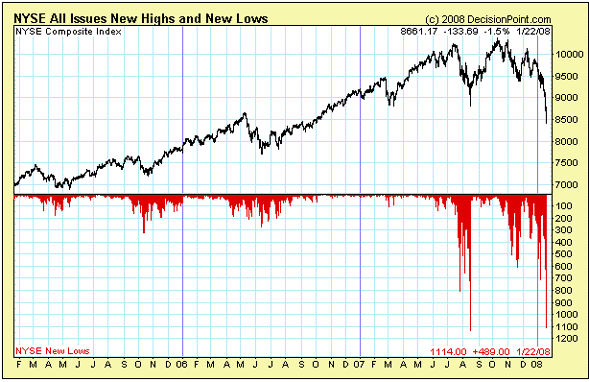
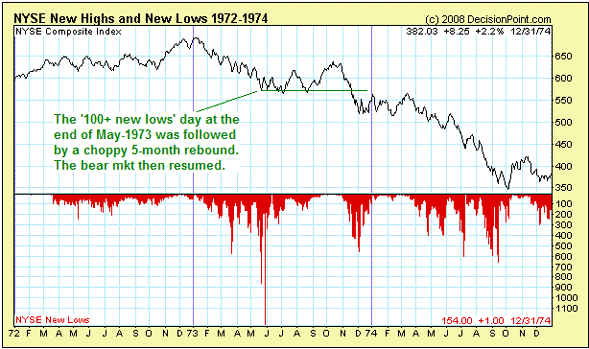
"There were more than 1100 new lows on the NYSE on Tuesday, which is something that has only happened on four prior occasions over the past 40 years. It happened in May of 1973; it happened on the day of the 1987 stock market crash; it happened on 31st August 1998 (the day of the US stock market's bottom during the 1998 financial crisis); and it happened at the peak of last August's financial market panic."

We will now take a look at the situations mentioned above with the aid of charts from the excellent Decisionpoint.com web site.

The first chart shows the most recent two occasions when the number of new lows on the NYSE exceeded 1100, including this week's event. Notice that the '1100+ new lows day' in August of last year was followed by a strong 2-month advance to a new all-time high, after which the market embarked on the downward trend that led to this week's selling climax. Last year's dramatic surge in new lows was actually the 'odd man out' in the historical record in that it wasn't followed, within three months, by a successful test of the bottom reached on the day of the selling climax.


Click Here, or on the image, to see a larger, undistorted image.


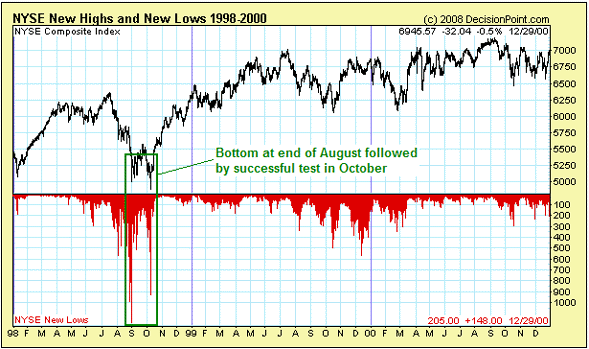
The next chart highlights the bottoming process during the 1998 financial crisis. For all intents and purposes the stock market reached its ultimate correction low on 31st August 1998— the day on which the number of new lows was greater than 1100. Notice, though, that the 31st August bottom was tested about 6 weeks later.


Click Here, or on the image, to see a larger, undistorted image.


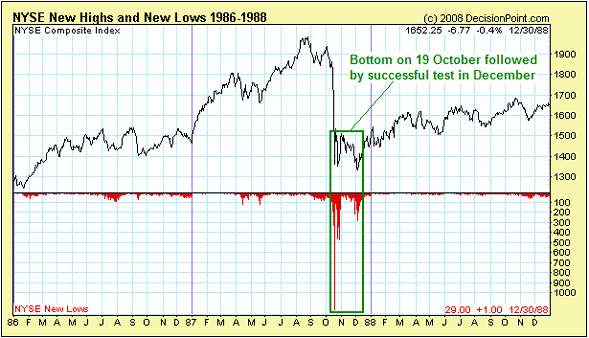
Moving along to the famous 1987 selling climax depicted on the chart presented below, notice, again, that the NYSE Composite Index returned to test its panic low before a sustained advance got underway.


Click Here, or on the image, to see a larger, undistorted image.


Last, but certainly not least, we'll take a look at a chart showing the dramatic May-1973 surge in new lows and its aftermath. The chart displayed below reveals that the selling climax near the end of May-1973— as marked by new lows surging to more than 1100— was followed by a choppy rebound that lasted about 5 months. The market then returned to its downward path.


Click Here, or on the image, to see a larger, undistorted image.


Although the recent decline was much steeper than the one that led to the May-1973 selling climax, we think it makes the most sense to compare the current situation with 1973. The reason is that the May-1973 selling climax, like this week's selling climax, occurred in the midst of a secular (very long-term) bear market, whereas the 1987 and 1998 climaxes occurred within the context of a secular bull market.

As an aside, for the past seven years we've consistently maintained that US equities are mired in a secular bear market as defined by long-term downward trends in VALUATIONS (P/E ratios, etc.) and REAL prices (gold-denominated prices). In a high-inflation world it is very important to define the long-term trend in this way, rather than in terms of nominal dollar prices, because it is purchasing power and not monetary value that matters. For example, if the US stock market were rising at 5% per year while the US$ were losing purchasing power at the rate of 10% per year then it would not, in our opinion, be reasonable to claim that US stocks were in a bull market. What we would have, in that situation, is a bear market in the dollar as opposed to a bull market in equities. To say otherwise is to say, in effect, that a million dollars is a million dollars regardless of whether it can buy a beautiful house in the best part of town or an ice-cream cone.

In any case, even if we assume the bearish 1973 parallel, the historical record suggests that the stock market has just made a low that will not be decisively breached for at least 5 months.

Steve Saville

ß§

Normxxx    
______________

The contents of any third-party letters/reports above do not necessarily reflect the opinions or viewpoint of normxxx. They are provided for informational/educational purposes only.
The content of any message or post by normxxx anywhere on this site is not to be construed as constituting market or investment advice. Such is intended for educational purposes only. Individuals should always consult with their own advisors for specific investment advice.

Bank Reserves Go Negative

Mish's Global Economic Trend Analysis

By Mike "Mish" Shedlock | 31 January 2008
http://globaleconomicanalysis.blogspot.com


Bank Reserves Go Negative

I have been watching a chart of Borrowed Bank Reserves for several weeks. The action is unprecedented.

Borrowed Reserves of Depository Institutions


Click Here, or on the image, to see a larger, undistorted image.

The NFORBES Chart above is courtesy of St. Louis Fed.

Here's an interesting excerpt from the book Investing Public Funds by Girard Miller about borrowed reserves.

"Another useful indicator of the Federal Reserve's relative monetary policies can be found weekly in the Federal Reserve data. A key statistic is the net free reserves or net borrowed reserves line item. This statistic measures the degree to which depository institutions have found it necessary to obtain funds in the Fed Funds market and through the Fed discount window in order to obtain required reserves.

During periods of central bank credit-tightening operations, the depository sector might find it necessary to borrow funds to meet reserve requirements. This practice results in net borrowed reserves, which shows as a negative number. Conversely, if ample funds are available through the banking system to meet reserve requirements, banks can become net lenders of reserves through the Fed Funds markets"

Given that the Fed is certainly not in a credit tightening mode, we must look for another explanation. Here it is: Banks in aggregate have now burnt through all of their capital and are forced to borrow reserves from the Fed in order to keep lending.

[ Normxxx Here:  For the financially challenged, this means that the banks are technically insolvent— they owe more than they are owed.  ]

Detail comes from the Federal Reserve H3 Release.

Table 2 Not Seasonally Adjusted Reserves in Millions of Dollars


Click Here, or on the image, to see a larger, undistorted image.


Total Reserves for two weeks ending January 16th are $39.988 billion. Inquiring minds are no doubt wondering where that $40 Billion came from. It's a good question. The answer is the Term Auction Facility. You can see that figure in Table 1 of the H3 release (not shown).

Were it not for the Term Auction Facility, banks would have had to raise another $40 billion in capital by selling assets or some other means. We will look at "other means" in just a moment.

For now, the Fed is not disclosing who is borrowing under the Term Auction Facility, probably out of fear that people just might find out what banks are capital impaired and by how much.

January 29 TAF Auction

Forbes is reporting Fed's TAF auctions $30 bln 28-day loans at 3.123 pct.
The Federal Reserve's latest loan auction through its Term Auction Facility (TAF) produced the lowest interest rate, lowest bid-to-cover ratio and fewest bidders yet. The lower demand suggests an improved liquidity situation in financial markets.

Yesterday's auction of
$30 bln 28-day loans came in at a 3.123 pct interest rate, a 1.25 bid-to-cover ratio with 52 bidders. This was the fourth auction under the new TAF program designed to relieve pressure in the short-term, inter-bank funding market [[i.e., the banks are just rolling over the borrowed funds! : normxxx]].

The Role Of The Monolines

What Happens if Ambac (ABK) and MBIA (MBI) are downgraded? That too is a good question. Let's take a look.

MarketWatch is reporting Banks may need $143 billion in fresh capital.
If bond insurers are downgraded a lot, banks will need as much as $143 billion in fresh capital to absorb the impact, Barclays Capital estimated Friday. Citigroup Inc. (C), Merrill Lynch & Co. (MER) Bank of America Corp. (BAC), and Wachovia Corp. (WB) are among U.S. banks most exposed to bond insurers, or "monolines" as they're also known, Barclays Capital wrote to investors.

The Telegraph is reporting Banks 'face a further $300bn sub-prime hit'.
The world's financial institutions will have to write down a further $300bn (£152bn) of US sub-prime losses before the crisis is over, according to a study by consulting firm Oliver Wyman.

"While governments, central banks and regulators scramble to address the aftermath of the sub-prime fallout, several other crises are mounting."

Tumbling property prices— especially in the UK and Spain— a weakening dollar, a possible collapse in commodity prices, and a fall in Chinese and Indian stocks will
"disrupt" the global economy, the report claimed.

As noted in Banks Attempt To Freeze Balance Sheets “Large money center banks have virtually frozen their balance sheets, reluctant to lend even to good credit,” according to Scott Anderson, a senior economist at Wells Fargo.

However, rising numbers of foreclosures are forcing assets back on to bank balance sheets in spite of that desire to freeze. It's no wonder banks are spooked by those walking away from debt. See 60 Minutes Legitimizes Walking Away for details.

Banks Raise ATM Fees To $3.00

One method of raising capital is to increase fees. $3 ATM Fees are one such method.

"They're looking for ways to make up for the losses and nickel and diming appears to be the only way they can do it," Consumer Affairs analyst Joseph Enoch said. Today, the average ATM fee is $1.78, while five years ago it cost a little more than a $1 to retrieve money from a bank with which you didn't have an account.

In some areas, JP Morgan Chase, Bank of America and Wachovia fees have hit $3 for non-customers. Some banks now charge their
own customers a fee for the convenience of using an ATM to the disdain of some.

Another way to raise cash (and a very expensive one at that) is to offer way above market rates on savings deposits and CDs. Let's take a look at some current offers on savings accounts.

Savings Deposit Rates


Click Here, or on the image, to see a larger, undistorted image.

Chart courtesy of Bankrate.Com.

Any bank paying those rates on savings accounts is desperate for cash. Those looking for candidate banks liable to go under need only look at the price banks are willing to pay for capital.

I cannot stress this enough: If you accept these offers, please make sure you never go above the FDIC limit.

$3.00 ATM Fees Will Backfire

As for banks charging $3.00 ATM fees, I think the strategy will backfire in several ways. Some customers will stop using anything but their own bank's ATMs. Instead of getting $1.50 banks will get nothing. Other customers will opt to max out the cash they take on each transaction to minimize the number of transaction fees.

Banks charging their own customers will find many switching banks out of resentment. In the grand scheme of things, $30 Billion or $40 billion is not a lot of money. However, when lack of reserves would otherwise prevent lending, it certainly is a lot of money. Imagine a major bank telling customers: "We have no cash reserves so we can't renew your loan." With that in mind, banks are scrambling to raise cash .

Borrowing reserves is expensive, paying 5% on CDs and Savings Deposits is expensive, and in the end, attempting to extract more blood out of consumers by raising ATM fees to $3.00 is going to prove expensive. There are simply no good ways to raise capital [[but it's why the Fed is desperately trying to steepen the interest rate curve (banks make money on the difference between short and long term rates): normxxx]]. And the problem is going to get far worse before it gets better.

A deepening recession, a falling stock market, plunging commercial real estate, and social acceptance of 'walking away' are all going to exacerbate the problems Bernanke and lending institutions face. A Crash Course For Bernanke on academic theory is coming. It will be interesting to watch how he reacts to it.

  M O R E. . .

Normxxx    
______________

The contents of any third-party letters/reports above do not necessarily reflect the opinions or viewpoint of normxxx. They are provided for informational/educational purposes only.
The content of any message or post by normxxx anywhere on this site is not to be construed as constituting market or investment advice. Such is intended for educational purposes only. Individuals should always consult with their own advisors for specific investment advice.

Wednesday, January 30, 2008

RE Scams by Homeowners!

The Modern Psychology Of A Crashing Housing Market: Just Sending In Your Home Keys
Click here for a link to complete article:

By Dr. Housingbubble | 30 January 2008

Well it shouldn’t come as a surprise to you that the market was expecting new home sales to come in at 645,000 but the actual number came in at 604,000. Being off by 41,000 isn’t a big deal given how horrible the establishment is at predicting the will of the people. Just a few short months ago, it was almost a given that the front runners in the 2008 presidential race were going to be Hillary and Rudy. It was hard to see anyone else in the race (that is if you only listened to the 'scientific' pollsters). Yet, just these past few days, we just saw how frustrated the public is with the status quo and with following in the footsteps of the past. They gave a resounding vote to someone new (in S.C.) and someone utterly different (in Fla.). Yes, we’ve heard it a million times, but people do want change. Even Joe and Susie public realize that when they hear "tax cuts stimulate the economy" and watch corrupt corporation leaders walk off scot free, with massive severance packages to boot, they understand that that a trickle down "tax cut" (two weeks groceries?) does not translate to a healthier economy or better wages.

Many are becoming convinced that the country is devolving more and more into a plutocracy— and looking at wealth statistics, especially distributions, this belief seems well founded enough. Corporate welfare/bailout is alive and well (with a few crumbs for the masses [[and isn't it only fair that we share out the same amount among the upper 1% as among the remaining 99%— fair's fair! : normxxx]]). The housing bubble just went mainstream with a cover report on 60 Minutes called "House of Cards." You can click on the link and watch the clip if you did not watch it during the weekend. It is well worth your time and plays out like any bubble blogger post. Take a wild guess at what city was the main focus? Stockton, California! In fact, they were showing folks going on repo bus tours to buy homes.

Sort of like a Universal Studios tour except instead of Jaws coming out to eat you alive, you have overpriced McMansions waiting to sink their teeth into your wallet. For any of you who have taken trips to the Inland Empire to what are now defunct new subdivisions, this will not come to you as a surprise. The 60 Minutes' piece didn’t shed any new light in regard to numbers and economics that many 'housing blog' readers wouldn’t know, but it cemented the fact that, yes, housing is in a historical bubble everywhere in the nation. It is a good piece and well worth your time.

The thing that really hits home (pun intended) is how willing people are to game the system. Learning from the best on Wall Street, many recent American homebuyers are giving the middle finger to (often innocent) lenders (it was mostly the brokers and "loan originators" who did the scamming) and are willingly going into foreclosure. They show two couples that bought homes with exotic mortgages. One couple talked about buying another (less expensive) home in a better area and about not knowing or understanding the terms of their current note— that was their justification for not trying very hard to keep their home. Another couple added to our insight into the psychology of recent buyers, telling us they are allowing their foreclosure to happen because "the home isn’t appreciating" and therefore just isn’t worth it. If you think about the psychology behind this and dig deeper, we have a nationwide epidemic of people looking for free lunches. People from Wall Street to main street are expecting profits each and every time they take on any risk, whatever the odds of payoff; then when losses appear, they expect everyone else to bail them out.

A reader (Linda) sent in this piece about "Intentional Foreclosure" from CBS News in Sacramento:

"This is how it works. Bob paid $420,000 for his home. Then he notices the house across the street, with more upgrades, is selling for $315,000.

“So Bob, who has pretty good credit, decides to buy the cheaper house.
He can’t afford both; so then he walks away from his original home, letting it fall into foreclosure. That will hurt his credit, but he’s willing to take the hit for a more affordable home and some cash [[besides, in a measly 7 years, he's whole again!: normxxx]]

“Is it wrong to steal when you’re hungry (e.g., for a few staples, such as a 100" plasma TV)?

That’s an issue that a lot of people are trying to figure out right now,"
says Linda.

I imagine that this strategy will become more and more pervasive as the market declines. A large number of people try to build up good credit to have the ability to purchase a home. And for many this is the end-game of good credit. So if you can get out and buy another home while your credit is still good, lock in a good rate (thanks to Boom Boom Bernanke), move into your new place and simply try to sell your previous home or just let it foreclose, then you've succeeded. And you wonder why there is such an uproar for rate cuts. Suddenly that poor family being kicked out in the street is mixed in with a boatload of folks that speculated in real estate, got burned, and now want you to pick up the tab. No need to mince words, this is a bailout. You wouldn’t be receiving your $600 check in the mail (payoff?) and allowing those golden parachutes to greedy companies and recent 'buyers' else. How do you feel about raising mortgage caps to $625,500 now?

The Psychology Of Housing Greed

From Calculated Risk we get a glaring statistics summing up the current market:

“From the Fed’s Flow of Funds report, household real estate assets totaled $20.99 trillion at the end of Q3 2007. So a 30% decline in prices would reduce "housing wealth" by about $6 trillion (Merrill’s number).”

Let's run a few scenarios to see potentially how much damage can occur:


Click Here, or on the image, to see a larger, undistorted image.


Merrill Lynch has already stated that it is very possible that we will see a decline of household real estate wealth by 30 percent. In Southern California we have already seen 10 to 20 percent drops in all counties. I would imagine simply by the sheer size of the homes and the extent of bubble prices, California will be a large percentage of that $6 trillion loss. Statistics! Go back to the presidential polls of a few months ago. The media and pollsters were utterly off and even [just before Iowa or S.C.], they were predicting Hillary losing by only a few percentage points (10 points at most) but things didn’t work out exactly as planned. And this was days before the vote!

Anyone using current housing prices is going to get burned because once you enter into a major bubble and you try to use peak prices to measure your decline, you are using artificially inflated price measures to predict the future. Did anyone see California housing going up nearly 200 percent in some regions over this decade? Of course not. Yet that is the definition of a bubble. Prices disconnect from reality and it becomes a question of "homeowner dreams", consumer behavior, and the frontiers of what is legal and/or moral. Add to this a semi-corrupt industry where the corruption and greed spread from speculators, banks, brokers, agents, Wall Street, politicians, to builders and even normally ultra-conservative foreign investors, and you realize that everyone wanted a free lunch. As the 60 Minutes piece highlighted, at each step of the process someone was getting a cut.

Now we have this pervasive mentality (of unrequited greed) where people are not only willing to let their homes be foreclosed on and walk away from their contracted debt obligations, but we have people that are prepared to do things (and self-justify them) that border on the criminal. In the piece cited above, we also read about people taking out "some equity" just before knowingly letting their homes go to foreclosure. Think about the mindset that occurs when this is happening. "Hey honey, we signed a contract, but so what? How about we tap into our HELOC and take out $50,000 and let this home go into foreclosure. By that time we'll have bought our new home and taken out some cash, so who cares what happens to our 'credit'. After all, Wall Street is just one crooked scam anyway and the lenders are more than willing to give us the money. Take that Wall Street!"

I assure you this conversation (or something very much like it) is happening at many households in the US as we speak. That is why fierce regulation and enforcement are utterly impotant. Rushing to raise caps is a knee-jerk reaction to the deeper and more profound problems with the economy and the psyche of many homeowners, who (often rightly) feel they have been scammed (by the 'system'). People are mostly willing to go to almost any lengths as long as they believe they can get away with it. All of these 'get rich quick books' cater to this free lunch mentality ('everybody's doing it!'). Once at the fringe of late night infomercials, now a majority of Americans think 'nothing down' is a birth right. Ben Bernanke was surprised that a trader in France was able to milk $7 billion from the markets. Why is that so shocking? If you allow people with no appreciable assets or income to take out $2 million loans in California, I assure you they will. When will the Fed and politicians stop to think: does this next move actually make any sense (especially long-term)? I guess that is a lot to ask in an election year.

Subprimed For Disaster: A blast heard 'round the world!
Irrational Housing: Insiders out Early and The Duesenberry effect.
Is Housing the Next Rocky Balboa? Only 2007/8 Will Tell…

  M O R E. . .

Normxxx    
______________

The contents of any third-party letters/reports above do not necessarily reflect the opinions or viewpoint of normxxx. They are provided for informational/educational purposes only.
The content of any message or post by normxxx anywhere on this site is not to be construed as constituting market or investment advice. Such is intended for educational purposes only. Individuals should always consult with their own advisors for specific investment advice.

Monday, January 28, 2008

Reviews Of 'Supercapitalism'

Reviews Of Supercapitalism:
The Transformation Of Business, Democracy, And Everyday Life


By various | 28 January 2008


Supercapitalism: The Transformation of Business, Democracy, and Everyday Life"
by Robert B. Reich

Introduction

Whether or not you agree with him, Robert Reich, former Secretary of Labor in the Clinton administration, opens up a dialogue on the joint problems of economics and social responsibility.

Reich makes a compelling argument that supercapitalism has robbed democracy of much of its power. supercapitalism by the definition presented in the book is simple— the consumer is king and prices always go down. What Reich looks at is the cost of such a narrow focus to companies, society, the individual, and its impact on the workings of democracy. Reich also points out the hidden costs and 'contributions' of the rise of well heeled, single-purposed, different lobbying groups (e.g., PACs) to politics and the political process, and to the process of globalization. This is hardly new. But it has become markedly more pronounced in recent years.

So how is democracy compromised? The 'great compromise' is not driven by some overarching conspiracy or hidden agenda— it is driven largely by the simple mechanics of Adam Smith's 'marketplace'— by simple consumption. Ultimately Reich argues that it robs the common citizen (the 'hoi polloi') of legitimate, effective, democratic control over his society. It's not surprising that this is a highly charged issue because the economics of what benefits society (or "the common good" as Reich calls it) often gets tangled up in the web of politics, history, and ethics. Reich also points out that the cost of supercompetitiveness and constantly falling prices is a loss to the economic and social health of America. Reich points out that everyone, of course, is driven to get the lowest price for a good or service as possible, but he suggests that we must balance that with our desire also to have decent wages and benefits— that the two are not necessarily complementary— and often at odds. He also points out that the move towards regulation was initiated by government and that companies/corporations went along because it tends to raise the bar for new competitors and guarantee a top and bottom for prices— i.e., stable prices. Regulation promised companies a profit without fear of prices so low that they might be put out of business— e.g., as the result of some new breakthrough technology or marketplace innovation— hence, most regulation does stifle novelty; every consumer 'protection' restricts the 'new'). And that companies/corporations fight tooth and nail against any regulations that would tend to 'open up' competition (especially to new companies or innovations promoted by 'new' companies) and for any regulations that would tend to 'close down' competition from new companies. And, of course, this should be considered the 'natural and necessary order' of things!

[ Normxxx Here:  It remains for us, the hoi polloi, to defend and protect our rights against regulations that constrict our choices to the benefit of established companies! It also should be noted, that this country was not always actually a democracy. Despite what the history books teach, democracy (little 'd') was hard won; first by the non-landed gentry and common folk, through many state and federal laws, then by the 14th Ammendment, and finally as late as the 19th Ammendment, well into the last, 20th, century. (Note the many remaining requirements, as in the ability of the 'supreme court' and no other to 'interpret' the constitution, as in the requirement for 'supermajorities' e.g., in congress for any substantive issue, such as overriding a veto or for impeachment, and among the states, for ratifying a congressional ammendment or a new constitution, to protect 'the few' from the 'wrath of the many'— 'mob rule'!) For the first third of our country's history, the U.S. was quite deliberately a republic (small 'r') NOT a democracy! Plato thought a republic, with an elite trained up to govern, was many times preferrable to a democracy, which in the words of our country's forefathers (who so carefully crafted the constitution) was prone to 'mob rule'. I sometimes agree, but then I believe everyone should have a say in how that republic is re-constructed.  ]

I should point out that this is a great oversimplification of Reich's points but it does capture some of the principal concepts. He also makes suggestions that should promote the free market without unduly undermining democracy and still allowing consumers to benefit from competitive pricing. Since this is economics we are discussing, politics is inextricably mixed in and will probably color whether or not you agree with his points or not— but try to give him a fair, unbiased reading before you make up your mind.

Reich's style is breezy for a book that looks at economics, democracy and the erosion of wages, benefits. Reich comes across as fair balanced and thoughtful even as he sells his take on what is undermining American society. Ultimately it's a worthwhile book to read simply because it opens up dialogue on the social cost of constantly lowering prices without regard to end effects, and how it impacts those who live next door to us.

According to Robert Reich, there was a time when capitalism and democracy where almost perfectly balanced. This was the period of 1945 to 1975, which he calls the "Not Quite Golden Age." During this period there was a three-way social contract among big business, big labor, and big government. Each made sure that they as well as the other two received a fair share of the pie. Unions recieved their wages and benefits, business' and investors their profits, and regulatory agencies regulated to 'protect' consumers (e.g., from unsanatory and otherwise harmful products) and make sure everyone could compete fairly. It was also a time when the gap between the rich and the poor was the narrowest in our history. It was not quite the golden age because women and minorities were still second class citizens, but at least there was hope.

Fast forward to 2007, capitalism is thriving and democracy is sputtering. Why has capitlism become supercapitalism and democracy become enfeebled? Reich explains that it was a combination of things: unthinking deregulation, globe spanning computer networks, better transportation, etc. The changes were mainly a result of technological and social breakthroughs; unlike many left-leaning authors, he sees no 'great conspiracy,' only a transformational change and contest. The winner of this great transformation was the consumer/investor and the loser was the citizen/wage earner. Throughout the world, the consumer has more choices than ever before him and at reasonable prices. The investor has unprecedented opportunities to make profits, if only he is patient and wise. The citizens and the wage earners, however, are less well off. The average citizen does not have much voice— other than occasional (and sometimes 'fixed') voting— in the body politic. And the wage earner income has been stagnating for many years. The most salient illustration of this trend is Walmart. Walmart delivers the goods at low prices, but the trade-off is low wages and poor benefits for their employees [[in their defense, it must be argued that they give preference to ex-military and retirees of all stripes, who usually come with their own benefits: normxxx]]. We justify this dilemma, as Reich nicely puts it, because "The awkward truth is that most of us are of two minds."

Reich makes some startling pronouncements. For starters, stop treating corporations as 'human beings'. They are neither moral or immoral, they are merely "bundles of contracts." I couldn't agree more. Stop expecting corporations to be socially responsible, see them for what they are: profit-seeking institutions. Any socially responsible action they are likely to take (and remain in business) as a result of coercion is probably defensive (and half-hearted) anyway. Don't even encourage them to be socially responsible, because it may only hurt them and wrongly lead us to believe that they are solving problems when they are not. Corporations play by the rules of the 'market place' and the laws of the states that they operate under: these are their givens, and it is up to wage earners and other citizens, and their elected representatives, to change the rules of the playing field so that it is possible for all to play a fair game and benefit— 'win-win' NOT 'win-lose'.

This is no easy task in the age of supercapitalism. There are currently 38,000 registered lobbyists in Washington DC in a virtual arms race of spending with each other to buy favors from our so-called representatives. The only way citizens can compete with this is not by hiring more lobbyists but advocating through new media outlets such as the internet and cable tv. This, according to Reich, is currently the most effective way to make government more responsive.

As noted, during the "Not Quite Golden Age," the government was charged with ensuring a 'level playing field' for all and also as being the referee. He refers to this political-economic balancing act as "democratic-capitalism." But that accommodation rapidly unraveled starting in the mid-70s as advances in transportation, communications, and various other technologies permitted the globalization of production and the rise of more efficient, generally international firms that challenged the monoliths and that also undermined and decimated labor unions and the 'mom and pop' companies, who could not compete. An ideology of free-market, 'laissez-faire' capitalism was legitimized that discredited any regulation [[so the 'market place,' including that for labor, is today becoming one mad scramble, subject to the laws of no nation : normxxx]]. He suggests that Americans as consumers and investors have benefited greatly from this transformation of the economy, but as wage earner-citizens we no longer have the political will or power (as non-union or weakly unionized wage earner-citizens) to counter the social impacts of largely unchecked international corporations. In other words, democratic-capitalism has morphed into supercapitalism.

For an author accused of being left-leaning, this book is remarkably neutral, even benign, in its assessment of dynamic capitalism in its current form of globe-spanning corporations, massive layoffs and job shifting, extravagant CEO pay, and vast political influence by corporations in both local and national elections and even day-to-day affairs. In fact, in his view, corporations are doing no more than reacting positively to consumers/investors in their demands for advancing shareholder prices and their insistence on lowest possible pricing. He points to the stock market run-up over the last thirty years and the ability to produce consumer items relatively more cheaply. However, little notice is made of the considerable market manipulation and price setting in many areas of the economy, such as in energy and telecommunications [[as government regulation, abetted by those large, international hegemons, stifle legitimate competition. : normxxx]]

Any perceived social harmony in the post-WWII generation is more of an aberration than indicative of democracy in action. A combination of devastated economies across the globe and the containment of workers in no-strike, inflation adjustable contracts permitted the setting of stable, high prices by now dominant US corporations. Dissidents were painted with as Comm-simps (communist sympathizers) and purged from unions. The fact that corporations nevertheless had the power to quickly destroy any so-called accord demonstrates clearly that democratic effectiveness even in democratic-capitalism was minimal at best.

In the present, Reich insists that the very existence of Wal-mart is indicative of consumer empowerment, setting aside the fact that consumers are also workers who have had their wages squeezed by the likes of Wal-mart. Lumping consumers and investors is highly convenient. The mega-profits of global corporations have highly enriched the most knowledgeable and deeply invested— generally, the upper (managerial and owner) classes. It is somewhat cynical to hold that the lower prices and the holding of a few shares of stock have enriched or empowered the working classes nearly as much.

But the author takes issue with those who perceive a conspiracy of big business and politicians or the existence of class warfare to explain the takeover of government functions by the most affluent (including corporations). His argument that businesses (and business combines/lobbies) compete for favorable legislation in no way discredits those who recognize the exclusion of average Americans and their concerns from government. The commonality of corporate interests is readily seen in their united opposition to populist initiatives. The author does accept that the corporate "social responsibility" movement- codes of conduct, etc. is little more than a cynical defensive ploy to deflect concerns about the ramifications of corporate dominance undercutting the possibility of democratic actions.

The author assures us that we can have both a vibrant democracy and a vibrant capitalism. The spheres of consumption and citizenship are likewise to be kept distinct. His essential contention is that powerful corporations need to be severely limited or kept out of the political process. Beyond that, we must elevate our actions as citizens above our actions as consumers [[to which I append a completely cynical, "good luck!" : normxxx]]. One cannot simply ignore the consequences to one's community in making buying decisions; for example, by frequenting Wal-mart[!?!] Most of all, we need to reinvigorate the political process. Democracy requires citizen interaction and debate to set an agenda and carry it out. The town square is long gone; perhaps online communities can act as meeting places [[like the viewers/listeners of PBS? Fat chance! : normxxx]]. By contrast, markets need only aggregate individual, self-interested behavior [[and democracy must do the same— or perish in its present form: normxxx]]. The greater difficulty in conducting [[unrewarded: normxxx]] democratic action is certainly a factor in the ascendance of the marketplace in supercapitalism.

The book is best at describing the evolution of so-called supercapitalism. It is a stretch to maintain that the post-WWII period can be termed 'democratic-capitalism'. It is, perhaps, disingenuous to suggest that American consumers have become 'empowered' with globalization and the advent of Wal-mart. A vibrant democracy cannot be distinct from consumer/investor actions— the latter must be involved in the economy to ensure a positive impact on all communities and the greater society.

The question that remains, after reading this book, is to what degree will 'consumers' be willing to sacrifice their low prices to achieve their goals as 'citizens'. If the answer is that we currently ARE imbalanced in the direction of 'the marketplace' we must rebalance the choices between capitalism and democracy. If not, we are left to the increasingly autocratic and not so tender mercies of supercapitalism.

ß§

Normxxx    
______________

The contents of any third-party letters/reports above do not necessarily reflect the opinions or viewpoint of normxxx. They are provided for informational/educational purposes only.
The content of any message or post by normxxx anywhere on this site is not to be construed as constituting market or investment advice. Such is intended for educational purposes only. Individuals should always consult with their own advisors for specific investment advice.

Sunday, January 27, 2008

Darker Days Ahead?

Darker Days Ahead?
Robert Reich Warns A Recession, Or Worse, Could Be Coming.


By Arlyn Tobias Gajilan, Newsweek | 27 January 2008

Think the last few days have been bad for Wall Street and the rest of the world's markets? Hang on, things are probably going to get worse, says Robert Reich, President Clinton's former secretary of Labor and author of the recent book
Supercapitalism: The Transformation of Business, Democracy, and Everyday Life"
by Robert B. Reich

According to Reich, who currently teaches public policy at the University of California, Berkeley, the United States might even be headed toward a depression.

NEWSWEEK's Arlyn Tobias Gajilan talked to Reich about the Fed's surprise rate cut Wednesday, the "D word," the growing criticism of Federal Reserve chairman Ben Bernanke and whether a stimulus package will include $500 check for each American. Excerpts:

NEWSWEEK: Many investors had hoped for an interest-rate cut, but this cut's size and timing took people by surprise. Were you taken aback by the Fed's three-quarter basis-point cut, the largest single-day reduction in the Fed's history? And do you think it's necessary?

Robert Reich: Yes and yes. The Fed is clearly becoming aware of the serious potential of an economic meltdown. The size of the cut is larger than anyone expected because the Fed usually moves in [increments of] .25 or .50 percentage points. But the danger of a cut this size is that it may panic the investors. They may conclude that the Fed has determined that the economy is even worse than assumed and that there is still a way to go before we hit bottom. Yet the Fed has to [cut]. Credit markets are still uncomfortably frozen, and the housing slump continues to worsen.

Unlike Ben Bernanke, Alan Greenspan had a habit of hinting at what his next move would be. While he kept investors on their toes, Greenspan rarely acted as unexpectedly as Bernanke did this week. Is it dangerous for a Fed chairman to surprise the market?

Yes, but I don't believe Bernanke wants to surprise the market as a general rule. This strikes me as a major exception to the relative transparency he's trying to achieve with regard to letting the market know where the Fed is going. It's a move that underscores the seriousness of the current economic problems.

Tuesday's rate cut initially caused a huge market swing, with the Dow, NASDAQ and the S&P 500 all hitting 14-, 15- and 16-month lows respectively. But by the end of the day, all three had bounced back considerably. Does that mean the cut is working?

The fact is that no one knows anything. Investors are flying blind. Even experienced Wall Street hands have no idea whether we're near the bottom. We can expect even more violent swings in the stock market. The reason for all the uncertainty is that the big banks and lenders simply have no idea how many bad loans they're holding. [During the housing bubble] credit markets evolved such complex ways of reselling and repackaging debt that even many top Wall Street professionals simply have no idea of the risks and costs they're involved with. The bottom line is there is a great deal of uncertainty out there, and the markets hate uncertainty.

Can we expect another rate cut at the Fed meeting next week?

Yes. I wouldn't be surprised if the Fed cut another quarter point. If it doesn't announce something at its meeting, it may cut .25 or even .50 within the next month or so. They are clearly worried. [And while lowering rates may cause] inflation, it is far less threatening now than a recession or perhaps— and I cringe at using the word— a depression.

You cringe, but you still used the D word. How far along are we on that particularly slippery slope?

Hopefully, not far. But several managing directors on the Street, whose opinions I trust, have said to me that the chances for a depression are 20 percent. That matches my sense. In other words, it's still low, but 20 percent is nonetheless far higher a probability than anyone should be comfortable with. Even absent a depression, it seems likely that the coming recession will be deeper than the last several.

There's a U.S. News & World Report blog item that was making the rounds on the NYSE floor Wednesday reporting that Bernanke has privately been much more negative about the economy than he publicly admits. From the indicators you've been watching, how bad do you think things are really going to get in the next six months to a year? Is a recession avoidable at this point?

It's going to be difficult to avoid a recession, defined as two consecutive quarters of economic contraction. Difficult because the scale of the problems is so much larger than any stimulus package or Fed rate cut can readily deal with. The stimulus package now being considered on the Hill is in the range of $140 [billion] to $150 billion. But at the rate housing prices are dropping, consumer purchases alone are likely to be hit by $360 [billion] to $400 billion. Similarly the Fed rate cuts, under normal circumstances, would free up money, but lenders are afraid of lending because they don't know how much risk of default they face, even at lower interest rates. It's a little like offering a lobster dinner to someone who is so constipated that they can't take in another mouthful.

Bernanke hasn't won many fans lately. Under his leadership, many on the Street think the Fed has moved too slowly to avoid recession and too ineffectively to prevent inflation. Is that fair criticism?

Probably not. Up until last week, Wall Street's assessment of Bernanke was quite positive. He was getting good press all around. He faces a very difficult balancing act under circumstances in which energy and food prices are rising, the dollar is falling and inflation is becoming more threatening. What should the Fed do? It is terribly unqualified to cope with speculative bubbles and their aftereffects. The housing bubble and the Wild West credit markets of the last few years came about not because the Fed kept interest rates too low, but because the treasury, the comptroller of the currency, and the Fed, in its regulatory capacity, failed miserably to use their authority to oversee credit markets and assure that they were not unduly exploiting those low interest rates with irresponsible lending practices. Now we have a mess on our hands. Bernanke has the only pooper-scooper in town, but it is too small for the job.

There's a theory that the global markets have matured past the point where they won't necessarily get slammed whenever the U.S. economy gets hammered. Do you buy into that thinking? Will our country's worsening economic situation infect the rest of the world economy?

The U.S. is not completely uncoupled from the rest of the global economy, but the good news is that consumers in Japan, China, India and Europe are now far better able to fill-in the gap when American consumers fail to do the job they have been doing for decades, which is to buy enough of the world's goods and services to keep the world out of recession. Remember American consumers have been the Energizer Bunnies of the global economy for some time. Now others around the world are wealthy enough to become Energizer Bunnies themselves.

The administration has called for a $140 billion economic stimulus package. There have been few details about the plan, but Treasury Secretary Henry Paulson and Congress have all hinted that taxpayers might soon receive checks of several hundred dollars or more. Can Americans expect those checks any time soon and will such a plan actually stimulate the economy?

Only relatively low-income people are likely to spend any extra money they get, since they need the extra money in order to maintain their living standards. So the first question is will the stimulus be targeted to them or will it be frittered away in tax breaks for the upper-middle class and for investors. Secondly, the money has to be in people's pockets right away, not eight or nine months from now in the form of a tax rebate from the IRS. The only surefire way to do that is to reduce withholding in payroll taxes, since 80 percent of Americans pay more in payroll tax than they do in income tax. Thirdly, the money has to be enough to change people's behavior. Five hundred dollars isn't likely to do the trick. I see far more politics in this than economics. Washington has to look like it's doing something, and so it will.


* * *

Facts

Since 1934, there have only been two years when no U.S. banks failed: 2005 and 2006, according to the Federal Deposit Insurance Corp.

During the savings-and-loan crisis of 1988-89, U.S. banks failed at a rate of more than two every business day.

Nearly 58% of Americans believe the globalization of the U.S. economy has been bad for the country, up from 48% 10 years ago, according to a December NBC News/WSJ poll.

Real-estate holdings accounted for 58% of total assets for U.S. banks in 2006, up from 45% in 2000, according to the FDIC.

The world's most-transparent state-run investment fund is New Zealand's, according to the Peterson Institute for International Economics, followed by the funds of Norway, Timor-Leste and Canada. The lowest-rated: the funds of the United Arab Emirates, Qatar and Singapore.

What's On The Horizon For The Banking Industry? Here's A Closer Look:

Points Of View

"Right now it's looking as if the U.S. banking system is on sale to the foreigners."
— Robert S. Patten, Morgan Keegan & Co.


Foreign investment is "a symbol of past mistakes but also of somebody's view of future potential."
— Alex J. Pollock, American Enterprise Institute


Chart: Bad Time for Banks
Review & Outlook: How the Credit Bubble Grew

Credit cards and consumer loans: Rising home prices allowed borrowers to refinance mortgages or take other loans to pay off credit-card bills and other loans, which prevented consumer-loan losses from rising. But that stopped in August, which has spurred a rise in loan and credit-card delinquencies since then.

Credit-card delinquencies and charge-offs increased by one percentage point to 6.83% last October from November 2006. But the figure jumped 0.8 percentage point just in in November 2007, to 7.63%. "That's the kind of jump you normally see after Christmas and not before," says Zach Gast, an analyst at RiskMetrics Group. Earnings reports this past week suggest that credit-card-debt repayment in December may have been as bad or worse. Moreover, losses stemming from delinquencies on holiday purchases won't show up until the summer, says Dennis Moroney, a bank-card analyst for TowerGroup.

Credit-default swaps: The sale of securitized loans using complex financial instruments can distribute risk broadly while democratizing credit, but the explosion of those complex investments may have gone too far because the "loan originators"— big banks, insurers and others— never knew [[or cared about: normxxx]] the real worth, or risk, these investments carried.

The market for credit-default swaps, which protect investors against borrowers defaulting on their loans, has soared in recent years to an estimated $43 trillion. If defaults in investment-grade or junk corporate bonds return to historical norms of 1.25% this year (from 0.5% last year), sellers of insurance on those loans could face losses of $250 billion, enough to match the losses some predict will result from subprime mortgages, says Bill Gross, chief investment officer at Allianz SE's Pacific Investment Management Co., or Pimco.

Loss reserves: Bank earnings could fall by as much as 20% over the next three years, suggests Mr. Gast, because they face a double whammy: Loan delinquencies are outpacing the capital reserves they are required to set aside, according to Mr. Moroney. As losses mount, banks have had to commit more of their revenue to loss reserves. Those low reserve levels, coupled with deteriorating credit, could force banks to increase their loan-loss provisions by $30 billion to $85 billion, according to Mr. Gast, which would put further pressure on earnings. Loss reserves fell to 1.28% of total loans in the third quarter of 2007, nearly half the 2.57% share reached in 1991.

Regulation: Bank deregulation in the 1970s and 1980s spurred the creation of larger banks, but it also fostered greater competition. Between 1970 and 2005, the number of banks fell to 7,500 from 13,500, but the number of banking locations nearly doubled to 80,300. Some argue that recent deregulation— such as a 1999 law that repealed the Depression-era Glass-Steagall Act separating investment- and commercial-banking activities— has made it too easy for banks to take bigger risks, even as they grow so large that the government can't allow them to fail.

But the problem may have more to do with management than regulation— indeed, top executives have been booted from the banks that posted the biggest losses. Banks have struggled to eliminate blind spots for risk, in part because banks have grown so large, says Guillermo Kopp, a former Citigroup information-technology head who is now TowerGroup's executive director. "Citi was supposed to be the quintessential diversified financial institution. But because it's so big, the leadership has been finding it hard to keep all of the pieces working together."

And regulation has its limits, says Alex J. Pollock, a resident fellow at the conservative American Enterprise Institute. "No matter what any regulator or legislator does, financial markets will create as much risk as they want."

ß§

Normxxx    
______________

The contents of any third-party letters/reports above do not necessarily reflect the opinions or viewpoint of normxxx. They are provided for informational/educational purposes only.
The content of any message or post by normxxx anywhere on this site is not to be construed as constituting market or investment advice. Such is intended for educational purposes only. Individuals should always consult with their own advisors for specific investment advice.
Stocks Plunge As Predicted!

Global Stock Markets Plunging As Predicted!

By Capital Multiplier | 27 January 2008

Clearly, we have now made several of the most spectacularly successful market calls of this decade as seen from the following:


1) Bank of America posted a 95% decline in quarterly profit after suffering a $5 Billion write down in the value of its mortgage holdings,

2) Wachovia Corp. announced a 98% decline in quarterly profit after taking a $1.7 Billion write down for loan losses,

3) E-Trade Financial reported a net loss in its latest quarter after losing $2.2 Billion on the sale of its portfolio of mortgage debt, and

4) After peaking last October, the Dow Jones World Index has been plunging lower reflecting the sharp drop in global stock markets. Indeed, according to a Bloomberg report, 43 of the world's biggest stock indexes fell into Bear market territory last week, representing a decline of at least 20% from their 2007 highs! Now you know why we repeatedly warned you not to believe Wall Street's nonsensical claims about 'global decoupling' and foreign markets being immune to a U.S. economic recession!

So how did U.S. policymakers respond to last week's global market plunge? The Federal Reserve resorted to an inter-meeting rate cut and slashed the Fed Funds rate by 75bps (the biggest interest rate cut in more than 2 decades)! And the U.S. Congress announced a $150 Billion 'economic stimulus' that would give most tax filers rebates of $600-$1,200 (and more for those with children) and raised the limits on Federal Housing Administration loans and home mortgages that Fannie Mae and Freddie Mac can purchase to as high as $725,000 in over-priced markets like NY and CA.

Global stock markets immediately bounced after the Fed's rate cut but there was no follow through and the S&P 500® rose just 0.4% last week. So now that U.S. policymakers have clearly shown that there is no limit to their stupidity and that they are willing to 'prop up' asset markets, Wall Street cheerleaders are once again declaring that stocks have 'bottomed'. Indeed, many analysts are calling for a significant market rally citing factors like good stock Values, Oversold Markets, and Investor Sentiment as probable catalysts.

We think they are wrong because: Values: Wall Street proponents of the 'Fed Model' are pointing to the 3.5% yield on 10-Year U.S. Treasuries as bullish for the stock market. However, our research shows that over the past several decades the Fed Model has proven to be a very unreliable tool for timing market tops and bottoms. Also, contrary to popular perception, we believe the stock market is currently overvalued based on most fundamental valuation metrics because Wall Street's 2008 earnings estimates for the S&P 500® are ridiculously over-optimistic. According to Wall Street consensus estimates, analysts are projecting S&P 500® earnings growth of nearly 15% this year ostensibly driven by very strong comebacks in the Consumer Discretionary and Financials sectors!

Given our expectations of: i) A global economic slowdown (possibly a global recession), ii) Further sharp declines in real estate prices in U.S., U.K., Spain and many other countries, iii) A significant correction in commodities, and iv) Further huge losses for global financial institutions at least this year and next, we think we will be lucky to see no significant losses in earnings.

Oversold Markets: In a Bear market, the market can get short-term 'oversold', bounce a little (and not even to as positive reading, e.g., Tuesday's market) and then market prices can continue to plunge through so-called 'support levels' without pausing!

Investor Sentiment: Recent surveys of individual investors have shown a huge jump in bearish sentiment which is considered bullish from a 'contrarian' standpoint since high readings of investor pessimism generally occur near market lows. However, given the fact that individuals account for a small percent of daily trading volumes these days, we believe their actions are likely to have only a marginal impact on market prices at best and their sentiment is not much reflected in today's 'computer driven program trading'. We have seen no signs of the 'panic' selling by institutional traders or individual investors that typically occurs near market bottoms (aka, the 'great washout').

Most investors seem to be as yet unaware that the eventual magnitude of capital losses suffered as a result of the U.S. housing and mortgage debt crisis alone by global financial institutions is likely to be several times that of the Savings & Loans crisis of 1990 (which, moreover, had little effect on homeowners, except that they were shielded from run-away interest rates during a period of run-away inflation— it was the S&Ls that went bankrupt). To make matters worse, it is only the tip of the iceberg, there are trillions of dollars in highly leverraged, high-risk LBO loans, ABCS, RMBS, CMBS, and a zoo of other paper 'assets' that have already started declining sharply in value, exposing global financial institutions to further huge losses this year! There are ABCBs which were rated triple-AAA for the highest rating that no longer even trade, i.e., their value has gone to zero!

Given that the relatively much smaller S&L crisis of the early '90s was enough to push stocks into a cyclical bear market, we really don't think it will be possible for the Federal Reserve and Wall Street to prevent a standard bear market decline of at least 20% in the S&P 500® by sometime this year (we are almost there already). That gives a minimum downside target for the S&P 500® of 1250. So we are not making any changes to our Model Portfolios at this stage. However, if you believe you are over-committed on the bearish side, we suggest taking appropriate precautions immediately, since we may be heading into a (limited) counter-rally around here.


Normxxx     ______________
The contents of any third-party letters/reports above do not necessarily reflect the opinions or viewpoint of normxxx. They are provided for informational/educational purposes only. The content of any message or post by normxxx anywhere on this site is not to be construed as constituting market or investment advice. Such is intended for educational purposes only. Individuals should always consult with their own advisors for specific investment advice.
Saturday, January 26, 2008

$7.2 billion French Fraud?

Trader Kerviel Taken Into Custody

By AP | 26 January 2008

PARIS—
A rogue trader who cost France's Société Générale bank more than $7 billion by making bad stock market bets to the tune of $70 billion was taken into custody on Saturday for questioning, judicial officials said.

Financial police in Paris were to question Jerome Kerviel as part of a probe into Société Générale's announcement Thursday that the 31-year-old trader had put tens of billions of dollars at risk in one of history's biggest frauds, judicial officials said. They spoke on condition of anonymity because the investigation is ongoing.

Skeptics from Mr. Kerviel's neighbors to France's prime minister have questioned whether a single, junior futures trader could have managed such large sums. Adding to the mystery, the bank said Mr. Kerviel may not have made any personal gain from his unauthorized trades.

The bank said it "discovered the fraud" last weekend and unwound the trader's losing bets starting Monday, when world markets tumbled. Some analysts have questioned whether Société Générale exacerbated the fall and indirectly led to the U.S. Federal Reserve's subsequent decision to cut rates.

Judicial officials also confirmed police searched Mr. Kerviel's apartment in the Paris suburb of Neuilly-sur-Seine. They said police also went Friday night to the bank's headquarters, where they were provided with documents relating to the investigation, officials said. Paris prosecutors are conducting a preliminary investigation based on three complaints: one by the bank accusing Mr. Kerviel of fraud, and two by small shareholders. The bank maintains it was the biggest loser in the case, because of the timing of the discovery.

Mr. Kerviel had been investing the bank's money by hedging on European equity market indices. That means he made bets on how the markets would perform at a future date. Société Générale's chief executive, Daniel Bouton, said the trader had been betting throughout 2007 that markets would fall[!?!] But the bank says he had overstepped his authority and was wagering more money than he should have. Ultimately it took three days to close the positions, and the bank lost $7.2 billion.

French presidential aide Raymond Soubie said the trader had been dealing with more than $73.3 billion. That figure outstrips the bank's market capitalization of $52.6 billion, and is close to the annual GDP of entire nations such Slovakia, Qatar or Libya. It remains unclear whether Mr. Kerviel's actions, if proved, were out of malevolence, ambition or some other reason. Three union officials representing Société Générale employees said managers at the bank who briefed them about the fraud told them Mr. Kerviel was having family problems[!?!]

The debacle generated buzz at the World Economic Forum in Davos, Switzerland, and raised questions sector-wide about risk management. French Finance Minister Christine Lagarde, speaking Saturday in Davos, said she has been asked to compile a report on the fraud. Ms. Lagarde said her report will look at "the reality of facts based on real hard data," and "how and why the controls did not work" to prevent the fraud. Ms. Lagarde said the report, whose results are to be made public, will address "what additional controls should be put in place to stop it happening again."

Société Générale's shares have lost nearly half their value over the past six months. After an up-and-down day Friday, the shares closed down 2.5% at $108.62. The company, which also posted another $2.99 billion subprime-related loss, planned to raise $8.02 billion in new capital.


Société Générale's Damage Control
After Alleged Fraud, French Bank Strives To Save Reputation


By David Gauthier-Villars | 26 January 2008

PARIS— For 72 hours this past week, top executives at Société Générale scrambled to save their company. Now, after a massive fraud that the French bank said cost it €4.9 billion ($7.2 billion), management faces another tough task: saving the firm's reputation.

In a telephone interview yesterday, Jean-Pierre Mustier, the head of Société Générale's investment-banking arm, said supervisors of the 31-year-old employee allegedly responsible for fraudulent trading missed several opportunities to stop him.

Missed Opportunities: The company credits swift intervention with allowing it to limit losses. But a senior executive says the French bank missed several opportunities to stop the alleged illicit actions of the junior trader. The trader caught the attention of back-office supervisors several times in recent months with unusual positions, Mr. Mustier said. "In some cases, he would tell them that it was a mistake," he said. "He would convince them, for example, by canceling the positions." Mr. Mustier said initial evidence of repeated lack of supervisory oversight is emerging in an internal investigation that Société Générale started after top executives learned of the alleged irregularities on Jan. 18. The bank said it was dismissing four to five people.

In disclosing the world's biggest-ever trading loss Thursday, Société Générale blamed fraudulent trades by Jérôme Kerviel, a junior trader on the bank's futures-trading desk in Paris. According to people familiar with the matter, the bank's total exposure had reached €50 billion by Jan 18.

Paris prosecutors have launched a preliminary criminal investigation into Mr. Kerviel's actions, though no charges have been pressed. Shareholders also have launched a complaint with Paris prosecutors. Mr. Kerviel's lawyer couldn't be reached for comment yesterday. An associate attorney said on Thursday that the trader was ready to answer to French justice.

In his interview Friday, Mr. Mustier said that after discovering the problem, Société Générale on Monday introduced new control systems to the back office of the bank's trading desk. Nonetheless, if Société Générale's internal inquiry finds a serious breakdown in supervisory control, it would add to pressure on the bank's embattled top executives. "They were strong, independent and a bit cocky, and now this whole fiasco has made the bank and its management vulnerable," said Bruno Berry, an equity-fund manager at Morley Asset Management in London, who owns Société Générale stock.

Mr. Mustier said he first learned of problems in the bank's futures-trading unit at 10 p.m. on Jan. 18. Philippe Citerne, co-chief executive of Société Générale, said he was warned at about the same time. The two executives said it took them two days to grasp the scope of the problem and map out a strategy to unwind the estimated €50 billion exposure they said was built up by Mr.Kerviel.

According to accounts from Mr. Mustier and other Société Générale executives, Mr. Kerviel managed to circumvent the bank's high-priced and complex security system to make trades over the past several months. Bank executives said Mr. Kerviel's alleged subterfuge was fairly straightforward. He was making large bets that European stock indexes, such as the CAC in Paris and the DAX in Frankfurt, would rise, they said. But the markets began working against him earlier this year, and the trader began racking up huge losses. Mr. Kerviel, according to bank executives, covered up those losses by recording fictitious trades[!?!] that went in the opposite direction.

Bank executives said Mr. Kerviel was acting alone. Some in the financial world have expressed skepticism of that assertion, considering the layers of controls that banks have in place in order to keep tabs on their traders' activities; experts question how a junior trader was able to gain intimate knowledge of settlement procedures and schedules, for example. Banks are supposed keep those operations completely separate as a safety mechanism. Bank executives said Mr. Kerviel was deeply knowledgeable of procedures because he had worked in the bank's so-called back office for several years. Moreover, the trader had kept up friendships in that section of the bank, possibly allowing him to keep up with the latest security features, they said. Mr. Mustier said Mr. Kerviel may have used the login and password of some colleagues to enter some transactions into the computer.

Société Générale executives say that Mr. Kerviel knew when checks were conducted. To prevent the bank's supervisors from uncovering the fictitious positions, he would erase them right before the checks and rebuild new ones immediately after, to ensure that his real positions were properly offset and concealed. Mr. Kerviel further would offset real positions that triggered real margin calls with fictitious positions, such as bets on forwards, that didn't trigger margin calls, Mr. Mustier said.

The real positions were significantly beyond Mr. Kerviel's authorized limit— the trader's annual target was to earn between €10 million and €15 million for the bank— but well within Société Générale's overall daily volume of transactions. Since the real and fake transactions balanced each other out, "we could not see anything," said Mr. Mustier. After studying the trading irregularities all weekend with Mr. Mustier, Mr. Citerne took the lead in a three-day selling marathon to unwind the massive positions allegedly created by Mr. Kurvier, according to the bank's investment-banking chief.

Société Générale's market capitalization is currently about €34 billion— a figure far less than the losses it was facing. By keeping knowledge of the problem only to a tight circle of insiders, Mr. Citerne was able to act fast. This secrecy, however, has raised questions over how many people actually knew what was going on at Société Générale while its securities were trading. Société Générale Chairman Daniel Bouton said Thursday that although he has a duty to disclose information to shareholders, he acted in the interest of the bank.

Société Générale’s Sales May Have Incited Market Plunge

By Nelson D. Schwartz and Nicola Clark, NYT | 26 January 2008

PARIS— As panic swept European markets on Monday, word spread that a big hedge fund was in trouble and dumping stocks. Someone was selling, all right— Société Générale. The French bank was frantically unwinding an estimated $75 billion of bad bets on European stocks placed by a rogue trader, Jérôme Kerviel.

As the bank struggled on Friday to determine how Mr. Kerviel could have run up $7.2 billion in losses before anyone caught on, the scope— and global impact— of his fraud began to emerge. From his desk in the middle of the trading floor on the sixth floor of Société Générale’s Alicante building in the La Défense business district outside Paris, Mr. Kerviel, 31, took huge bullish positions on the Dow Jones Euro Stoxx 50 index and the German DAX in particular, according to a fellow trader still working there who insisted on anonymity.

Société Générale rushed to unwind those trades during Monday’s market plunge, and trading in those futures contracts soared to record levels. The bank’s abrupt reversal contributed to a decline that snowballed into an avalanche of sell orders around the world, some traders said. The ensuing turmoil helped prompt the Federal Reserve to orchestrate the surprise cut in interest rates announced Tuesday.

"I have little doubt that Société Générale’s unwinding of those positions absolutely pressured indexes worldwide," said Barry L. Ritholtz, chief executive of FusionIQ, a New York-based investment research and money management firm. "And wouldn’t it be embarrassing if the Fed had to make one of the biggest emergency rate cuts ever because of some rogue trader?"

Granted, fears of a recession in the United States and continuing worries about the spread of the subprime mortgage collapse were also responsible for the market downdraft in the last 10 days. But Mr. Ritholtz argued the rapid move by Société Générale to close out tens of billions in futures positions might have been a major factor in pushing an already nervous market into an outright panic. Mr. Ritholtz is not alone in his suspicions. "I definitely think there is a link," said Byron R. Wien, chief investment strategist at Pequot Capital Management and a 40-year Wall Street veteran. "This precipitous unwinding created the negative momentum that spread around the world."

Mr. Wien also singled out the Federal Reserve chairman, Ben S. Bernanke, for criticism. "Bernanke has been reacting to events, rather than anticipating them," he said. On Monday afternoon, with United States markets closed for Martin Luther King’s Birthday, Mr. Ritholtz said, many Wall Streeters were struggling to figure out just why Europe and Asian markets were off so steeply. "Instant messages were lighting up, and people were saying ‘This looks like a big European hedge fund blew up.’ " Indeed, there was little market-moving data before the plunge.

He was quick to add that the French bank’s rapid turnover of the positions assembled by Mr. Kerviel would not have been enough to push the German market down 7.2 percent Monday. But in today’s fast-paced markets, hedge funds and investment firms often pile on once the selling starts. "These things take on a momentum of their own," he said. On Tuesday, the volume on the DAX and Euro Stoxx 50 contracts was twice that of open futures contracts, suggesting that the bank was having to sell and then buy back contracts to cover leveraged positions. Ten percent of the volume on DAX futures on Tuesday alone was 9.2 billion euros.

On a typical day, the total open interest on the Dax futures market is roughly $50 billion, according to Hélyette Geman, a professor of mathematical finance at ESSEC business school in Paris. Although the exact positions are not known at this moment, she said, it was quite likely that Société Générale’s trades would have accounted for a major portion of DAX futures activity in recent weeks. She added that settling those positions might have created some downward pressure in the market.

A Société Générale trader said that Mr. Kerviel, a member of Société Générale’s Delta One team, frequently worked late into the night after other members of the group had gone home. He added that it appeared the pace of Mr. Kerviel’s trading picked up toward the close of 2007. Many of the trades were placed on near-term futures contracts, the trader said. Jean-Pierre Mustier, chief executive of Société Générale’s corporate and investment banking division, declined to identify which particular indexes formed the bulk of the specious trades, but insisted during an interview that closing the positions early in the week did not cause the steep plunge in markets across Europe.

Meanwhile, the legal noose appeared to tighten around Mr. Kerviel, as French police raided his apartment in the suburban Paris neighborhood of Neuilly-sur-Seine Friday evening. A spokeswoman for the Paris prosecutor’s office, which on Friday opened a preliminary investigation into the case, declined to comment on the raid. "An investigation is under way," said the spokeswoman, Isabelle Montagne. "We must let the police do their work." At the same time, French government authorities signaled growing frustration with Société Générale.

Indeed, Paris appeared to be putting pressure on Société Générale to come forward with a more detailed accounting of how Mr. Kerviel could have racked up the staggering losses by himself over the course of a year without raising any red flags among either his supervisors or the internal auditors of the bank. François Fillon, the French prime minister, expressed frustration Friday at having been kept in the dark about the unfolding crisis until Wednesday— four days after Société Générale’s chief executive, Daniel Bouton, informed the governor of the country’s central bank, Christian Noyer.

Speaking to reporters at a briefing in Luxembourg, Mr. Fillon conceded that as a private bank, Société Générale was not obliged to inform the French government. He said, however: "It’s an affair of such an importance for the French financial system, that maybe the government could have been informed earlier." Mr. Fillon said that he had asked the finance minister, Christine Lagarde, to conduct a separate inquiry into the affair and report back to him within eight days. A spokesman for Ms. Lagarde could not be reached for comment.

The bank, meanwhile, identified four other individuals, in addition to Mr. Kerviel, who had been dismissed in connection with the scandal and would face disciplinary action: Marc Breillout and Grégoire Varenne, co-heads of fixed-income trading; Christophe Mianné, global head of market activities; and Luc François, global head of equities and derivatives activities.

ß§

Normxxx    
______________

The contents of any third-party letters/reports above do not necessarily reflect the opinions or viewpoint of normxxx. They are provided for informational/educational purposes only.
The content of any message or post by normxxx anywhere on this site is not to be construed as constituting market or investment advice. Such is intended for educational purposes only. Individuals should always consult with their own advisors for specific investment advice.
Secular Bears

SPX Secular Bears
Click here for a link to complete article:

By Adam Hamilton, Zeal | 26 January 2008

Back in early October when the benchmark S&P 500 stock index was hitting all-time highs, "bear" was a heretical four-letter word. Merely letting it roll off your tongue or spill from your pen offered a fast track to pariah status. In the best of times, people tend to forget that the worst of times are even possible anymore.

But after the most brutal new-year selloff in market history, investors and speculators are far more receptive to the usually taboo topic of stock bears. Most on Wall Street consider a bear market a
20% decline from the latest interim high. This week we came pretty darned close to a 20% slide in S&P 500 (SPX) terms.

On a closing basis from early October to this week,
the SPX slid 16.3%. Fully 2/3rds of these losses ballooned in January alone, which explains why this month feels so awful. On an intraday basis, the SPX had corrected 19.4% at worst before Wednesday's sharp bounce. The formal 20% bear in the best measure of US stocks was within spitting distance.

So is a new bear looming? It depends on what kind of bear we're talking about here. There are short-term cyclical bears that last a couple years or so, which tend to cut major stock indexes in half. And there are far worse long-term secular bears, which tend to run for 17 years or so. We may be entering the former but we never left the latter!

Yes, you read that right. Some unrepentant contrarians still believe we remain deep in the bowels of the ravenous secular bear that awoke after the 2000 bubble tops. I am one of them. I realize this probably seems absurd on its face, as the SPX soared 101.5% higher from October, 9th 2002 to October, 9th 2007. How on earth could a double in five years happen deep within a secular bear market?

It turns out the stock markets meander in great cycles lasting about a third of a century each. I call these the Long Valuation Waves. As an LVW begins stocks are deeply undervalued and despised. These fear extremes exhaust all selling until buying pressure eventually takes the driver's seat. This launches a mighty secular bull market that runs higher for 17 years or so, half of an LVW.

But by the end of this secular bull, stock-market valuations are extremely overvalued and unsustainable. The popular mania's tremendous greed sucks in all buyers and soon there are not enough left to outnumber sellers. Thus stocks start grinding sideways to lower for the second half of the LVW which also runs about 17 years. These secular bears exist to take stocks from hyper-overvalued levels back down to deeply undervalued levels. Then the entire LVW cycle begins anew.

If these long valuation cycles are new to you, I strongly encourage you to read one of my essays on the Long Valuation Waves that explain them in depth. Our current LVW started in 1982 when the stocks of the SPX were ridiculously cheap and trading at P/E ratios under 7x earnings. Stocks then soared in the first half of this LVW, powering higher for 17 years in one of the greatest bulls in history.

But by early 2000, stocks were ridiculously overpriced and deep into classical bubble territory. The SPX was trading at 44x earnings, way above the 33x seen at the infamous 1929 stock-market top! So the second half of this LVW arrived and stocks started receding to bleed off their excessive valuations. By the SPX's latest October 2007 top, it was trading near 21x earnings or just under half its early 2000 valuation levels.

What we witnessed between March 2000 and today, despite the massive 5-year SPX cyclical bull within this span, is a classic LVW valuation mean reversion. At best in early October, the SPX was just 2.5% (nominally, unadjusted for inflation or earnings) above its March 2000 highs. So over all the years since, the US stock markets were dead flat. Yet despite this sideways trading, valuations have been cut in half so great LVW progress has been made.

With almost 8 years of sideways trading, and general valuations shrinking relentlessly, there is just no doubt we are in the second half of a Long Valuation Wave. The "second half of an LVW" is just a synonym for a secular bear market. The problem is these secular bears tend to run for 17 years in duration and we are merely starting to approach the half-way point today.

Could the SPX really continue grinding sideways on balance for another decade? Ouch. To explore US stocks' behavior in these second halves of LVWs, I decided to compare today's SPX with its last secular bear straddling the 1970s. I've been analyzing such comparisons with the Dow 30 for five years now, most recently in March 2007. So this kind of analysis certainly isn't new.

But I hadn't yet done this analysis with the much bigger SPX, which is a far broader and better measure of the general US stock markets than the elite blue-chip Dow 30. Looking at the SPX since 2000 compared to the last LVW second half in the 1970s offers a lot of additional insights not apparent on the usual Dow 30 comparison.


Click Here, or on the image, to see a larger, undistorted image.


The Dow 30 secular bear comparisons worked beautifully and offered powerful evidence that we remained in an ongoing secular bear until October 2006. That month the Dow first exceeded its January 2000 high of 11723. As the Dow broke through 12k two weeks later, 13k in April 2007, and then 14k in October 2007, the long-trading-range secular-bear thesis looked broken. This elite index was 20.8% above its 2000 top!

This didn't bother me all that much, as a 21% gain in nearly 8 years is a joke. We are talking about 2.5% compound annual returns here, worse than inflation. Almost any other investment under the sun would have performed better. This, and the fact that the far-superior SPX measure of US stocks was only up 2.5% at best over all these years, led me to believe that the 17-year secular bear was very much alive and well.

The Dow 30 chart of the 1970s secular bear showed 17 years of flat tops in the 1000 to 1050 range. This historical precedent led contrarians to expect that today's Dow wouldn't head much above 12k or so, largely killing the secular bear theory once the Dow headed higher. But check out the SPX chart above, it is quite different. Despite languishing in an indisputable secular bear in the 1970s, the SPX exhibited periodic higher tops [[unadjusted for inflation! : normxxx]] It offers a whole new perspective on bears.

Most traders tend to think bear markets mean fast relentless declines, like this month. But this popular perception couldn't be farther from the truth. Bear markets are truly slow and boring, long drawn-out episodes designed to keep bulls' hope alive as long as possible to minimize preemptive selling. And secular bears' only purpose is to take general valuations from overvalued to undervalued levels, a very gradual process.

There is not a trader or academic on the planet who will argue that 1966 to 1982 did not witness a brutal secular bear. It is rock-solid fact. Yet as the red SPX line shows, the SPX actually made several major higher highs within this long-term bear! This radically alters my expectations for today's secular bear. The SPX can climb considerably above its March 2000 top yet still remain mired deep in bear-dom. The linked Dow chart compares the Dow (1900 - Present) to an inflation-adjusted Dow (1925 - Present). See HERE and HERE for larger and different views of the inflation adjusted Dow (note especially the 1970s decline and the breakdown from the 1982 bull in 2002!) Chart showing inflation adjusted dividend re-invested Dow Jones Utilities. The latter a big loser, especially when you consider these indexes are NOT adjusted for survivorship bias (the BAD stocks are selectively removed along the way)!

They say "the market always goes up in the long term," but at an average return of 1.9% per year, it can take many years to recover from a large decline. The peak in 1929 was not ultimately exceeded until 1992. When the market touched the bottom of the channel in 1982, its value was about equal to the value at the beginning of the chart in 1910.

In February 1966 (that LVW's equivalent to the March 2000 top), both the Dow 30 and SPX hit their ultimate bull-market highs. The Dow closed at 995 and the SPX 94. The Dow 30 managed to claw above 995 several times in the next 17 years, but only briefly. At best over this entire span in January 1973, it briefly closed 5.7% above its defining February 1966 secular bull top (its LVW peak).

But the SPX rendered above is an entirely different ballgame. It too was mired deep in an indisputable secular bear, yet it carved higher highs periodically. In November 1968, it briefly closed 15.2% above its February 1966 bull-market top. Four years later in January 1973, the SPX briefly closed 27.8% above its bull-market top! And 15 years into its bear in November 1980, it briefly closed 49.4% above.

Now did the SPX secular bear of the 1970s end in late 1968 because it made a new high 15% above its early 1966 levels? Did it end in early 1973 because it made a high 28% above its bull top? Did it end in late 1980 at a massive 49% above its bull top? The answer to all these questions, of course, is a resounding no. Not only were the new interim highs in each of these cases fleeting, but the real-inflation-adjusted returns each granted since 1966 were horribly bad.

So does the SPX edging 2.5% above its March 2000 bull top nearly 8 years later in October 2007 negate our current secular bear? How about the Dow 30 running 20.8% above its own January 2000 bull top? Most definitely not! Major new interim highs are possible deep within the bowels of even the most nasty secular stock bear. Indeed based on 1970s precedents, we should see several within 17 years.

Secular bears are not defined by the nominal market tops we all like to remember. In reality they are defined by valuation mean reversions driven by receding Long Valuation Waves. LVWs take the bubble valuations at bull tops and gradually bleed out the excesses until the stock markets are deeply undervalued and primed for their next 17-year secular bull. This valuation work is the sole mission of secular bears.

In the first chart above, I labeled valuations in both secular bears at key points in their histories. First let your eyes gradually follow the red 1970s line and observe the retreating SPX valuation trend as evidenced by the white SPX P/E ratio numbers. Through highs and lows, cyclical bulls and cyclical bears alike within that secular bear, stock-market valuations declined on balance. The 1960s bull-market excesses were very gradually being squeezed out, and the 1970s bear didn't end until valuations fell under 7x earnings.

Now let your eyes trail our current SPX rendered in blue, and note the yellow numbers highlighting its valuations at key points in time. Just as in the 1970s, valuations are gradually declining on balance through cyclical bear and cyclical bull alike. After nearly 8 years, I just don't see how anyone can rationally argue that we are not witnessing a classical LVW second-half mean reversion. There is no other explanation.

I also find it provocative that today, approaching the halfway point between 2000 and 2016, the SPX's valuations since 2000 have been cut in half. How symmetrical! Even at the October 2007 top which was a few percent above the March 2000 one, US corporations' earnings had grown so much in the intervening 8 years that valuations were half of what they were at the bubble top. This is very healthy and wonderful to see. Nevertheless secular bears don't end until 7ish P/E levels, one third of today's.

So if you want to understand secular bears, you have to think purely in valuation terms. High-to-high comparisons across many years miss the entire point. As the 1970s showed, even deep within secular bears new nominal highs can be made from time to time. Today's SPX could briefly climb 15%, 30%, or even higher above its March 2000 top. But since that bull top was so long ago, these marginally higher highs cannot even entertain the notion of negating today's ongoing secular bear.

If the US stock markets continue trading sideways on balance until 2016, at which point stocks will be a once-in-a-trading-lifetime bargain at 7x earnings, are we now due for a cyclical bear to keep the SPX within its secular trading range? This chart zooms in to compare today's mighty SPX cyclical bull since 2003 with the equivalent period during the last secular bear.


Click Here, or on the image, to see a larger, undistorted image.


From May 1970 to January 1973, the SPX powered 73.5% higher in a mighty cyclical bull within its secular bear. Its technical behavior and chart pattern is fairly similar to the SPX's latest mighty cyclical bull between March 2003 and October 2007, a massive 95.5% run higher. By early 1973, like in late 2007, investors who hadn't studied LVW market history thought a glorious new bull had begun.

After years of rallying, traders [[including Bob Brinker!?!: normxxx]] largely forget that bear markets are even possible. By biding its time, a secular bear builds up a great surplus of optimism that will keep investors fully invested long into the next cyclical bear. Right after that early 1973 high, the SPX entered its worst cyclical bear of the 1970s. In 1973 and 1974, this flagship American stock index fell 48.2%. Half of the capital invested in American stocks was obliterated in less than two years!

Today's SPX is near the same point in today's LVW where the notorious 1973-1974 bear erupted in the last LVW. So could a new cyclical bear be looming? Absolutely, and you'd better be prepared just in case. And lest you think a 50% decline in today's stock markets is impossible thanks to the Fed's perpetual inflation and Washington's incessant meddling, think again. From March 2000 to October 2002 the SPX lost 49.1% of its value despite a similar inflationary Fed and the same Keynesian regime in Washington.

Also, note that even the worst cyclical bears are slow and boring. The average daily SPX decline in its mid-1970s bear was just 0.11% per day. This is such a lethargic rate that it was hardly noticeable at the time. By boiling the water slowly (so the drowsy frog doesn't notice), bears keep investors invested as long as possible. They don't notice their peril until they are already cooked. So realize that early January 2008's decline, 7x faster at 0.77% per day, is exceptional. Even within the worst cyclical bears within secular bears, such fast declines are rare and short-lived.

Like you, I hate secular and cyclical stock bears too. It is vastly easier to multiply your capital in bulls than in bears. Nevertheless as prudent traders we must recognize prevailing market conditions, which we are powerless to change, and trade accordingly. As such, much of our trading at Zeal has been focused on a scorned sector that thrives during both secular and cyclical bears, precious metals.

The massive gold and silver bulls of the 1970s are the stuff of legend. Since 2000, these precious metals have also performed extremely well. And during the brutal 1973-to-1974 stock bear, gold more than tripled! Gold stocks follow gold most of the time, regardless of general-market bull or bear. The headline HUI gold-stock index more than quadrupled within the wicked 49% stock bear of 2000 to 2002. So if you want to multiply your capital within secular and cyclical SPX bears, look to gold, silver, and their miners.

The opposing SPX and HUI behavior in recent months is a great tactical illustration of this awesome negative beta. In January 2008 prior to this week's bounce, the SPX fell 10.8% while the HUI rose 9.8% in extremely hostile market conditions. While the SPX fell 16.3% from its early October high, the HUI rose 12.8% to the very day. Since the mid-August lows, the SPX was down 6.8% while the HUI soared 49.7% as of the SPX's worst close in January! Stock bear or not, gold and silver are in strong fundamentally-driven global bulls and their miners and explorers are earning fortunes for investors and speculators.

The bottom line is the US stock markets are still mired deep within the secular bear that started in early 2000. These 17-year bear markets are defined by valuation reversions, not high-to-high comparisons. As the SPX in the 1970s clearly illustrated, new interim (nominal, NOT inflation adjusted) highs are probable from time to time even within the worst secular bears. So watch the valuations and avoid placing your faith solely in new index highs!

Within these secular bears, large cyclical bulls and bears are probable. The bulls can witness 100% gains while the bears can destroy 50% of the stock markets' value. After five years of a massive cyclical bull, unfortunately today the odds are swinging in favor of a big multi-year cyclical bear in the SPX. If such an event comes to pass, precious-metals stocks are one of the few sectors that should thrive despite the bear.

  M O R E. . .

Normxxx    
______________

The contents of any third-party letters/reports above do not necessarily reflect the opinions or viewpoint of normxxx. They are provided for informational/educational purposes only.
The content of any message or post by normxxx anywhere on this site is not to be construed as constituting market or investment advice. Such is intended for educational purposes only. Individuals should always consult with their own advisors for specific investment advice.

Friday, January 25, 2008

Stocks: Classic Bear Signals?

Stocks Show Classic Bear Signals,
And This Time, Impact Is Global


By E.S. Browning And Joanna Slater, WSJ | 23 January 2008

A classic bear market starts with a period of exuberance. Then a downturn hits one part of the market, and gradually, the losses spread even to strong companies. A prolonged grind begins.

It happened in the 1970s, when an oil embargo helped puncture the
"nifty fifty" big-company stocks, and again in 2001, when the bursting of the Internet bubble caused a broad decline. Now, investors shaken by two days of severe volatility
[['severe volatility' is the latest euphemism for stocks generally tanking: normxxx]] fear another bear market— only this time, it would fully span the globe.

Even as some world-wide markets recovered yesterday on the back of the Federal Reserve's interest-rate cut, the losses have put some markets already in bear territory by the traditional definition of a
20% drop from a high.

The Russell 2000 small-stock index, bank-stock indexes and the Dow Jones Transportation Average already are down more than 20% from last year's highs. So are benchmark indexes from Switzerland to Taiwan to Chile.

The Nasdaq Composite Index fell 2.04% yesterday and now is 19.8% off last year's high. The Dow Jones Industrial Average is 15.5% below last October's record. Indexes in India and China are getting close to the 20% mark.

Some investors don't think a lengthy bear market is upon us. They believe the worst may be over as the Fed moves aggressively to prop up the U.S. economy. Yesterday, markets around the world bounced back, with
London rising 2.9% and Brazil 4.5%. Tokyo shares were up more than 3% in trading this [Wednesday] morning. The Dow Jones Industrial Average recovered significantly from big losses shortly after the opening bell, though it still finished the day down a little more than 1%.

Working Out Distortions

Bears see a much longer working-out of the distortions that developed this decade as the U.S., along with many other nations, went through a burst of housing exuberance. Home prices surged far beyond historic levels relative to income. Stocks in home builders, mortgage companies and financial institutions cashing in on the boom as all benefited.

Confident U.S. consumers fed— and were fed by— a broader boom abroad, particularly in developing markets such as China and India. Exports from Asian countries excluding Japan grew to 55% of their total economic output in 2005 from 45% in 2001, according to the Asian Development Bank. The lion's share of those exports— about 60%— end up in the U.S., Europe and Japan.

"We are all still tied together one way or another, either psychologically or through trade," said Hans Utsch, who manages the $10.5 billion Federated Kaufmann Fund, which focuses on U.S. midcap stocks but also has 15% of its portfolio in Indian shares. "Only if you're living in a dream world do you say, 'I'm immune.'"

The current market looks a lot like the beginning of past bear markets, said Paul Desmond, president of market-research firm Lowry's Reports in North Palm Beach, Fla. First, the most troubled stocks decline— home builders and financial stocks in the current case— and then others gradually get hit, including small stocks, retailers and technology stocks. Finally, even stocks of strong companies are affected.

Japanese companies, for example, are historically cheap relative to profits, which are rising for a sixth consecutive year. Yet Toyota Motor Co., the world's most profitable car maker, plunged 7.2% yesterday.


"There's a crisis of confidence at the moment," said Khiem Do, portfolio manager at Baring Asset Management, which manages about $13 billion in Asia. "In fact, good stocks with strong fundamentals are getting routed because people want to lock in profits."

As a bear market develops, Mr. Desmond says, trading volume and price movement get heavier and heavier for stocks that are declining, and lighter and lighter on the buying side, as more investors look for a way out. When the selling reaches a climax, the bear market is nearing an end, but Mr. Desmond says he doesn't see any sign of a climax yet. "We feel we have been in a bear market since July. Everything that we have seen since then has just been a progression, almost like a disease that you are monitoring and the disease is spreading," he says. "We are still a long way from a major bottom."

He is watching for a sign of panic selling, but says it hasn't gotten to that point yet. "Everything we are seeing looks like a typical bear market," he says. Yesterday, even commodities including oil and copper declined, amid concerns about slower world growth. Investors put money into refuges including gold and Treasury bonds, pushing their prices higher.

World-Wide Market Plunge

The Fed's move yesterday was hastened by the world-wide market plunge on Monday, when U.S. markets were closed. While some investors thought the Fed's move looked panicky, others liked it because rate cuts reinforce the Fed's willingness to support the economy despite inflation risks. One silver lining to the links among world markets: If the Fed rate cuts do blunt the credit crisis and support growth, that should benefit markets world-wide. The U.S. is still by far the biggest, strongest economy in the world. If Americans begin spending and borrowing again, then economies and markets around the world will benefit.

Investors around the world had their eyes on the Fed yesterday. After the Fed news hit, "everyone was trying to buy and our order screens were full. Then within minutes, that euphoria evaporated," said Martin Slaney, head of derivatives at GFT Global Markets in London. European markets continued to gyrate, although they recovered from the day's lows and many finished with gains for the day.

The Dow Jones Industrial Average was down 464.48 points, or 3.84%, shortly after the opening bell. It finished down 128.11 points, or 1.06%, at 11971.19, the first finish below 12000 in more than a year. Total trading in New York Stock Exchange-listed stocks hit 6.42 billion shares, the second-heaviest day ever, after last Aug. 16.

Some more-optimistic investors were beginning to buy already, and others were looking for buying opportunities. Uri Landesman, a senior portfolio manager at ING Investment Management in New York, said he slept fitfully Monday night, with some of his international stocks showing double-digit declines. Yesterday, he went through all of his holdings and came up with seven potential stocks to sell and to buy, but decided to do nothing— for now. "Anything I want to sell is already oversold," he says. As for buying, he's waiting to see if markets steady.

Investment strategist Thomas McManus of Banc of America Securities, who last year had urged clients to pull back from stocks, recommended that they buy beaten-down shares, boosting their stock holdings by 5%. U.S. banking stocks, which have been among the hardest-hit in the selloff, staged a recovery yesterday, in part on hopes the rate cut will improve their profit margins.


Fed Rate Cut Halts Market Free Fall,
But Recession Fears Are Mounting as
Foreign Shares' Tumble Prompts Bernanke Call—
Biggest Trim In 20 Years


By Greg Ip, WSJ | 23 January 2008

Ben Bernanke blinked.

The Federal Reserve chairman, who normally tries to avoid reacting directly to financial markets, saw global markets in free fall, and yesterday abruptly orchestrated the single deepest cut in the Fed's main interest-rate target in more than two decades. The move shored up confidence, at least for the moment. U.S. and many global markets quickly rebounded from huge losses in response to the three-quarter percentage-point cut in the target for the federal-funds rate, to 3.5%.

But in a sign that risks to the U.S. and global economy remain strong, the Fed hinted another rate cut next week is likely. The central bank's moves may be too late to stop the U.S. from entering recession, as many economists now forecast, but it may make one milder and shorter. By acting so explicitly in response to market developments— just a week before a scheduled meeting to decide on rates— the Fed is running a risk. Investors may view the steps as panicky, undermining the goal of the rate cuts. And investors may come to judge the Fed's success narrowly, by how the stock market, rather than the economy as a whole, performs.

Still, Fed officials agreed on the emergency move during a videoconference call convened hastily Monday evening by Mr. Bernanke. It came after Mr. Bernanke spent Monday in the office, despite the national holiday, watching the fallout as Asian and European markets plummeted and consulting with aides. Futures markets Monday were predicting a 4% plunge Tuesday in U.S. stocks.

His main concern: Investor fears of an economic catastrophe could become self-fulfilling. Another big drop in U.S. stocks, on top of a 15% decline since last October, would represent a hit to household wealth on top of eroding home values. Falling asset prices could force banks to take more write-downs, further eroding capital and constricting credit. Mr. Bernanke believed the Fed should try to short-circuit the negative psychology, and that it stood a better chance by acting right away instead of waiting a week. It was the first time the Fed has cut rates between meetings since the aftermath of the terrorist attacks of Sept. 11, 2001.

The Dow Jones Industrial Average, down as much as 464 points early in the morning, later recovered to close down 128.11 points, or 1%. European markets, which were falling steeply for a second straight day, reversed course and closed higher on the Fed's action. "Appreciable downside risks to growth remain," the Fed said in a statement, vowing to "act in a timely manner as needed to address those risks." Futures markets see a high likelihood of another half-point cut, to 3%, at the meeting scheduled for next Tuesday and Wednesday , and see the Fed bringing its target as low as 2% by year end.

"The sense was that we were facing a meltdown," said former Fed governor Laurence Meyer, now at forecasting firm Macroeconomic Advisers LLC. "That was the reason for trying to get out in front rather than trying to sit out on the sidelines." The move would be "pointless" if it merely shifted a scheduled rate cut ahead by a week, he added. The aim, he predicted, is to get the rate lower by month's end than it otherwise would have been. He predicted another half-point cut next week.

Mr. Bernanke's rate cut is a telling sign of the urgency with which policy makers are responding to the risk of recession. The Bush administration is pushing for a fiscal stimulus package of $145 billion composed primarily of temporary tax breaks. Treasury Secretary Henry Paulson told the U.S. Chamber of Commerce in response to a question yesterday that the Fed's rate cut is "constructive...That should be a confidence builder." After President Bush met congressional leaders at the White House amid growing anxiety about the economy, there was speculation that a fiscal stimulus bill might exceed $145 billion, or that it might be accompanied by measures that would take effect automatically later in the year if the economy weakens.

The odds of recession are rising, and some economists believe the U.S. already has entered one, or is about to do so. "The best forecast now, based on guesstimates of first-quarter data, is that we're not in a recession right now," said Robert Gordon, a Northwestern University economist who sits on the academic National Bureau of Economic Research committee that officially dates recessions. But he says odds favor a recession starting late this quarter or next quarter. Merrill Lynch yesterday predicted that the economy will contract in each of the first three quarters of the year. Today's economy shows some signs that are common to most recessions: Stock prices are falling; long-term interest rates are dropping below the level of short-term rates; housing construction is declining; and the unemployment rate is up sharply.

But some usual indicators aren't flashing recession. Employers haven't trimmed employee work weeks, as they commonly do when demand trails off; initial claims for unemployment insurance have been dropping recently, and inventories aren't unusually high, which makes it less urgent for manufacturers to scale back production. "There is no clear evidence" a recession has begun, said Victor Zarnowitz, a scholar at the Conference Board who is also a member of the NBER committee, "but it bears watching very, very closely."

Consumers are feeling the pinch of weaker job growth and higher energy prices. Darion Hammie of Inglewood, Calif., who makes about $50,000 as logistics coordinator for a freight-forwarding company, has been cutting back on everything from Christmas toys to organic groceries. Her wages are rising, but rent on her two-bedroom house has risen $200 to $1,400 a month from last year. Filling her Ford Explorer costs $80, up from $40 or $50 a few years ago. So she has largely abandoned Whole Foods for less-expensive supermarkets, and enrolled her children in the lunch program at school. "I have to make choices that I never thought I would have to make," she says.

Businesses are also cutting back in response to tighter lending conditions and weaker demand. Dan Imbrogno, president of Ohio Screw Products Inc., a manufacturer in Elyria, Ohio, started noticing a slowdown in inquiries a few months ago in September, which accelerated in the past month. His company, which makes hydraulic fittings as well as screws and bolts, took delivery of a computerized metal-cutting machine last fall that cost more than $100,000 and was planning to get a second machine early this year. He has now canceled the order.

The Fed move marks a radical shift for Mr. Bernanke. Since August, the Fed has cut its target for the federal-funds rate— at which banks lend to each other overnight— three times by a full percentage point. But at no time was it willing to say it was more worried about the weakening economy than inflation, a reflection of the stubbornness of price pressures emanating in particular from energy costs.

But by earlier this month, weakening employment, retail sales and manufacturing activity convinced Mr. Bernanke that risks to the economy were paramount. In a Jan. 10 speech he promised "substantive" action, widely read as a promise to cut rates further. Many in the markets expected a cut shortly at that time. Some Fed officials saw merit in the idea. Mr. Bernanke thought it better to act at next week's scheduled meeting. But market events forced his hand. Last week, bond insurers faced the threat of rating downgrades that would force banks to take on billions of dollars of added default risk, and then came the global stock-market plunge on Monday.

The Fed itself and markets were closed for the Martin Luther King Jr. holiday, but Mr. Bernanke— who comes into the office seven days a week— was at his desk. After consulting with Federal Reserve Bank of New York President Timothy Geithner and Vice Chairman Donald Kohn, he convened a videoconference call of the Federal Open Market Committee. Since economic fundamentals justified a significant rate cut, the main issue was convincing the committee that it should be done now. All but one of the participants, William Poole, president of the Federal Reserve Bank of St. Louis, voted for the move. He didn't believe conditions justified moving before the meeting, the Fed said. Another member, Fed governor Frederic Mishkin, was on a skiing trip and unable to get to a secure Fed facility in time for the session.

The timing may resurrect accusations that the Fed is too quick to bail out investors at the expense of low inflation and prudent behavior. And by setting aside the longstanding preference of moving only at meetings, the FOMC risks looking desperate. Vincent Reinhart, a former top staffer at the Fed who is now a scholar at the American Enterprise Institute, said the Fed may have put itself in "harm's way" by basing its action so explicitly on market developments.

"If markets go down after you've acted, do you jeopardize some of your credibility? I think they did," Mr. Reinhart says. If market panic resumes, "You are then faced with the question, what is plan B?" But former Fed governor Lyle Gramley, who now follows the Fed for Stanford Washington Group, says the risk of not acting was larger. "You have a credibility problem whenever things don't go right," he said. "You have a much larger credibility problem twiddling your thumbs, doing nothing, when the economy is going down the tubes."

Before announcing the rate cut Tuesday, the Fed notified its counterparts in Japan, Britain, Canada and the European Central Bank. By the end of the day, only the Bank of Canada had followed suit, lowering its short-term rate a quarter of a percentage point at a scheduled meeting, as expected. But the governor of the Bank of England suggested rate cuts in the U.K. are likely, and markets anticipate the European Central Bank— despite its tough rhetoric about inflation worries— will follow later this year.

The Fed said it acted because of a "weakening of the economic outlook and increasing downside risks to growth. Broader financial market conditions have continued to deteriorate and credit has tightened further for some businesses and households. Moreover, incoming information indicates a deepening of the housing contraction as well as some softening in labor markets." It also said it expects "inflation to moderate in coming quarters" though it will "monitor inflation developments carefully."


Click Here, or on the image, to see a larger, undistorted image.


Stanford economist Robert Hall, chairman of the seven-member NBER committee that dates recession, said colleagues on the usually dormant panel have begun to discuss the numbers by email. "The crystallizing event was the weak employment numbers at the beginning of the month," Mr. Hall said. It would not announce a starting date for any recession until well after one has started, he said. Typically, lower interest rates begin to help revive a sagging economy by spurring purchases and construction of homes. But the deflating real-estate boom has left an unprecedented share of homes standing unsold and vacant, says Columbia Business School economist Christopher Mayer, suggesting the moves may have less effect than usual. "No matter how much the Fed cuts interest rates we are not going to see an appreciable pickup in home construction for a couple of years," he says.

Lou Barnes, president of Boulder West Inc., a Lafayette, Colo., mortgage bank, said the cuts will help only those home buyers who qualify for prime mortgages of $417,000 or less. Banks that used to originate mortgages for less-than-perfect credits or for amounts above $417,000 are reluctant to do so because they can't sell them to investors and have little room left on their own balance sheets for them. (Mortgage giants Fannie Mae and Freddie Mac can't buy mortgages above $417,000.)

Still, lower short-term rates will produce benefits that grow with time. Because banks usually borrow for shorter terms than they lend, the reduction in short-term rates will make lending more profitable and thus appealing. Major banks yesterday lowered their prime lending rates to 6.5% from 7.25%, which will deliver savings to anyone with a prime-linked loan, such as on a home-equity line of credit. Stanford's Mr. Hall said while fiscal stimulus plans will take too long to influence the economy significantly, by contrast, "the Fed can turn on a dime as it did this morning. Claims that it's lost its grip on the economy are misplaced."

The current month is proving to be a critical test of Mr. Bernanke's leadership. He became chairman in February 2006, intending to be more collegial than his predecessor, Alan Greenspan. He made sure fellow FOMC members had their say before he settled on the course for interest rates, tried to stay out of the limelight and to avoid explicit clues on interest rates. While that style worked in his first year on the job, it has been criticized since the crisis erupted in August for encouraging Fed officials to air multiple, often disparate, views when the markets most want clarity. Officials have since been advised to hedge their remarks more carefully, people close to the Fed say.

Mr. Bernanke also tried to focus the market's attention more on explicit forecasts than verbal clues. In October, the Fed released the first of expanded quarterly economic projections which helped quantify the inflation rate the Fed is aiming for. But like most of the Fed's projections lately, that forecast was made obsolete within days by the intensifying credit crunch and housing slump. Wall Street has been quick to vilify Mr. Bernanke for being slow and indecisive. "A number of our clients believe Bernanke has lost it and they are uncertain as to what the Fed is up to," ISI Group, a New York brokerage firm, wrote in a morning report. Greg Peters, head of credit strategy at Morgan Stanley, said, "I think the Fed definitely has lost a decent amount of credibility...they have been behind the curve and reacted to the market and that doesn't engender a lot of confidence."

But Mr. Bernanke's defenders note he has plenty of company: Most Wall Street economists have also had to mark down growth expectations and mark up expected Fed easing as the outlook has deteriorated since August. Investors also wrongly thought the worst had passed in October when they pushed stocks to their last, all-time high. Moreover, even as Mr. Bernanke battles the risk of recession, inflation has not faded from view. "You have the underlying inflation rate moving in the wrong direction," noted Al Broaddus, former president of the Richmond Fed. If the Fed is going to be flexible in the face of risks to growth, "it needs to move back in the other direction as soon as the balance is shifting back towards inflation risk. And it's not easy to do that."

Tuesday's move came closer to the day of a scheduled meeting than any between-meetings move since the Fed began announcing rate changes in 1994. The Fed last cut the target for the federal-funds rate in one move by as much as three-quarters of a point back in 1982, when it was lowered a full point. Prior to 1994, however, the Fed publicized only the less-important discount rate, charged on the Fed's direct loans to banks. It cut that rate a full percentage point in 1991.

ß§

Normxxx    
______________

The contents of any third-party letters/reports above do not necessarily reflect the opinions or viewpoint of normxxx. They are provided for informational/educational purposes only.
The content of any message or post by normxxx anywhere on this site is not to be construed as constituting market or investment advice. Such is intended for educational purposes only. Individuals should always consult with their own advisors for specific investment advice.

WMDs in Financial Markets

Complex Financial Trades Worry Economy Watchers
Rise of Bets Called Swaps Could Worsen Subprime Damage


Even as lawmakers agreed yesterday on a tax rebate to stimulate consumer spending, a new threat to the economy is emerging because of the complex way the financial system has recently tried to cover its losses. The issue has come to a head as damage mounts from the subprime mortgage/ARM crisis. While early estimates put losses from those troublesome home loans at $250 billion, the total exposure could be five times greater, mortgage analysts and researchers say.

The explanation for that may seem, initially, unrelated to mortgages. Financiers have realized in recent years they could start gambling on things they didn't own. Many banks, hedge funds and institutions began making side bets on a host of other financial developments as varied as an earnings report at Sprint Nextel and the fate of North Korea's economy. Like two gamblers betting on a football game they don't play in, investors all over the world made bets on the performance of securities backed by subprime mortgages [[and other 'events' equally or even more risky : normxxx]]. These bets were so profitable and generated such large fees on Wall Street that they eventually outgrew the total value of the underlying assets themselves.

The market for all of the side bets, called credit default swaps, exploded from $6.4 trillion in 2004 to at least $43 trillion at the end of 2007, far surpassing the total value of the debt markets, according to the Bank for International Settlements. Swaps originated as insurance for financial institutions that lent money. They sold these policies to other investors who, in turn, could trade them and speculate on whether the riskiness of a loan would rise or fall. See "Trader Made Billions on Subprime"

The astonishingly rapid evolution of swaps took place largely outside the view of regulators. [[who, like umpires, are not noted for the acuity of their vision: normxxx]]. Many Wall Street investors now say that these side bets may have magnified losses in the mortgage industry because they pulled in unrelated investors and financial institutions. An example of this danger came to light when a little-known firm called ACA Financial Guaranty caused some of Wall Street's biggest banks to write down billions of dollars in holdings, restating their value on corporate balance sheets. ACA revealed last month that it had promised to cover $60 billion worth of mortgage and corporate debt, but had enough cash to cover only a fraction of that. Merrill Lynch, Citigroup and financial institutions in Canada and France, which had all sold swaps to ACA, had to 'set aside' billions in case the firm collapsed.

ACA isn't the only firm that took on more swaps than it could handle. Two of its larger competitors, MBIA and Ambac Financial Group, had also promised to cover massive losses in subprime mortgages but now say they don't have enough cash to do so. That shortfall is threatening MBIA and Ambac's $1 trillion business of providing insurance to companies and municipalities that issue bonds. The prospect of losses rippling across the bond markets has pushed banks and regulators in New York and Washington to craft a multibillion-dollar rescue package for the firms. It could involve a cash infusion of up to $15 billion. But see "A Messy Squabble Erupts As Bear Stearns Buys Mortgages" for what happens to those guys who bet right and are likely to sue over any such "market manipulation!"

With the possibility of a recession and the global financial system 'unsettled'[!?!] [[to say the least: normxxx]], federal officials say the swaps market has become a primary concern. Since swaps are traded privately, outside any exchange or clearinghouse, it is difficult for regulators to know how quickly and how far losses can spread and who is making the riskiest bets. "Given the size of the market now and the lack of public information on who holds what ... this market will be really tested for the first time if we do see a big round of defaults," said David Munves, head of capital markets research group at Moody's. "It's a risk factor no doubt."

As ACA demonstrated, when one firm in the chain of swaps contracts has a shortfall, it can affect many financial firms and banks around the world, said Greg Medcraft, chairman of the American Securitization Forum, an association of investors. "There is a chain effect," he said [[a chain of unknown length and reach: normxxx]]. "That's the great concern at the moment. It gets to the common theme of trust and confidence. Banks rely on trust and confidence, and if that trust and confidence is impaired, if people start getting panicky about financial credit quality of a counter-party, you'll have a further tightening of credit availability."

[ Normxxx Here:  Which is what happened last summer, when everything financial froze. Think of LTCM, multiplied by a thousand— nobody is responsible for monitoring the "credit-worthiness" of the parties, if they are "well known"— like LTCM"  ]

Since becoming a major financial player, the swaps market has not been tested when default rates were high. In the past few years, as swaps grew, the default rate has remained at historic lows— below 1 percent of all corporations. But both Moody's Investor Services and Standard & Poor's estimate that defaults will reach 4 to 5 percent this year. S&P reported yesterday that the amount of corporate debt issued by companies in distress has increased to its highest level in four years. Bill Gross, managing director of PIMCO, one of the largest bond funds in the world, calculates that losses on swaps contracts could reach $250 billion this year if default rates return to historic norms [[if all goes well, and nobody makes a mistake, and ...: normxxx]]. If a recession were to occur, [[kiss goodbye to the world financial system: normxxx]] the default rate and the resulting losses among swaps likely would be much higher and far more widely felt. Swaps have made the global financial system a much smaller place since they became common in the 1990s.

Corporate bond holders enter into swaps contracts to try to minimize their losses in case the company issuing the bond runs out of cash or cannot make payments on its loans. The bond holder does this by paying a financial firm to cover any losses. That financial firm, in turn, typically creates and sells swaps to cover its own risky positions. This process continues, forming a chain of swap contracts and linking the fortunes of banks, hedge funds and financial firms around the world. As a result, many parties end up sharing the risk of a single investment. Advocates of this financial instrument often say swaps spread risk a mile wide and an inch deep [[it's turned out to be much, much deeper than an inch! : normxxx]].

Over the past few years, bond holders discovered that swaps contracts, when traded, act like corporate bonds, only better. Bond holders are limited in how much they can invest by the total amount of available debt, while swaps traders can create an unlimited number of bets on the same underlying instrument. Two 'counter' parties are needed for a swap to work— one who believes a firm's fortunes are going down and another who believes they are not going down. To bring the parties together, some of Wall Street's biggest banks served as brokers, usually charging 0.1 percent for a $10 million swap contract [[coffee money: normxxx]].

Derek Smith, head of U.S. flow credit trading at Deutsche Bank, said his firm was brokering 100 swap trades a day five years ago. Now it does 1,000. The whole industry does about $50 billion daily, he said. "It's definitely a mainstream instrument now," Smith said. Kent Wosepka, managing director at Standish, which manages $210 billion in investments, says swaps have become bigger and more important to most financiers than the bond markets that created them. "The bond markets are no longer the dog," he said. "They have become the tail. Credit default swaps are the dog now."

But swaps come with a major hazard: You have to know whether the counter-party who has agreed to your contract has the money to cover the loss in the event of a default. Some noted investors such as Warren Buffett have called them "ticking time bombs" and "WMDs: weapons of mass destruction." In a letter published in Investment Outlook, Gross, the PIMCO managing director, warned that the swaps market represents a "bank of shadows" largely because it operates without anyone watching. "Credit default swaps are perhaps the most egregious offenders" of all derivatives, Gross wrote. "Throw in an embarrassed regulatory network consisting of the Fed and Congressional watchdogs asleep at their post, and you have a recipe for credit contraction— a run on the shadow banking system" [[that could dwarf anything that happened in 1929: normxxx]].

ß§

Normxxx    
______________

The contents of any third-party letters/reports above do not necessarily reflect the opinions or viewpoint of normxxx. They are provided for informational/educational purposes only.
The content of any message or post by normxxx anywhere on this site is not to be construed as constituting market or investment advice. Such is intended for educational purposes only. Individuals should always consult with their own advisors for specific investment advice.

Thursday, January 24, 2008

US Can Learn From Asia

The US Can Learn From The Asian Financial Crisis

By Valentino Sy | 25 January 2008

During a conversation with BPI president Gigi Montinola, he pointed out that he advised one of his American bank counterparties that the US can learn from the 1997 Asian financial crisis. He said that looking back to what happened in Asia 10 years ago could provide the US with a good history lesson that may help determine how they should respond to the crisis at hand.

Similarities

The events and circumstances during the Asian financial crisis are far too similar to what has been happening in the world’s largest economy, the US. Enumerated below are the similarities:

[1.] Both crises had their origins on easy credit. In Asia, short-term foreign capital looking for higher returns found its way into emerging Asian economies. In the US, extremely loose monetary policies in the early 2000s and the advances in securitization led to the proliferation of loans to borrowers with bad credit history (subprime lending).

[2.] Easy credit coupled with inadequate financial supervision led to excessive investments in real estate triggering property bubbles.

[3.] When the bubbles burst, it resulted in a massive non-performing loan (NPL) problem in Asia and a subprime [[and ARM: normxxx]] mortgage problem in the US.

[4.] In an eyeblink, banks in Asia could not find buyers for their NPLs or the collateral in their portfolio. Similarly, in the US, there suddenly were no buyers for their mortgages, CDOs and other financial instruments.

[5.] As property prices collapsed and the property market turned illiquid, there was no way of valuing the illiquid assets held by the banks as collateral. Therefore, there was no way of knowing the extent of their losses (which in fact had to develop over years as mortgage holders defauled— or not). In the US, illiquidity of more complex structured securities was compounded by a lack of transparency about their exposure to underlying problem loans and to uncertainty about ratings.

[6.] Bank share prices in both instances suffered steep declines of 50 percent and more.

[7.] To deal with impaired assets, most governments in Asia formed centralized asset management companies (AMCs). Because of fiscal constraints in the Philippines, private-owned AMCs known as special purpose vehicles (SPVs) were set up to address this problem. In the US today, special investment vehicles (SIVs) were established by major banks to hold assets off their balance sheets and reduce bankruptcy risks— but in fact have now compounded the problem.

[8.] Impaired assets were sold at deep discounts, some as much as 70 to 80 percent discount to face value.

[9.] Banks suffered massive write down in their capital. In the US, where the capital market is more developed, the banks can write down aggressively because of their easy access to credit. In Asia, however, it was not as easy to raise capital. Most banks, like those in the Philippines, had to carry the non-performing assets on their books for several years.

[10.] Before, it was US investment firms and Opportunity funds (such as Lehman Brothers Southeast Asia Pte Ltd, JP Morgan International Finance Ltd., etc.) that bought Asian depressed assets. Now it is the Asian sovereign wealth funds (SWFs) like Temasek, and GIC of Singapore and CIC of China which are buying into US banks.

[11.] Banks became totally risk averse after the Asian crisis. The reluctance of the banks to lend became a drag on the economy. They failed to perform properly in their primary function as financial intermediary— as the lubricant for the economy. In the Philippines, the inter-bank market (previously a major source of funding) disappeared as questions on counter-party risk arose. The same thing is now happening in the US and other developed countries. But the big difference is that the Fed and other central banks have been more aggressive in injecting liquidity to ease concerns.

[12.] The problems of the banking industry in Asia quickly spread to the entire economy causing a major recession in 1997 to 1998. It is this fear of the same thing happening here that has caused the massive drop in the US markets for the past three weeks.

Lessons To Be Learned

With the benefit of hindsight, the Asian crisis showed how a weak banking system can damage the economy as a whole. We also know that fixing the US housing and credit crises will ultimately carry a significant price tag. But this cannot be avoided if a country is to fill the hole in its banking system created by insolvencies and bad debts. Therefore, there is nothing to be gained by postponing economic stimulus and delaying the implementation of reforms needed for economic recovery.

Given the lessons of the past, it also seems that markets are headed for further bouts of volatility and market turmoil. In fact, Asian markets declined for a year before bottoming out during the Asian crisis (see Hong Kong’s Hang Seng index and Korea’s KOSPI index).

Meanwhile, the US subprime mess started to unfold only in July 2007. It may take a few more months before all the bad news is discounted in the market. Along the way, however, there may be sharp rallies just as happened in the Asian markets from January to March 1998. So far, the Dow Jones Industrial Average has lost almost 15 percent from its peak last year and looks extremely oversold. Who knows? A rally may be just around the corner. If the US can learn from the Asian financial crisis of 1997, the turnaround may be quicker and the bottom may be nearing.

ß§

Normxxx    
______________

The contents of any third-party letters/reports above do not necessarily reflect the opinions or viewpoint of normxxx. They are provided for informational/educational purposes only.
The content of any message or post by normxxx anywhere on this site is not to be construed as constituting market or investment advice. Such is intended for educational purposes only. Individuals should always consult with their own advisors for specific investment advice.

Monoline Bailout?

Credit Market Cheered By Monoline Bailout Plan

By Sarah Oconnor | 24 January 2008

The perceived riskiness of European corporate debt receded on Thursday as the credit market cautiously welcomed news of a possible monoline bailout plan.

In Europe,
the iTraxx Crossover index of mostly junk-rated corporate debt tightened about 34 basis points to 448bp according to UBS prices. This means it now costs €34,000 less than it did on Wednesday to protect €10 million worth of Crossover debt against default over five years.

The rally was driven by reports New York state’s insurance regulator was trying to persuade leading US banks to support the struggling bond insurers. Worries about the sector’s possible collapse— which could trigger systemic problems for the credit markets— sent the Crossover to an all-time high of 530bp on Monday.

Overnight in the US the cost of protecting Ambac and MBIA against default plummeted by over 500 basis points apiece. "This is the first positive piece of news on the monolines for a very long time…the market seems to believe some sort of deal will be struck, whether it’s this or a different one," said Andrea Cicione at BNP Paribas. But he urged caution, stressing that the plan was in the early stages. "Some banks are unwilling to get involved, they would prefer the government to step in," he said. "We’ve seen similar initiatives fail, like the super SIV plan."

Geraud Charpin at UBS agreed. "The good news is that the US authorities have shown that they do not want to see a collapse of the monolines. The bad news is that the banks are the ones asked to provide capital, something they do not have in the first place and therefore need to raise elsewhere," he said in a note. The FT reported overnight that the banks are being asked to contribute up to $15 billion for a rescue plan.

Meanwhile, the cost of protecting Societe Generale’s debt against default tightened by 13 basis points according to BNP Paris prices after the French bank said an "exceptional fraud" by a rogue trader, [[Gee; where have we heard this before?: normxxx]] along with big writedowns, had forced it into an emergency €5.5bn share issue. Analysts said spreads had moved tighter because the one-off hit wasn’t as bad as the rumours circulating the markets on Wednesday had predicted. The bank also wrote down €550 million on its counterparty exposure to monolines, including ACA, Ambac and MBIA [[Hey, it's only OP money!* : normxxx]].

* Other People's

ß§

Normxxx    
______________

The contents of any third-party letters/reports above do not necessarily reflect the opinions or viewpoint of normxxx. They are provided for informational/educational purposes only.
The content of any message or post by normxxx anywhere on this site is not to be construed as constituting market or investment advice. Such is intended for educational purposes only. Individuals should always consult with their own advisors for specific investment advice.
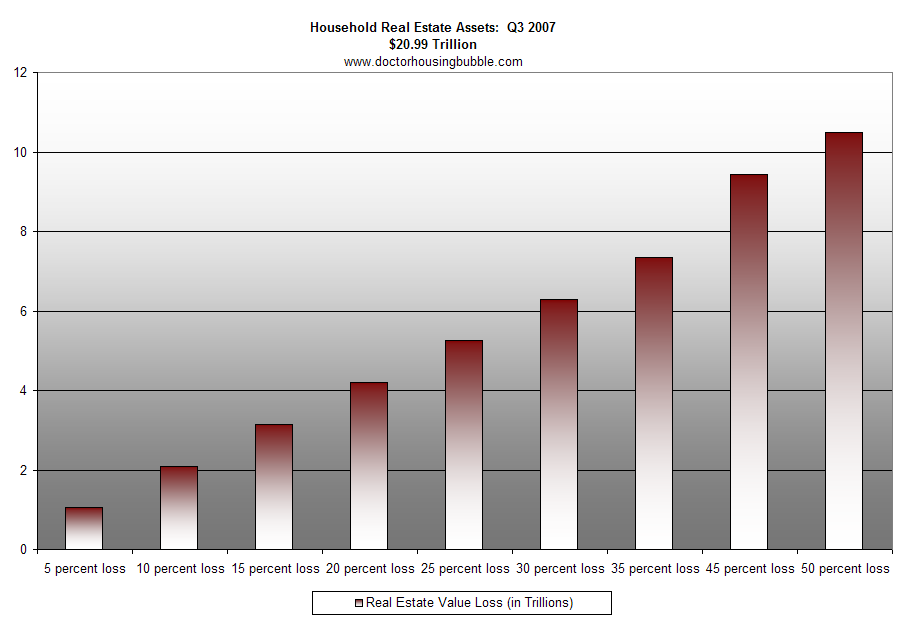
Wednesday, January 23, 2008

Bon Appetit

Bon Appetit

By Andrew Bary, Barron's | 23 January 2008

There was a whiff of panic on wall street as stocks fell sharply and continuously on concerns about the economy and the health of the financial system.

As of Friday's close, the Dow Jones Industrial Average was down 8.8% for the year, putting it on course for
the worst January since 1950. The sell off, punctuated by Thursday's 2.5% drop in the Dow, has shattered the optimism that prevailed on the Street at the start of the year. The upbeat assessment was apparent in Barron's December survey of Wall Street strategists, which found all 12 bullish on stocks for 2008.

The good news is that barring a deep recession or financial catastrophe, stocks could be approaching a huge buying opportunity. With the Standard & Poor's 500 index down 9.8% this year, to 1325, the index now trades for little more than 13 times projected 2008 operating earnings. That's one of the lowest price/earnings ratios in the past decade. At the market low in 2002, the S&P traded at 15 times forward earnings.

The obvious risk is that 2008 earnings disappoint and that profits actually could fall from 2007 levels if the economy sinks into recession. Collective earnings per share for the 500 companies in the S&P were $88 in 2006 and for last year were expected to hit around $93 before banks and securities firms began taking huge mortgage and credit-related charges in the fourth quarter. The final 2007 number could be in the range of $87. Even if S&P earnings for 2008 fall to $85, from the current projection of $100, the index is trading for a moderate P/E of 15.

"A full-fledged recession is now priced into the bond market and is increasingly priced into stocks," says Jim Paulsen, chief investment strategist at Wells Capital Management in Minneapolis. Bulls point to the so-called Fed model, which compares the earnings yield on the S&P 500 and the yield on the 10-year Treasury note. That indicator is now screaming "buy" for stocks, with the forward earnings yield on S&P now topping 7%, double the 3.6% rate on the 10-year Treasury.

Wall Street could get some help from Washington. Congress and President Bush are rushing to produce an economic stimulus package that could total $150 billion, including tax rebates that may put cash into consumer pockets this spring. That could help beleaguered retailers like Macy's (ticker: M), J.C. Penney (JCP) and Sears Holdings (SHLD), some of which have seen their stock prices halved from the peaks reached last year.

[The Fed funds rate was reduced by 75 basis points] leaving the key rate well below the 5.25% that prevailed before the Fed began easing this past August. Stock-market history, however, isn't encouraging about the near-term outlook. A bad January generally doesn't bode well for the rest of the year. As of Friday, the Dow industrials were down 8.8% in 2008 to 12,099. Many down Januarys have heralded bad years for stocks, but not always. Bulls can take heart the Dow ended 2003 with a 26% gain despite a 2.7% drop in January. See table: Once Mighty, Now Fallen

How much more could the major averages fall? The small-stock Russell 2000 index, now down 12% for the year, already has fallen from its July 2007 peak into bear-market territory, defined as a drop of 20% or more. The S&P 500 now is down 15% from its October high. The average peak-to-trough move in recession-related slides since 1950 has been 25.6%, according to Citigroup strategist Tobias Levkovich. This suggests a further potential drop of about 10%, but that assumes a recession, which is still widely considered to be no more than a 50% probability.

A bullish Levkovich carries a 1675 target for the S&P 500 for year-end 2008, which would mean a 27% gain from Friday's closing level. If the upside for the S&P 500 is 25%-plus and the downside is 10%, the stock market's risk/reward looks pretty favorable. Among the few prescient Street seers is veteran Byron Wien, the chief investment strategist at Pequot Capital. At the start of 2008, Wien predicted that the S&P 500 would drop 10% this year, that earnings would decline and that the country's first recession since 2001 would prompt the Fed to cut short-term rates to below 3%. "We're beginning to see some bottoming signs," he said Friday. "We've switched from complacency to concern but not to capitulation yet."

Shifting Fortunes: How some major markets did in local currencies in 2007, and how they've fared this year.

Value-oriented investors are getting excited because there are now plenty of inexpensive stocks, measured either by earnings or book value. There were more than 50 stocks last week within the S&P 500 trading below 10 times forward earnings, including insurers Chubb (CB) and Allstate (ALL), oil refiners Tesoro (TSO) and Sunoco (SUN), retailers J.C. Penney and Macy's, and many major securities firms, including Lehman Brothers (LEH) and Morgan Stanley (MS).

About 40 companies in the S&P 500 now trade below book value, which often can provide a floor underneath stock prices. Nearly all the major home builders, for instance, are trading below book. Lennar (LEN) and Pulte Homes (PHM) now fetch about 50% of book value, while Toll Brothers (TOL), the high-end specialist, trades for 80% of book.

A housing recovery could be a year or more away, but the home builders seem to be discounting a dire financial outlook given their current share prices. The combined market value of eight big home builders, Lennar, D.R. Horton (DHI), Toll, Centex (CTX), NVR (NVR), Pulte, KB Home (KBH) and MDC Holdings (MDC) stands at less than $20 billion, down from $80 billion at the peak in 2005.

Regional-bank shares have been pummeled in the past year, falling an average of 35%. The result is that dividend yields on many bank stocks are 5% or higher. Big regionals like Wachovia Bank (WB), at 30.80, yields 8.3%; Wells Fargo (WFC), at 25.48, yields 4.7%; and giant Bank of America (BAC), at 35.97, yields 7%.

The investment community is worried that rising credit losses will depress banks' 2008 profits and potentially prompt dividend cuts, as happened at Washington Mutual (WM) and Citigroup (C). If the credit situation proves manageable, though, regional banks could have a lot of upside potential in 2008.

WaMu, whose shares have fallen 69% in the past year owing to major mortgage woes, rose a point Friday to 13.55 amid takeover talk. The rumored potential buyer is JPMorgan Chase (JPM), whose CEO, Jamie Dimon, once again stirred the deal pot when he said last week that he was "open-minded" about acquisitions.

JPMorgan, which has been relatively unscathed by credit problems, is one of few potential buyers of any size in the battered financial sector. That gives Dimon plenty of leverage if he decides to pursue a deal. Potential targets include WaMu, SunTrust Banks (STI) and even Bear Stearns (BSC).

Expect Dimon to tread cautiously in the deal arena, knowing that bad deals, like Wachovia's purchase of Golden West Financial in 2006, can prove damaging. Dimon also knows that merger integrations can be difficult and distracting for buyers. That means any deal likely will have to be compelling strategically and financially for JPMorgan to pursue it.

Takeover arbitragers, meanwhile, are hurting because share prices of the remaining targets of sizable leveraged buyouts have come down lately as the Street wonders whether private-equity firms will back out of deals, as Cerberus did recently with United Rentals (URI). There are four big LBOs that have yet to close: Alliance Data Systems (ADS), Clear Channel Communications (CCU), BCE (BCE) and Harrah's Entertainment (HET).

Alliance Data was a big casualty last week, falling 9% to 62, leaving it way below the deal price of 81.75.
Unhappy Precedents: Measured by the
S&P 500's movements during the past
nine recessions, the stock market
has fallen on average of 25.60%
from its peak prior to each downturn
to its trough during the recession.
The stock got as low as 47.50 before a company spokesman said Thursday that it isn't discussing a renegotiation of the buyout price and that financing is in place.


The Street fear is that Blackstone Group (BX), the private-equity buyer of Alliance Data, may want to walk away from the deal because it's paying a rich price, and its investment in the $6.5 billion transaction likely will be underwater from day one. If the deal breaks, Alliance Data could trade at 40, meaning Blackstone arguably is paying double the market's assessment of the company's value.

The $27 billion Harrah's deal is set to close this month, but shares of the big casino operator ended Friday at 87.68, more than $2 below the deal price. Casino shares have been crunched lately on economic concerns, meaning that the buyout group, including Apollo Management, seems to be overpaying, based on the valuation of comparable gaming companies. Takeover arbs are betting the Harrah's deal gets done, but if it comes undone, the stock could trade below 70. Clear Channel, the big radio operator, finished Friday at 33.55, almost $6 below its takeover price of 39.20.

So far this year, investors have been ruthless in punishing many of the highfliers from 2007. Infrastructure plays, casinos, fertilizer companies and energy-service providers all have been crunched lately (see the table of a dozen of 2007's winners and how they've fared in 2008). Schlumberger (SLB), the leading oil-service company, got whacked Friday, falling $3 to 79.52, after reporting mildly disappointing fourth-quarter profits and dampening expectations for 2008. Schlumberger now is down 29% from its fall peak of 112.


Click Here, or on the image, to see a larger, undistorted image.

Trouble Across the Board: The Dow Industrials are off 8.8% so far this year, the S&P 500 is down 9.8% and the Nasdaq Composite has lost 11.8%.

One of the few big stocks to rise in Thursday's rout was Berkshire Hathaway (BRK-A), whose Class A shares finished Friday at $131,200, down 0.7% on the week. Berkshire is benefiting from its safe-haven status, its cash-rich balance sheet with $40 billion in cash, and expectations that CEO Warren Buffett will find opportunity in the current financial distress.

So far, a patient Buffett is willing to wait for what he calls a "fat pitch," or an unusually attractive investment opportunity. Buffett likes financial travail because bargains can arise, and Berkshire is one of the few companies with the capacity to capitalize on them. Daring individual investors with cash on hand can put on their Warren hats because the recent market rout may have created one of the best buying opportunities in years.

ß§

Normxxx    
______________

The contents of any third-party letters/reports above do not necessarily reflect the opinions or viewpoint of normxxx. They are provided for informational/educational purposes only.
The content of any message or post by normxxx anywhere on this site is not to be construed as constituting market or investment advice. Such is intended for educational purposes only. Individuals should always consult with their own advisors for specific investment advice.

2008 vs 1992

2008 vs 1992

By TheBigPicture | 16 January 2008

Today's chart porn (below) comes from the NYT: "A Revival of 1992’s Glum Mood."

The current situation was summed up by David Leonhardt:

"Economists argue about the reasons for the great wage slowdown— technology, globalization, health care costs, the decline of unions, the rise of the new wealthy— but it clearly seems to have made people feel more vulnerable to small economic swings. In the latest New York Times/CBS News poll, only 19 percent of those responding said the country was headed in the right direction. That was the lowest percentage since the early 1990s.

"This glumness is especially striking because perceptions of the economy usually lag behind reality, and the reality hasn’t deteriorated much yet for most families. But as in 1992, said Alan Blinder, a former vice chairman of the Federal Reserve, “people are more sour about the economy than the data would seem to warrant."

Leonhardt comes very close to resolving the conundrum, but alas, he gets it wrong in the end. At the very least, he fails to consider an alternative explanation: The measured economic readings— inflation, growth, unemployment, job creation, real income— are far less accurate than many people (quants and politicians who don't have to worry about their next paycheck) perceive them to be . . .


Source:
Economic Scene: A Revival of 1992’s Glum Mood
David Leonhardt, NYT January 16, 2008
http://www.nytimes.com/2008/01/16/business/16leonhardt.html


Study Suggests Lengthy U.S. Home Price Decline

By Ros Krasny | 14 January 2008

CHICAGO, Jan 3 (Reuters)— U.S. home prices could fall "considerably" over a number of years as a benchmark ratio of rents to prices slowly returns to its long-run average, according to a new study. "If the rent-price ratio were to rise from its level at the end of 2006 up to about its historical average value of 5 percent by mid-2012, house prices might fall by 3 percent per year," two Federal Reserve Board economists and a University of Wisconsin professor said. In a paper accepted for publication by the Review of Income and Wealth, the authors termed the estimate "more of a back-of-the-envelope calculation than an actual forecast."

Andreas Lehnert and Robert Martin of the Fed and Wisconsin's Morris Davis developed a series that shows the ratio of rents to the value of owner-occupied housing stretching back to 1960. The ratio, which compares imputed rents of homeowners to the value of owner-occupied housing, is a valuation of residential housing that is equivalent to the earnings-price ratio used to value stocks and is considered an important component of housing valuations. The rent-price ratio ranged between 5 percent and 5.5 percent between 1960 and 1995 but fell rapidly after that, hitting a historic low of 3.5 percent by the end of 2006. In the first half of 2007 the ratio started to climb again, and incoming data suggest that the rent-price ratio has continued to increase, the authors said.

ß§

Normxxx    
______________

The contents of any third-party letters/reports above do not necessarily reflect the opinions or viewpoint of normxxx. They are provided for informational/educational purposes only.
The content of any message or post by normxxx anywhere on this site is not to be construed as constituting market or investment advice. Such is intended for educational purposes only. Individuals should always consult with their own advisors for specific investment advice.

Tuesday, January 22, 2008

Couple Of Days, Couple Of Months?

Couple Of Days, Couple Of Months?

By normxxx | 23 January 2008

One of the hallmarks of the decline that began the year is that despite severe price losses, sentiment was pretty blah. By the start of the third week in January, though, the pressure was becoming intense and we were finally starting to see some sentiment extremes crop up.

One of them was in the BKX Index of banking shares, which had dropped nearly 25% below its 200-day moving average. There were only a few previous instances of it suffering such an inglorious fate, and each of them preceded major intermediate-term rallies.

However, at each of those lows the BKX Index enjoyed a one-day 5% jump that kick-started the rally, and prices rose steadily thereafter, gaining an average of +17% over the next several months. I thought I might want to wait for such an overwhelming display of buying interest in the sector before assuming the worst was over. We got that today, with the index gaining well over 5% from yesterday's close.

If the much-despised banks can get it together here, at least for the short-term, then there's little doubt that the broader market will too. It has been the financials leading us down, and they will be the ones everyone will look to to lead us out of this pit. I've gone over a few extremes indicators that have been triggered and are intriguing enough to promote the possibility that perhaps we've seen the bulk of the selling pressure for the time being: yesterday registered a rare instances of more than 30% of all issues on the NYSE hitting a new 52-week low on the same day; the ratio between stocks and bonds reached an historic extreme; and there are any number of sentiment indicators we can point to showing excessive pessimism. Now we've seen huge consecutive-day reversals in the major indices, a rare and previously bullish event.

For many of these developments, there are few precedents, but the ones I do have were generally constructive in the near-term. It has been rare not to see at least another one to three days of upside follow-trough after events like those noted above, and when we consider that they're all hitting at the same time, then the argument is compelling for more strength. I'm still not convinced that we've seen the absolute low for the intermediate-term, but this looks to at least be a start in the right direction.

ß§

Normxxx    
______________

The contents of any third-party letters/reports above do not necessarily reflect the opinions or viewpoint of normxxx. They are provided for informational/educational purposes only.
The content of any message or post by normxxx anywhere on this site is not to be construed as constituting market or investment advice. Such is intended for educational purposes only. Individuals should always consult with their own advisors for specific investment advice.

The Crash Of 2008 Has Arrived

Up And Down Wall Street Daily
The Credit-Induced Crash Of 2008 Has Arrived


By Randall W. Forsyth | 22 January 2008

WELCOME TO THE CRASH OF 2008.

After the biggest falls in global markets since the aftermath of Sept. 11, 2001, the U.S. equity markets appear headed for a rerun of October 1987, or at least October 1998.

And, as in those episodes, the markets are anticipating the Federal Reserve will take similar, decisive action to counter the free-fall in equity asset values. Indeed, a coordinated interest-rate cut by the Fed, the European Central Bank, the Bank of England, and other major central banks including even the Bank of Japan should not be dismissed as a counter to the crash in equity values around the world.

Make no mistake, interest-rate cuts would not cure the bursting of the credit bubble in all corners of the globe. Think of them as parachutes; they won't prevent the fall, but they may help slow the declines and dampen the worst of the impacts.

Indeed, credit injections by central banks would merely bandage over the asset losses suffered by lenders and investors. Without such action, credit losses can result in a downward spiral as plunging asset prices beget further tightening of credit conditions as market participants rein in risks.

Many bourses have already entered bear market territory with losses of 20% or more from their highs of last October or November.

As of Monday evening in the U.S. (Tuesday morning in Asia), stocks in Asia are down another 5%-7% after Monday's plunges in the region of 4%-5.5% and upwards of 7% in Europe and 5%-6% in Latin America. The closure of U.S. markets for the Martin Luther King holiday may have exaggerated the overseas losses, but clearly can't be blamed for the entire extent of the decline. Futures on the S&P 500 fell 4.5% in electronic trading while the cash markets were closed.

Neither can the U.S. fiscal stimulus plan proposed by President Bush be fingered for the declines. The putative $140 billion "stimulus" package pales next to the $2.4 trillion decline in the value of DJ Wilshire 5000 index, the broadest measure of the U.S. stock market, since its peak in October, a 15% decline as of the end of last week, prior to the Monday meltdown abroad. To expect such a scheme to counter the credit crunch is unrealistic, at best.

As in 1987 and 1998, equity markets are plunging because of the squeeze on credit. In 1987, credit was being squeezed as a result of the dollar's decline and the pressure on the Federal Reserve to raise interest rates to defend the U.S. currency under the exchange-rate regime prevailing at the time. The 1998 Asian crisis followed the unraveling of exchange-rate pegs, which had encouraged reckless borrowing in the region.

Ironically, exchange rates are not a factor in the current collapse. While the yen is rising sharply, this is an effect rather than cause of the equity plunge; the unwinding of carry trades— involving the borrowing of yen to fund other investments— results in the purchase of yen to repay those loans.

In the current market plunge, the credit contraction is emanating from the U.S. but the losses are reverberating around the globe. Tuesday, trading in the Bank of China (a commercial bank, not the central bank, which is the People's Bank of China) was suspended on reports it would be the latest to take writedowns totaling $8 billion on its U.S. subprime mortgage holdings. Year-to-date, Bank of China is off 18%, which isn't an aberration for the sector.

The latest manifestation is apparent in the meltdown in monoline credit insurers, culminating in the downgrade of Ambac by Fitch Investors, stripping it of its former triple-A rating. This is but the latest wobble in the credit house of cards. Credit inflated asset values, from U.S. residential real estate to stock prices being pumped up by leveraged private-equity buyout artists or hedge fund players. Now the process is being played in reverse. And it is far from over.

ß§

Normxxx    
______________

The contents of any third-party letters/reports above do not necessarily reflect the opinions or viewpoint of normxxx. They are provided for informational/educational purposes only.
The content of any message or post by normxxx anywhere on this site is not to be construed as constituting market or investment advice. Such is intended for educational purposes only. Individuals should always consult with their own advisors for specific investment advice.

The Worst Market Crisis

The Worst Market Crisis In 60 Years

By George Soros | 22 January 2008

The current financial crisis was precipitated by a bubble in the US housing market. In some ways it resembles other crises that have occurred since the end of the second world war at intervals ranging from four to 10 years.

However, there is a profound difference: the current crisis marks the end of an era of credit expansion based on the dollar as the international reserve currency. The periodic crises were part of a larger boom-bust process. The current crisis is the culmination of a super-boom that has lasted for more than 60 years.

Boom-bust processes usually revolve around credit and always involve a bias or misconception. This is usually a failure to recognise a reflexive, circular connection between the willingness to lend and the value of the collateral. Ease of credit generates demand that pushes up the value of property, which in turn increases the amount of credit available.
A bubble starts when people buy something in the expectation that they can refinance at a profit. The recent US housing boom is a case in point. The 60-year super-boom is a more complicated case.

Every time the credit expansion ran into trouble the financial authorities intervened, injecting liquidity and finding other ways to stimulate the economy. That created a system of asymmetric incentives also known as moral hazard, [[another way to say that, since they had been bailed out, and had not lost any "real" money, the players assumed that they could take on even more risk on the next go-round: normxxx]] which encouraged ever greater credit expansion. The system was so successful that people came to believe in what former US president Ronald Reagan called the magic of the marketplace and I call market fundamentalism. Fundamentalists believe that markets tend towards equilibrium and the common interest is best served by allowing participants to pursue their self-interest. It is an obvious misconception, because it was the intervention of the authorities that prevented financial markets from breaking down, not the markets themselves. Nevertheless, market fundamentalism emerged as the dominant ideology in the 1980s, when financial markets started to become globalised and the US started to run a current account deficit.

Globalisation allowed the US to suck up the savings of the rest of the world and consume more than it produced. The US current account deficit reached 6.2 per cent of gross national product in 2006. The financial markets encouraged consumers to borrow by introducing ever more sophisticated instruments and more generous terms. The authorities aided and abetted the process by intervening whenever the global financial system was at risk. Since 1980, regulations have been progressively relaxed until they have practically disappeared.

The super-boom got out of hand when the new products became so complicated that the authorities could no longer calculate the risks and started relying on the risk management methods of the banks themselves. Similarly, the rating agencies relied on the information provided by the originators of synthetic products. It was a shocking abdication of responsibility.

Everything that could go wrong did. What started with subprime mortgages spread to all collateralised debt obligations, endangered municipal and mortgage insurance and reinsurance companies and threatened to unravel the multi-trillion-dollar credit default swap market. Investment banks’ commitments to leveraged buyouts became liabilities. Market-neutral hedge funds turned out not to be market-neutral and had to be unwound. The asset-backed commercial paper market came to a standstill and the special investment vehicles set up by banks to get mortgages off their balance sheets could no longer get outside financing. The final blow came when interbank lending, which is at the heart of the financial system, was disrupted because banks had to husband their resources and could not trust their counterparties. The central banks had to inject an unprecedented amount of money and extend credit on an unprecedented range of securities to a broader range of institutions than ever before. That made the crisis more severe than any since the second world war.

Credit expansion must now be followed by a period of contraction, because some of the new credit instruments and practices are unsound and unsustainable. The ability of the financial authorities to stimulate the economy is constrained by the unwillingness of the rest of the world to accumulate additional dollar reserves. Until recently, investors were hoping that the US Federal Reserve would do whatever it takes to avoid a recession, because that is what it did on previous occasions. Now they will have to realise that the Fed may no longer be in a position to do so. With oil, food and other commodities firm, and the renminbi appreciating somewhat faster, the Fed also has to worry about inflation. If federal funds were lowered beyond a certain point, the dollar would come under renewed pressure and long-term bonds would actually go up in yield. Where that point is, is impossible to determine. When it is reached, the ability of the Fed to stimulate the economy comes to an end.

Although a recession in the developed world is now more or less inevitable, China, India and some of the oil-producing countries are in a very strong countertrend. So, the current financial crisis is less likely to cause a global recession than a radical realignment of the global economy, with a relative decline of the US and the rise of China and other countries in the developing world.

The danger is that the resulting political tensions, including US protectionism, may disrupt the global economy and plunge the world into recession or worse.

ß§

Normxxx    
______________

The contents of any third-party letters/reports above do not necessarily reflect the opinions or viewpoint of normxxx. They are provided for informational/educational purposes only.
The content of any message or post by normxxx anywhere on this site is not to be construed as constituting market or investment advice. Such is intended for educational purposes only. Individuals should always consult with their own advisors for specific investment advice.

A (few) Big Caveats

Comparison To August Is Fair, With A Big Caveat

By | 22 January 2008

The indices have held up very well today, mostly closing the gaping holes left from the close of trading last week. It has been a very impressive bounce, going further than I thought it would, but still about in line with the other times the Fed has surprised the markets with an unscheduled rate cut. The reversal today has brought up some comparisons to the low last August, and there may be some validity to that.

Similarly to then was that while the probability of being at an intermediate-term low seemed high, all the prior precedents we looked at came back down to test (but not exceed) the low of the reversal day. We didn't really see that last August, though. The S&P 500 did suffer a two-day 45 point decline about a week after the low, but it would be something of a stretch to call that a "test". The precedents that were more geared towards crash-type situations, typically did see lower lows in the days and weeks ahead.

There are several positive comparisons to last August's low and reversal, but the big (big!) difference is that we're not in an uptrend and holding above support, like so many times in the past few years, including August. For me, that tips the scales more towards other, similar 'crash-type' scenerios studied, and those were pretty clear in that the initial crash day more often than not led to further selling pressure and new lows, after one or two more days of rallying.

The big test for any nascent recovery is how much buying pressure is seen right after the low. Big up days, with heavily skewed volume into advancing stocks, is a good tipoff that buyers have found enough value and confidence to be aggressive, and that usually continues for several weeks at least. If the market hits short-term overbought readings, and keeps right on rallying (as it did in August), that's another good sign seen at almost every intermediate-term low.

I'll be on the lookout for those types of developments in the days ahead in order to judge whether it's more likely we've seen such a low or just a severely oversold temporary snapback. Unlike the past few years, I'm not ready to bet on the idea of a lasting bottom based solely on the readings we've seen lately. If we continue to rally in the short-term, the next good setup should be on the short side, and I'd be looking for any move towards 1350-1375 as a place where sellers should come out in force.

•  •  •  •  •  •  •  •  •  •  •  •  •  •  •  •  •  •  •  •  •  

Bond Insurers— All Fall Down?
Huge New Problems In The Capital Markets?


From Economist.Com | 22 January 2008

NEW YORK— America’s big bond insurers, which have underwritten some $2.4 trillion of private and public-sector bonds, usually go about their business largely unnoticed. But now they are looking distinctly wobbly they have started to attract attention. If one or more of them were to topple over, there will be a huge knock-on effect on banks and other financial institutions that rely on their guarantees. This in turn will further worsen the credit crunch and cause an even bigger headache for policymakers already grappling with a sharp slowdown in the American economy.

The threat of such a financial domino effect looms large. Moody’s, a credit-rating agency, has signalled that it might downgrade the AAA-ratings of two of the biggest bond insurers, MBIA and Ambac, in the near future. On Friday January 18th, Ambac said that it had dropped a plan to raise $1 billion of new equity capital to preserve its rating— making futher downgrades even likelier. In response, Fitch, another rating firm, cut Ambac's rating.

MBIA, which recently managed to raise $1 billion of new capital on top of another billion that it received from Warburg Pincus, a private-equity firm, will almost certainly need even more money if it is to preserve its AAA-rating. ACA Financial Guaranty Corporation, another insurer, is in even direr straits. In December its single-A credit rating was cut to junk status. The firm begged its trading partners to give it more time to sort out its problems. But by Friday it had still not come up with a rescue plan. The state insurance regulator of Maryland, where ACA is incorporated, has already assumed responsibility for some of its operations.

Bond insurers in effect "lend" their top-notch ratings to lower-quality debt, raising its value in the eyes of investors. Any cut in those ratings may make it impossible for the bond insurers to take on new business and would reduce the value of the securities they have already underwritten. Such cuts are now a distinct possibility because the insurers have underwritten billions of dollars of mortgage-backed securities, including those notorious collateralised-debt obligations (CDOs) that have now gone sour.

On Wednesday Ambac announced a $3.5 billion writedown— as well as the ousting of its chief executive— $1.1 billion of which was related to CDOs. The insurers’ exposure to these and other exotic products is a huge multiple of their flimsy capital bases— and the chances of them having to cover claims has soared as the economy has slowed. Small wonder, then, that their share prices plummeted this week— proving that the market has already decided they no longer deserve such lofty ratings and creating a vicious downwards spiral. Ambac’s falling share price has severely dented it chances of raising fresh capital.

There are already signs that the insurers’ woes are contagious. On Thursday Merrill Lynch wrote down $3.1 billion on debt securities that it had hedged with ACA and other bond insurers. Other banks have also made writedowns to reflect their lack of confidence in ACA’s ability to meet its commitments. The full extent of the "counterparty risk" banks face in dealing with bond insurers is only now becoming apparent. Jamie Dimon, the boss of JP Morgan Chase, has said that the fallout from the bond-insurer crisis could be "pretty terrible" for the debt markets. If a big insurer such as Ambac or MBIA were to take a tumble, that could look like an understatement.

•  •  •  •  •  •  •  •  •  •  •  •  •  •  •  •  •  •  •  •  •  

Stock Markets Plunge Worldwide
ANOTHER Big Vote Of Confidence For the American Way!


By Toby Anderson, AP | 21 January 2008

LONDON—
Stocks fell sharply worldwide Monday following declines on Wall Street last week amid investor pessimism over the U.S. government's stimulus plan to prevent a recession.

U.S. markets were closed for Martin Luther King Jr. Day, but the downbeat mood from last week's market declines there circled through Europe, Asia and the Americas. Britain's benchmark FTSE-100 slumped 5.5 percent to 5,578.20, France's CAC-40 Index tumbled 6.8 percent to 4,744.15, and Germany's blue-chip DAX 30 plunged 7.2 percent to 6,790.19.

In Asia, India's benchmark stock index tumbled 7.4 percent, while Hong Kong's blue-chip Hang Seng index plummeted 5.5 percent to 23,818.86, its biggest percentage drop since the Sept. 11, 2001, terror attacks. Canadian stocks fell as well, with the S&P/TSX composite index on the Toronto Stock Exchange down 4 percent in early afternoon trading. In Brazil, stocks plunged 6.9 percent on the main index of Sao Paulo's Bovespa exchange.

Investors dumped shares because they were skeptical that an economic stimulus plan President Bush announced Friday would shore up the economy that has been battered by problems in its housing and credit markets. The plan, which requires approval by Congress, calls for about $145 billion worth of tax relief to encourage consumer spending.

"We've taken our lead from the Asian markets who have not been impressed by the U.S. There's debate if there's going to be a recession in the U.S. I don't think there's much chance of that though," said Richard Hunter an analyst at Hargreaves Lansdown Stockbrokers Ltd. in London. Concerns about the outlook for the U.S. economy, the major export market for Asian companies, has sent the region's markets sliding in 2008. Just last Wednesday, the Hang Seng index sank 5.4 percent. "It's another horrible day," said Francis Lun, a general manager at Fulbright Securities in Hong Kong. "Today it's because of disappointment that the U.S. stimulus (package) is too little, too late and investors feel it won't help the economy recover."

Japan's benchmark Nikkei 225 index slid 3.9 percent to close at 13,325.94 points, its lowest close in more than two years. China's Shanghai Composite index plunged 5.1 percent, partly on worries about mainland Chinese banks' exposure to risky U.S. mortgage investments. "People are certainly nervous about a potential recession in the U.S. spilling over to the rest of the world," said David Cohen, Director of Asian Economic Forecasting at Action Economics in Singapore.

"Maybe there's still some wariness about if politicians are able to come up with a compromise and act sufficiently quickly" on a stimulus package, Cohen said. "I think the impact would be marginal anyway." Investors took cues from the negative reaction to the president's plan on Wall Street on Friday, when the Dow Jones industrial average slid 0.5 percent to 12,099.30, bringing its loss for the year so far to nearly 9 percent.

Traders also have shrugged off assurances from Federal Reserve Chairman Ben Bernanke that the U.S. central bank is ready to act aggressively— which means a likely big interest rate cut later this month— to help the sagging economy. Some analysts predict that Asia won't suffer dramatically from a U.S. recession because increased trade and investment within Asia has made the region less reliant on the United States than in the past. Excluding Japan, 43 percent of Asia's exports go to other nations in the region [[but mostly for products whose end sale is in the U.S.: normxxx]], Lehman Brothers calculates, up from 37 percent in 1995.

But on Monday, uncertainty and pessimism reigned.

In Tokyo trading, exporters got hit hard, partly because of the yen's recent strength against the dollar. Toyota Motor Corp. lost 3.3 percent and Honda Motor Co. sank 3.4 percent. Shares of Bank of China dropped 6.4 percent in Hong Kong after the South China Morning Post newspaper reported that the bank is expected to announce a "significant write-down" in U.S. subprime mortgage securities, citing unidentified sources. In Shanghai, the bank's stock declined 4.1 percent.

India's benchmark Sensex index fell 1,353 points, or 7.4 percent— its second-biggest percentage drop ever— to 17,605.35 points. At one point, it was down nearly 11 percent. The decline hit companies across the board, with power utility Reliance Energy Ltd. falling 16.4 percent. Major software company Tata Consultancy Services Ltd. slid 7.6 percent.

"A gloomy U.S. climate has affected the global markets. Even if those markets recover, it will take sometime for the recovery to reach India because today's fall has been so drastic," said Jayant Pai, of the Mumbai investment company IL&FS Ltd. Still, Pai and others suggested that the declines could lead to a buying opportunity. "The sell-off today takes us close to the bottom," she said.

Since the start of the year, Japan's Nikkei index has declined 13 percent, while Hong Kong's blue-chip index is down more than 14 percent. Even China's Shanghai index— which nearly doubled last year— has fallen 6.6 percent over the same period and nearly 20 percent from its all-time closing high on Oct. 16.

•  •  •  •  •  •  •  •  •  •  •  •  •  •  •  •  •  •  •  •  •  

Cue Bernanke

By Brady Willett | 21 January 2008

With the potentially multi-trillion dollar meltdown in the U.S. housing market well underway and a bear market in equities taking root, President Bush mentioned a $150 billion stimulus package last week. Given the U.S. consumer’s rapidly deteriorating financial position and the non-prospect of wage gains being able to fill the void that falling asset prices threaten to create, it is unlikely that $150 billion is a large enough counter-ripple to seriously combat an economic tsunami.

Needless to say, it is impossible to forget that Mr. Bush passed multiple stimulus packages starting in 2001 based upon the pledge that government deficits now would be forgotten about when growth picked up later. Sorry Mr. Bush: with a U.S. government surplus nowhere to be seen and even more government assistance likely on the way, your perversion of Art Laffer’s curve is quickly coming into view.

The stark reality, for those that care to think about it, is that the U.S. government cannot perpetually help avert painful recessions and economic crises because eventually the government’s financial position will itself become the crisis. And yes, not many U.S. politicians today, save Ron Paul, seem to ‘care’…. To the dismay of deficit hawks, Bush spoke of no plans to pay for the giveaway— and insisted during his address the package should "not include any tax increases".

While another round of fiscal stimulus may or may not be able to slow the housing depression and equities plunge, an even less certain outlook can be gleaned when looking at U.S. monetary policy. Having already tinkered with interest rates, expanded what it deems acceptable discount window collateral, and launched a more secretive 'auction lending' process [[a was to shield the bigger banks from the 'shame' of their 'toxic' investments, which BB is all but promising to make good at near face value (well above their market rates): normxxx]], Bernanke and company will likely continue to toil with novel lending platforms while reducing interest rates. But what the Fed may not be able to do is spark the positive and lasting reaction it so desperately needs from the marketplace. Quite frankly, as U.S. consumers and investors threaten to seriously retrench in tandem for the first time in almost 30-years, the danger is that Fed rate cuts have lost the all important element that is psychological gas.

[ Normxxx Here:  Moreover, the U.S. Fed is now just a tail trying vainly to 'wag the dog' which is composed of the whole international financial system plus all those international investors who so naively and trustingly turned over their hard earned cash for that 'toxic' waste  ]

In short, after Bush’s announcement last week global stock markets plunged to begin this week. Unless there is a material improvement in stocks soon, Bernanke is about to take the stage… [[and, lo, we got our 75 basis point, emergency rate cut— for whatever good it will do.: normxxx]]

•  •  •  •  •  •  •  •  •  •  •  •  •  •  •  •  •  •  •  •  •  

Fullblown Panic

By Jim Kunstler | 21 January 2008

Knees knocked last week from sea to shining sea as the shape-shifting monster of economic reality cut a swathe of destruction through the markets and financial ranks. The exact nature of this giant beast still remained largely concealed in a fog of accounting gambits, policy blusters, and reporting dodges, but a few intrepid scouts who glimpsed the behemoth up close said it looked like Godzilla with Herbert Hoover's face. George W. Bush, tried to appease the beast by offering each American adult the dollar equivalent of half a month's mortgage payment— with the exhortation to drive forthwith to the nearest WalMart and blow it on salad shooters and plasma TV's— but Hooverzilla just laughed at the offering and pounded the equity markets further into the dust of loss, while the "bank-like" guardians of wealth lay in the drainage ditches bleeding from their ears and eyes.

I resort to such admitted extreme hyperbole because it may be the only language that an infotainment-drunk society can still process in the face of an epochal calamity that will transform the lush terms of everyday life as we've known it into something like a bleak surrealist landscape in the manner of Tanguy. That crashing sound out there is the armature of confidence needed to support an economy based on faith that borrowed money will be paid back. It's as simple as that. (Doesn't seem so exciting now, does it?)

The United States is so broke, its people at every level from the Federal Reserve on down don't know whether to shit or go blind. The homeowners cringing in the media rooms of their 5000-square-foot personal family resorts don't know how long they can stay put microwaving pepperoni hot pockets with the default clock ticking. The mortgage "servicers" don't know how they will persuade interested parties like, say, the Illinois State Cafeteria Workers' Pension Fund (holder of X-amount of mortgage-backed securities underwritten by, say, Merrill Lynch or Deutsche Bank) to foreclose on properties scattered everywhere from Key West to Bainbridge Island— or if there is actually any legal mechanism known to man that would make it possible to "work out" the sliced-and-diced collateral. The millions of maxed-out credit card holders and the issuers of their plastic are stuck together paddling a leaky tub in a sea of troubles every bit as wide, deep, and polluted as the one the mortgage junkies and their enablers are sinking in. The developers of malls, office parks, and power centers are weeping into their filing cabinets as the harsh daylight of insolvency stops the orgy of "consumption" and the retail tenants pack up their unsellable goodies for the liquidators, and the rent checks stop arriving in the mail, and the notes on this mall and that mall enter the eerie realm of "non-performance." And, of course, there are the genius wonder boyz and Wall Street playerz whose algorithms and turpitudes underwrote the script of this horror show— for all I know they'll end up laughing into sugary skull drinks on a beach in the Cayman Islands, or doing Chinese fire drills in federal prison (or simply hacked to pieces on the granite countertops of their Tribecca aeries by mobs of angry, repossessed, swindled former American dreamers pouring into Manhattan from the tract house dormitories of New Jersey and Long Island).

There's a lot to be concerned about out there. I don't mean to be too cute about it. But, as the master once said, nothing beats gallows' humor.

A whole closet full of "other shoes" is now waiting to be dropped. Surely the biggest clodhoppers in the closet belong to the hedge funds, representing trillions and trillions of dollar-denominated "positions" which, however hallucinatory, had previously yielded enough real "money" year-by-year to keep all the realtors and Humvee dealers in the Hamptons goose-stepping to Goldman Sachs's drumbeat. These "positions" can't help now from moving into counterparty crisis territory, especially as the bond insurers such as MBIA and Ambac go up in a vapor, and if that happens the damage could be so colossal globally that Stephen Hawking might have to be brought in to run the "black hole," which would be all that remained of the Federal Reserve.

This is going to be a rough week. Fastening your seat belts may not be enough for this ride. Better superglue yourselves to the floorboards and pray for God's mercy.

ß§

Normxxx    
______________

The contents of any third-party letters/reports above do not necessarily reflect the opinions or viewpoint of normxxx. They are provided for informational/educational purposes only.
The content of any message or post by normxxx anywhere on this site is not to be construed as constituting market or investment advice. Such is intended for educational purposes only. Individuals should always consult with their own advisors for specific investment advice.

Monday, January 21, 2008

Panic Shuts £2bn Fund

Panic Selling Shuts £2bn Fund

By Patrick Collinson, The Guardian | 18 January 2008


The fund, invested in London office blocks and shopping centres across Britain, apparently no longer has sufficient cash reserves to meet demands from investors. Photograph: Martin Argles

One of Britain's biggest property funds was forced to shut its doors to withdrawals yesterday after the slump in commercial prices triggered panic selling by small investors. The move prompted fears of a Northern Rock-style run on billions of pounds invested in once high-flying funds which many savers have seen as a safe haven for their pensions. Scottish Equitable (whose parent is Aegon UK) said yesterday that 129,000 small investors in its £2bn property fund will not be able to access their money for up to a year, although payments relating to regular income already being paid, retirements and death claims will not be affected.

It said the fund, invested in London office blocks and shopping centres across Britain, no longer had sufficient cash reserves to meet demands from investors wanting to withdraw their money. Its "buffer fund" was down to 1% of its total assets, instead of the usual 10-15%. Commercial property values, especially in the City of London office market, have dived amid fears of a recession brought on by the global credit crunch. The Financial Services Authority said it was closely monitoring the situation and had been informed by Aegon UK of the decision to halt withdrawals. The crisis in Britain's commercial property market is now worse than at any time since the early 1990s, when Olympia & York, the company that began the Canary Wharf office development in London, went into [bankruptcy].

In late December another insurer, Friends Provident, halted access to its £1.2bn property fund and last night speculation was growing that Scottish Widows may be on the verge of restricting customer withdrawals on some of its funds. The insurer said last night: "We are looking at all the options, but no decisions have been taken." Scottish Equitable's parent group, Aegon UK, is due to announce the closure of its fund today. It said last night: "Aegon UK has decided to take this step to protect investors following a significant level of customer withdrawals from the UK property fund market." It blamed "worldwide phenomena relating to concerns over the US sub-prime mortgage market fallout, rising interest rates and talk of recession".

The credit crunch has raised borrowing costs, making many property deals no longer attractive. Financial institutions hit by the fallout are already beginning to cut staff, reducing demand in the City office market in which most of the UK's property funds are invested. A downturn in consumer spending growth is also making retail shopping developments less attractive to investors. Small investors have put about £15bn into property unit trusts— £5bn pouring in during 2006 and early 2007 alone. Billions more are invested through pension funds held by millions of company employees. Investors bought into promises of rich returns after a decade in which returns far outstripped gains on shares or bonds.

But the downturn in values since the middle of 2007 has been savage. Shares in British Land, the UK's leading property company, have fallen by nearly half, and most funds are showing falls of between 20% and 40%. But investors stampeding for the exit are now finding that they cannot access their cash. The crux of the problem is that the funds are invested in buildings which can take months to sell, and therefore cannot produce the cash to pay out money to small investors if they all want it back at the same time.

Usually the funds hold a cash "buffer" of 10-15% of total assets to meet withdrawals. But Scottish Equitable said yesterday that the cash buffer in the £2bn fund had fallen to just £80m following a wave of redemptions, giving it little choice but to suspend the fund. The only alternative was a "fire sale" of its holdings which could leave investors even worse off. It emerged yesterday that staff at some of the property managers have been informing key clients in advance that a fund is heading for suspension. The FSA said that such trading may fall foul of its rules regarding treating customers fairly.

Financial advisers continue to recommend that investors take their cash out of the funds that remain open. Jason Hemmings of Albannach Financial Management in Edinburgh said: "There are lots of rumours going about that other providers may be considering following Friends Provident and Aegon." The Aegon/Scottish Equitable property funds are managed by Morley Fund Management, which also runs the £4bn Norwich Union Property unit trust, the UK's biggest property fund. This week Norwich Union said the fund had fallen in value by a fifth over the year, but its cash buffer was at 6.4% after selling office blocks in London and Manchester worth £165m. Aegon UK added that it believes the "underlying fundamentals of the asset class remain healthy".

ß§

Normxxx    
______________

The contents of any third-party letters/reports above do not necessarily reflect the opinions or viewpoint of normxxx. They are provided for informational/educational purposes only.
The content of any message or post by normxxx anywhere on this site is not to be construed as constituting market or investment advice. Such is intended for educational purposes only. Individuals should always consult with their own advisors for specific investment advice.

Stock Markets Plunge!

Stock Markets Plunge Worldwide
ANOTHER Big Vote Of Confidence For the American Way!


By Toby Anderson, AP | 21 January 2008

LONDON—
Stocks fell sharply worldwide Monday following declines on Wall Street last week amid investor pessimism over the U.S. government's stimulus plan to prevent a recession.

U.S. markets were closed for Martin Luther King Jr. Day, but the downbeat mood from last week's market declines there circled through Europe, Asia and the Americas. Britain's benchmark FTSE-100 slumped 5.5 percent to 5,578.20, France's CAC-40 Index tumbled 6.8 percent to 4,744.15, and Germany's blue-chip DAX 30 plunged 7.2 percent to 6,790.19.

In Asia, India's benchmark stock index tumbled 7.4 percent, while Hong Kong's blue-chip Hang Seng index plummeted 5.5 percent to 23,818.86, its biggest percentage drop since the Sept. 11, 2001, terror attacks. Canadian stocks fell as well, with the S&P/TSX composite index on the Toronto Stock Exchange down 4 percent in early afternoon trading. In Brazil, stocks plunged 6.9 percent on the main index of Sao Paulo's Bovespa exchange.

Investors dumped shares because they were skeptical that an economic stimulus plan President Bush announced Friday would shore up the economy that has been battered by problems in its housing and credit markets. The plan, which requires approval by Congress, calls for about $145 billion worth of tax relief to encourage consumer spending.

"We've taken our lead from the Asian markets who have not been impressed by the U.S. There's debate if there's going to be a recession in the U.S. I don't think there's much chance of that though," said Richard Hunter an analyst at Hargreaves Lansdown Stockbrokers Ltd. in London. Concerns about the outlook for the U.S. economy, the major export market for Asian companies, has sent the region's markets sliding in 2008. Just last Wednesday, the Hang Seng index sank 5.4 percent. "It's another horrible day," said Francis Lun, a general manager at Fulbright Securities in Hong Kong. "Today it's because of disappointment that the U.S. stimulus (package) is too little, too late and investors feel it won't help the economy recover."

Japan's benchmark Nikkei 225 index slid 3.9 percent to close at 13,325.94 points, its lowest close in more than two years. China's Shanghai Composite index plunged 5.1 percent, partly on worries about mainland Chinese banks' exposure to risky U.S. mortgage investments. "People are certainly nervous about a potential recession in the U.S. spilling over to the rest of the world," said David Cohen, Director of Asian Economic Forecasting at Action Economics in Singapore.

"Maybe there's still some wariness about if politicians are able to come up with a compromise and act sufficiently quickly" on a stimulus package, Cohen said. "I think the impact would be marginal anyway." Investors took cues from the negative reaction to the president's plan on Wall Street on Friday, when the Dow Jones industrial average slid 0.5 percent to 12,099.30, bringing its loss for the year so far to nearly 9 percent.

Traders also have shrugged off assurances from Federal Reserve Chairman Ben Bernanke that the U.S. central bank is ready to act aggressively— which means a likely big interest rate cut later this month— to help the sagging economy. Some analysts predict that Asia won't suffer dramatically from a U.S. recession because increased trade and investment within Asia has made the region less reliant on the United States than in the past. Excluding Japan, 43 percent of Asia's exports go to other nations in the region [[but mostly for products whose end sale is in the U.S.: normxxx]], Lehman Brothers calculates, up from 37 percent in 1995.

But on Monday, uncertainty and pessimism reigned.

In Tokyo trading, exporters got hit hard, partly because of the yen's recent strength against the dollar. Toyota Motor Corp. lost 3.3 percent and Honda Motor Co. sank 3.4 percent. Shares of Bank of China dropped 6.4 percent in Hong Kong after the South China Morning Post newspaper reported that the bank is expected to announce a "significant write-down" in U.S. subprime mortgage securities, citing unidentified sources. In Shanghai, the bank's stock declined 4.1 percent.

India's benchmark Sensex index fell 1,353 points, or 7.4 percent— its second-biggest percentage drop ever— to 17,605.35 points. At one point, it was down nearly 11 percent. The decline hit companies across the board, with power utility Reliance Energy Ltd. falling 16.4 percent. Major software company Tata Consultancy Services Ltd. slid 7.6 percent.

"A gloomy U.S. climate has affected the global markets. Even if those markets recover, it will take sometime for the recovery to reach India because today's fall has been so drastic," said Jayant Pai, of the Mumbai investment company IL&FS Ltd. Still, Pai and others suggested that the declines could lead to a buying opportunity. "The sell-off today takes us close to the bottom," she said.

Since the start of the year, Japan's Nikkei index has declined 13 percent, while Hong Kong's blue-chip index is down more than 14 percent. Even China's Shanghai index— which nearly doubled last year— has fallen 6.6 percent over the same period and nearly 20 percent from its all-time closing high on Oct. 16.

ß§

Normxxx    
______________

The contents of any third-party letters/reports above do not necessarily reflect the opinions or viewpoint of normxxx. They are provided for informational/educational purposes only.
The content of any message or post by normxxx anywhere on this site is not to be construed as constituting market or investment advice. Such is intended for educational purposes only. Individuals should always consult with their own advisors for specific investment advice.

Thursday, January 17, 2008

The 'Internet' Bubble

The Internet Bubble
It Might Pop Again, But Some Say That May Not Be A Bad Thing


By Scott Kirsner, Boston Globe | November 2007

Eric Janszen, an entrepreneur and investor who runs the economics investing site iTulip.com, doesn't believe we're seeing another bubble like the dot-com one, but he foresees
"a long and relatively deep recession" sparked by the crashing housing market.
"Advertising gets hammered in a recession," he says, as does consumer spending. And acquisitions of small Internet companies, a favored cash-out strategy for entrepreneurs, could be hurt, too. "Nothing slows down the acquisition pace more than falling stock prices, and the falling perceived valuations of companies that might be acquired," Janszen says. "The acquirers think, 'Why not wait until they get cheaper?'" (Janszen's site, as it happens, is also supported by ads.)

AntiSpin: Speaking of predictions, let's do a post-mortem on Janszen's 2007 forecasts made in November 2006.

  • The dollar will be the headline issue all next year as the US goes into recession and its trading partners react [[a little premature: normxxx]].

  • The Chinese government will not allow for more rapid appreciation of the renmimbi, but the euro may rise until the EU needs to prints euros to buy dollars, in which case gold ends 2007 over $800.

  • I do not envy the Fed next year. 2007 will be the year when all the policies of the last ten years or so finally produce undeniable stagflation.

  • The Dems will be overly conservative, and will not act until the economic pain becomes quite palpable [[at least until the administration blinks first; they will be wary of the usual accusations of profligacy: normxxx]]. The pain will come relatively slowly, as declining housing bubbles are slow compared to collapsing stock market bubbles. I don't expect any action from Congress until Q3 2007 at the earliest [[at the current rate, it may well be not before this summer: normxxx]].


Recession Looms For The U.S. Economy In 2007

By Dean Baker | December 2006
Center for Economic and Policy Research


The recovery that began in November of 2001 is likely to come to an end in 2007. The main factor pushing the economy into recession will be weakness in the housing market. The housing market had been the primary fuel for the recovery until the last year, as there was an unprecedented run-up in house prices since 1997. With prices now headed downward, construction and home sales have dropped off by almost 20 percent against year ago levels. Even more importantly, borrowing against home equity, which had been the main factor fueling consumption growth, will plummet as many homeowners lack any further equity to borrow against. The result will be a downturn in consumption spending, which together with plunging housing investment, will likely push the economy into recession. The economy will see a substantial net loss of jobs, with nominal wage growth slowing as the labor market weakens over the course of the year.

AntiSpin: The folks over at CEPR, and Dean Daker in particular, have been realists throughout the tech stock and housing bubbles. This analysis is as compelling as any they have produced, and of course I agree with the prediction of a recession in 2007. This excellent analysis [[end of year 2006 : normxxx]] raises a few questions.

Let's summarize the main points and address them:

  • This recovery has been fueled to a very large extent by a housing bubble,

  • And federal government spending.

  • Based on past patterns, it is reasonable to expect a drop in output in the housing sector from its 2005 peaks of at least 40 percent.

  • [Janszen: 40% sounds as good a number as any. But expect a downside over-shoot as the housing market reverts to the mean during a (severe?) recession [[this year [2008] and/or next: normxxx]].]

  • It should reach this bottom by the end of 2007 or early 2008 at the latest [[that's probably delayed at least a year; I believe iTulip and CEPR reckoned without the desperate machinations of BB and his gang, and 'W' and his gang, to 'forestall' a recession that's already in the cards and (at least get credit for) easing the 'pain': normxxx]].

  • The iTulip Jan. 2005 housing correction analysis predicted a 10 year correction starting from the peak of Q3 June 2005. It's possible that most of the price declines happen as quickly as projected by CEPR, and bottom three years into the down cycle, and take another seven or more years to get back to where they were in 2005 by, say, 2015 [[at least in nominal prices: normxxx]].

  • The wealth effect created by the housing bubble fueled an extraordinary surge in consumption over the last five years, as savings actually turned negative. The run-up in prices created $5 trillion in excess housing wealth. Conventional estimates of the size of the housing wealth effect imply that this wealth would have generated an additional $200-$300 billion of consumption (1.6% - 2.3% of GDP). This home equity-fueled consumption will be sharply curtailed in the near future.

  • With $50 of consumption generated per $1,000 of housing wealth on the way up, assume optimistically a reduction of, say, half or $25 per $1,000 on the way down over a year. That represents an approximate $100-$150B decline in consumption by the end of 2008.

  • Homeowners will also be hit by the resetting of more than $2 trillion in adjustable rate mortgages in 2006 and 2007 [[and another $2 - $4 trillion in 2008 and 2009?: normxxx]]. There also will be an increase in default rates, as many homeowners will be unable to meet mortgage payments and unable or unwilling to sell their homes.

  • This will also tend to be concentrated in California and other areas where ARMs and other products were heavily sold at the top of the housing bubble.

  • The savings rate is no longer declining. It is likely to begin rising in the near future, and will almost certainly have moved into positive territory by early 2007 [[early 2008?: normxxx]]. This means that consumption growth will be trailing income growth.

  • Indeed consumers are cutting back on revolving credit as a proportion of income–in other words, they are starting to save [[no longer, as consumers are now tapping their remaining CC credit to maintain 'minimum' living standards: normxxx]]. Blame Suze Orman and Ben Stein.

  • Investment spending has weakened in recent months, following the slower growth in consumption.

  • Firms have been cautious throughout this so-called recovery and will get considerably more careful as signs of recession start to crop up [[hardest hit will be our overseas 'suppliers': normxxx]].

  • The slowdown in the U.S. economy should lead to a modest improvement in the trade deficit, assuming that there are no major adjustments in currency prices and that oil stays near its current price.

  • "No major adjustments in currency prices and that oil stays near its current price" are two big asks in this prediction.

  • Government spending is likely to make somewhat more of a contribution to GDP growth in 2007, primarily due to the relatively rapid growth of state and local spending.

  • Government spending will certainly contribute more relative to private industry due to the end of the housing bubble that has represented the bulk of private employment growth since 2001.

  • The growth of federal spending is likely to slow due to pressures to limit the size of the deficit and possibly some reduction in the size of the forces occupying Iraq. Federal spending will grow at a 0.7 percent rate in 2007, with real defense spending increasing by 0.2 percent and non-defense spending rising at a 1.8 percent rate. This will lead to an overall increase in government spending of 2.2 percent.

  • This is the big wild card: History shows that, paradoxically, a new Democratic Congress tends to try to prove how fiscally conservative it is, to buck its reputation for over-spending.

  • The decline in GDP will lead to a substantial drop in tax revenues. As result, the deficit in fiscal year 2007 will be $370 billion. It will rise to $460 billion in fiscal year 2008.

  • This, combined with a resolution— one way or the other [[postponed for at least another year: normxxx]]— to the Afghanistan and Iraq War will have a considerable impact on interest rates and the dollar.

  • The rate of job growth has slowed sharply over the course of 2006 [[and 2007: normxxx]]. The economy was creating jobs at a healthy rate of 230,000 per month in 2005. As consumption growth falls off, there will be reduction in employment growth in other sectors. This downturn is already visible in manufacturing, which has lost 55,000 jobs from July to October. Retail trade has also been shedding jobs, with employment down by 63,000 year over year. Much of this job decline is attributable to consolidation within the industry, but it is likely that slower demand growth will lead to continuing job losses even as the impact of the consolidation diminishes [[actually, job growth merely plateaued for 2007; CEPR and Janszen forgot that the uncounted illegal immigrants would be laid off first: normxxx]]. Slower consumption growth will likely also curtail the growth in employment in restaurants, a sector that added 292,000 jobs over the last year. The health care sector, which added 300,000 jobs in the last year, is likely to sustain a healthy pace of job growth, as also the government sector, which added 230,000 jobs.

  • Again, if we end 2008 with many of us in the States working for the State or Federal government, some corporation that depends on government spending such as General Dynamics, or some pharma company or hospital, what does that mean for the bonar and interest rates?

  • Over the course of the year, the economy will shed 1.2 million jobs [[See above.: normxxx]]. The greatest job loss will be the housing related sectors, construction, real estate, and mortgage banking, but most sectors are likely to be affected by the drop in output.

  • No doubt, a lot of those folks came out of the technology industry after the tech bust. Whither the 1999 dot com product/project manager post housing bubble?

  • There will be important forces pushing inflation in opposite directions in 2007. The higher unemployment rate and resulting downward pressure on wage growth will help to ameliorate inflation. Similarly, the oversupply of housing and the record high vacancy rates will lead to downward pressure on rents [[but not during 2007; as the recently dispossessed/foreclosed need more rentals, and banks will try to sell— not rent— their repossessed houses: normxxx]]. The rental components account for more than 30 percent of the overall consumer price index and almost 40 percent of the core index, so a slower rate of rental inflation will have a substantial impact on the overall index.

  • The pushme-pullyou of inflation will have less to do with rents than mortgage costs, and that will be a function of foreign demand for US financial assets [[which you can expect to be much lower than usual— "once burnt; twice shy": normxxx]].

  • On the other side, productivity growth has slowed sharply over the last year. Productivity rose by just 1.3 percent from the third quarter of 2005 through the third quarter of 2006. This is down from a growth rate of more than three percent in 2001-2004. This number will be revised down by approximately 0.2 percentage points after the benchmark revision to the establishment survey. In addition to slower productivity growth, import prices are likely to stay on an upward path in 2007.

  • Increased federal and state government employment as a proportion of total employment does not bode well for improvements in productivity.

  • Non-oil import prices had been falling earlier in this cycle. However, with most other economies growing rapidly and the dollar falling at least modestly against other currencies, we are likely to see some further increase in the inflation rate in non-oil imports.

  • And likely oil imports as well, depending on how things work out in Afghanistan and Iraq.

  • On net, the inflation rate is likely to moderate slightly in 2007 as the impact of slower wage growth and rental inflation more than offsets the impact of slower productivity growth and higher inflation in import prices[!?!] The core and overall CPI inflation rate should both average 2.6 percent over the year, with both easing downward from their current rates over the course of the year. Rental inflation is likely to end the year at just over 2.0 percent, driven down by the record high vacancy rate.

  • It's possible that inflation will net out this way, but lower productivity, a higher dependence on government for employment, and a falling dollar will create a strong inflationary bias.

  • The Fed will be torn between the desire to slow inflation, which will remain slightly above its target range, and the need to boost the economy.

  • Managing interest rates and the economy through stagflation is a bitch.

  • With the economy's weakness becoming evident by the end of the year, the Fed is likely to begin lowering rates no later than its first meeting in January. However, just as raising the Federal Funds rate had little impact on the 10-year treasury rate, lowering the Federal Funds rate is likely to have little effect in lowering rates [[the current two-year bond rate is already around 2.6%, considerably below the FF rate at 4.25%: normxxx]], especially in a context in which the bond market seems to have already anticipated a drop in interest rates.

  • The last bond bull market has ended, as Bill Gross warned.

  • By the end of the year, the Fed will likely have lowered the Federal Funds rate to close to 4.0 percent[!?!] However, investors are likely to be more concerned about the prospects of a falling dollar as rising interest rates in Europe, Japan and elsewhere make foreign currencies more attractive. For this reason, the short-term and long-term rates will move in opposite directions. The 10-year treasury rate is likely to end the year close to 5.2 percent [[actually, around 3.8% : normxxx]], which would still be relatively low by historical standards in both nominal and real terms.

  • The bonar will be the headline issue all next year as the US goes into recession and the its trading partners react [[the 2007 recession has been delayed, as such things usually are: normxxx]].

  • Both the euro and the yen will appreciate modestly against the dollar, with the dollar worth 0.77 euros and 105 yen by the end of the year [[actually, 0.68 and 107, respectively: normxxx]]. This analysis assumes only modest appreciation of the yuan (about 2 percent) against the dollar. If the Chinese government allows for more rapid appreciation, then long-term interest rates in the United States could be considerably higher.

  • The Chinese government will not allow for more rapid appreciation but the euro may rise until the EU needs to prints euros to buy dollars, in which case gold ends 2007 over $800.

  • The ability of the economy to recover from the 2007 recession will depend both on how quickly the imbalances are corrected (the housing bubble and the over-valued dollar) and the direction of the policy response. The Federal Reserve Board will have to choose whether to fight the risk of inflation associated with a declining dollar (which is essential for correcting the trade imbalance) or whether to provide stimulus to counterattack the slump brought on by the collapse of the housing bubble. Since there may be no consensus for either path, it is very possible that it will end up in an intermediate position where it lowers interest rates modestly, but does not act to aggressively counteract the slump.

  • Again, I do not envy the Fed next year. 2007 will be the year when all the policies of the last ten years or so finally produce undeniable stagflation. A high rate of unemployment with stable prices or more modest unemployment and less modest inflation? Tough choice going into an election.

  • Fiscal policy could be subject to a similar paralysis. It would be reasonable for Congress to enact a stimulus package including tax cuts and/or spending measures to counteract the slump; however, concern over the size of the deficit could prevent effective action. If political factors prevent effective monetary and fiscal measures, then a slump caused by the collapse of the housing bubble could be prolonged considerably.

  • The Dems will be overly conservative, and will not act until the economic pain becomes quite palpable. But the pain will come relatively slowly, as declining housing bubbles are slow compared to collapsing stock market bubbles. I don't expect any action from Congress until Q3 2007 at the earliest.

Crashing dollar? $800 gold? [[$900 gold?: normxxx]]The Fed hitting a policy wall as inflation rises and a housing led economic contraction strike at the same time? Who could have known[!?!]

Meanwhile, the mythical Dept. of Clueless Leadership has summoned so many private jets to this year's climate conference that there's not enough space to park them all. Greenhouse gases never stopped a jet but maybe $200 oil will.

A Lack of Apron Area Will Compel Delegations Attending the UN Climate Change Conference to Park their Planes Outside of Bali— Nov. 25, 2007 (Bali News)

Tempo Interaktif reports that Angkasa Pura— the management of Bali's Ngurah Rai International Airport are concerned that the large number of additional private charter flights expected in Bali during the UN Conference on Climate Change (UNFCCC) December 3-15, 2007, will exceed the carrying capacity of apron areas. To meet the added demand for aircraft storage officials are allocating "parking space" at other airports in Indonesia.

European Journal notes:
The euro's rise and dollar's slide are squeezing European exporters' profits or multiplying their losses, prompting layoffs and plant closings. Firms are not only curbing production of goods headed to U.S. buyers, but also rethinking the way they do business. The euro recently passed the record $1.47 mark, gaining 11.5 percent since the beginning of the [2007] year against the greenback. A strong British pound, moribund Japanese yen, and undervalued Chinese yuan also play roles in this tale of currency chaos, from a European exporter's perspective.

Shoppers have been trained over the past few years to buy the discounts. These occur at the start and the end of the holiday season, and the first two days offer 50% or greater incentives.

Final report from EJ's after the after Thanksgiving "Black Friday" (in U.S.) shopping with the wife:
Today, with the deep discounts over, the mall was no more busy than on an average Sunday afternoon. Keep in mind, the local economy is strong due to technology industry rebound, especially for companies with overseas markets, employment by large military firms and military sub-contractors, employment by biotech that is supported by a strong investment climate, and tourism supported by a weak dollar.

See also: "Black Friday's Sales Down"

Wednesday, January 16, 2008

Housing Market Monitor

Housing Market Monitor
Credit Card Debt Soars as House Prices Plunge


By Dean Baker | 10 January 2008

"The current rate of house price decline will destroy $2.2 trillion of wealth this year."

The Federal Reserve Board reported yesterday that credit card debt rose at an 11.3 percent annual rate in November after rising at an 8.5 percent rate in October. By comparison, credit card debt rose at a rate between 2 percent and 4 percent from 2003 to 2005.

The explanation for this surge in credit card debt is that millions of homeowners are losing the ability to borrow against their home. In the last Flow of Funds release, the Fed reported that the ratio of homeowners’ equity to value stood at just 50.4 percent, down from 54.2 percent at the end of 2005, and 57.3 percent at the end of 2001. The ratio will almost certainly cross below 50 percent for the first time in history when the fourth quarter data is reported. This is a remarkably rapid decline, especially since the soaring home prices of recent years translated dollar for dollar into additional equity.

This aggregate number conceals vast differences among homeowners. More than one-third of homeowners have completely paid off their mortgages and many others are close to having them paid off. This means that a large number of the remaining homeowners have little or no equity in their home. These people are now running up credit card debt at near record rates. Of course, credit card debt cannot offset the ability to borrow against home equity for long. Total outstanding credit debt is less than $940 billion; mortgage debt was increasing at a $730 billion annual rate in the third quarter. Millions of households will soon have little choice but to sharply curtail their consumption.

The latest Case-Shiller indexes, which received little attention because they were released on December 26th, showed that house prices in the aggregate index were dropping at an annual rate of 11.7 percent in the most recent three months from July to October. At this pace, households will lose more than $2.2 TRillion in housing wealth over the next year. Some of the really big losers in the latest data were Las Vegas, where house prices were falling at an 18.9 percent annual rate over the last three months, San Diego, where they declined at a 20.3 percent rate, and Miami where they dropped at a 22.0 percent rate.

Many homeowners in these formerly hot markets put little or nothing down when they purchased homes in the last two or three years. As a result, a large percentage of recent homebuyers will soon find themselves with negative equity. This is the reason that the foreclosure crisis is spreading from the subprime segment of the mortgage market to the Alt-A and prime segment. Homeowners who find themselves owing more than the value of their home have enormous incentive to default.

The pending home sales data for November are somewhat better than most analysts had expected. While they are down slightly from the October levels, the latter were revised up to show a gain of 3.7 percent from September instead of 0.6 percent. The improvement from the August-September trough is concentrated in the West, where sales have risen by almost 8 percent from the lows hit in the summer. This probably is due more to the extraordinary weakness of the summer sales levels (down almost 40 percent from 2005) than to any real upturn in the market.

The mortgage applications index continues to give erratic readings, jumping 32 percent from last week’s seasonally adjusted measure. The recent mortgage application data is hard to interpret for two reasons. First, the subprime segment of the mortgage market is underrepresented in the Mortgage Bankers Association (MBA), which constructs the index. This means that the index will not fully capture some of the falloff in subprime loans. Also, as borrowers switch from defunct subprime lenders to MBA members, it will appear in the index as an increase in lending. The other problem with this data is that a far higher portion of applications are turned down now that a year ago. Even with these factors inflating the index, the four-week average for the purchase index was just 397.9. It had been over 500 at its peaks in 2005.

ß§

Normxxx    
______________

The contents of any third-party letters/reports above do not necessarily reflect the opinions or viewpoint of normxxx. They are provided for informational/educational purposes only.
The content of any message or post by normxxx anywhere on this site is not to be construed as constituting market or investment advice. Such is intended for educational purposes only. Individuals should always consult with their own advisors for specific investment advice.

Taleb: Traders— Look Out

'Black Swan' Author Nassim Taleb Warns Traders To Look Out For The Improbable

By Joshua Boak | Tribune | 16 January 2008

Market meltdowns that scorch investors, 100-year floods that occur every 10 years and terrorist attacks such as 9/11.

Nassim Taleb, an author, lecturer and big thinker, calls such unforeseen events "black swans," borrowing from a tale about 17th Century European seafarers who landed on Australia and, much to their surprise, learned that not all swans were white. Such shocks occur, Taleb says, because even experts fail to consider the likelihood of very extreme scenarios. That's why his theory, outlined in his book, "The Black Swan: The Impact of the Highly Improbable," is so intriguing to Chicago's trading community, which seeks to lessen risk by exchanging futures and options. His ideas have earned him cachet with investment bankers as well as rock 'n' rollers.

Radiohead frontman Thom Yorke sings during
"Black Swan" (the song): "This is your blind spot, blind spot. It should be obvious, but it's not."

Taleb considers investment to be an art form, not a mathematical science that can shield investors from disasters. "It's better to do art than fraud," he told an audience of more than 200 at the Chicago Mercantile Exchange Friday. As a former commodities trader at the Merc, his speech was a homecoming of sorts that meshed the lessons of the classroom with the realities of the trading pit. The University of Illinois at Chicago and the University of Chicago, sponsors of his lecture, noted that the combination has generated controversy.

Editors at The American Statistician, the profession's leading academic journal, said in August that if forecasting such extreme events is impossible, "then we might as well assume that the future will be populated with only beautiful white swans." They compared his theory with statements by former U.S. Secretary of Defense Donald Rumsfeld, who famously responded to prewar doubts about whether Iraq supplied weapons to terrorists as "unknown unknowns." His ideas even have riled the godfather of modern options trading, Myron Scholes.

Scholes shared the 1997 Nobel Memorial Prize in Economic Sciences for his work on the Black-Scholes formula, which the Chicago Board Options Exchange adopted more than 30 years ago to determine the value of options traded in quick bursts on its floor. Options provide the right to buy a stock at a prearranged price in the future, presumably helping to protect buyers from black swans. "I don't want to glorify him by refuting what he says," said Scholes. "But academics do not take him seriously because he does not cite previous academic literature in his theories, relegating him to a popularizer of ideas, making money selling books."

[ Normxxx Here:  Since when does a mathematical theory require references? It can be proved irrefutably to be true or false! And Taleb's contention that the stock market and many other such 'natural' phenomena do not follow Gauss' famous bell curve, has been well proved. It's not the 'real' world that's at fault, it's the mathematics!  ]

'Doomed by the exceptions'

In "The Black Swan," Taleb considers Scholes' namesake flawed because it relies on a bell curve. A bell curve models risk geometrically by clustering averages at a bulbous middle while pushing the extremes downward, forming the shape of a bell. By pushing those extremes downward, that form of modeling an option's value underestimates the likelihood of black swans, Taleb wrote.

To prove his point at the lecture, he displayed a 10-Deutsche mark, the German bank note that disappeared with the euro's introduction. The bill has a portrait of Johann Carl Friedrich Gauss and his creation, the bell curve. Taleb noted that during Germany's economic crisis in the 1920s, the mark went from three per each American dollar to more than 4.2 trillion per dollar, a slope considered impossible by Gauss' mathematics.

"We're doomed by the exceptions," he said.

It is a concept that has baffled many. A reader summarized the fallout by sending Taleb a T-shirt that read: "The Absence of Evidence is not Evidence of Absence." Taleb wore it in the gym, confusing his neighbors on the treadmill. While Taleb kindly considers the traders in Chicago "immune" to black swans attacks, members of the audience noted that his ideas are contrary to much of the conventional wisdom that built a multibillion-dollar futures and options industry in the Windy City.

"What he's saying is a threat to the way things are," said Chris Hart, a stock options trader for Okoboji Options. "It's had some impact, but the industry keeps going on." Hitesh Patel, who works for Allegiant Asset Management Group, said opponents to Taleb's core notions are guilty of excessive pride. "He's correct," Patel said. "It's hubris to try to predict extremes."

ß§

Normxxx    
______________

The contents of any third-party letters/reports above do not necessarily reflect the opinions or viewpoint of normxxx. They are provided for informational/educational purposes only.
The content of any message or post by normxxx anywhere on this site is not to be construed as constituting market or investment advice. Such is intended for educational purposes only. Individuals should always consult with their own advisors for specific investment advice.

A Vicious Cycle Sets In

As Consumers Pull Back, A Vicious Cycle Sets In

By Moneynews.com | 15 January 2008

Consumers are in trouble, and many experts believe weakness in personal spending will send the economy into recession. Indeed some believe it already has. From low- and middle-end retailers to hoity-toity luxury stores, sales are slumping.

Target reported that same-store sales dropped 5 percent in December from a year earlier, while Nordstrom sales fell 4 percent. And that was nothing compared to the carnage at Kohl’s— an 11 percent plunge— and at Macy’s, where sales fell 7.9 percent.

"This is the real deal: consumers are slowing down across the spectrum,” David Schick, a retail analyst at Stifel Nicolaus, a St. Louis securities firm, told The New York Times.

Consumer spending accounts for 70 percent of economic output (GDP). So any weakness in that sector represents very bad news for the economy. The nation hasn’t seen a quarterly decline in personal consumption since 1991, when the economy was in recession. The shallow economic downturn of 2001 took place without such a drop. If December’s trend continues, spending could decrease into the first quarter of 2008.

The vicious cycle started with the 7 percent drop in home prices since 2006. That made it tougher for consumers to borrow against their homes— borrowing that had buttressed spending since 2001. Housing gurus are now calling for a housing decline of 20 percent, even 30 percent more. Soaring food and energy prices also put a dent in the consumer. Full year inflation for 2007 at the wholesale level came in at 6.3%, several times over the official government consumer index. The only question is, how much did companies pass on?

Now, fear among businesses over the consumer spending slowdown has made them more reluctant to hire and give raises, further crimping consumer spending. The housing meltdown has pushed consumers to take on auto loans and credit-card debt, putting further pressure on the credit markets which have suffered already from the subprime mortgage crisis. Debt is now 18.7 percent of assets for households and non-profit organizations, the Federal Reserve reports.

Plenty of analysts think much of the auto loans and credit card debt will turn sour, just as so many subprime mortgages did. That in turn would mean another crisis for the credit markets and a second, equally severe blow for the economy. "Households are in terrible shape right now," Paul Kasriel, chief economist at Northern Trust bank, told The Wall Street Journal. "They don’t have any reserves to really fall back on.” Kasriel sees a 65 percent chance of recession this year.

That makes him an optimist compared to David Rosenberg, chief North American economist Merrill Lynch. "The question is not whether we will have a recession, but how deep and prolonged it will be," he told The New York Times. Rosenberg and others think the Federal Reserve won’t be able to cut interest rates fast enough, and the White House and Congress won’t be able to implement tax cuts and spending hikes fast enough to prevent recession. It takes at least six months for rate cuts to take effect. The small cuts taken to date, for instance, are not even in play— yet.

Over the last year, as poor and middle-class consumers began to slash their spending, the wealthy, buoyed by stock market gains, took up the slack. Now, however, even the rich are reining in their shopping sprees. The fancy jewelry chain Tiffany reported that sales at its U.S. stores dipped 2 percent in December from a year ago. "It’s a reaction to the general economic uncertainty everyone is feeling," Tiffany chief executive Michael Kowalski told The New York Times. "There are housing price declines and financial market instability. There is a lot of caution out there, and it’s reflected in jewelry sales."

ß§

Normxxx    
______________

The contents of any third-party letters/reports above do not necessarily reflect the opinions or viewpoint of normxxx. They are provided for informational/educational purposes only.
The content of any message or post by normxxx anywhere on this site is not to be construed as constituting market or investment advice. Such is intended for educational purposes only. Individuals should always consult with their own advisors for specific investment advice.

Rollover on Wall Street

Rollover In Emerging Markets

By Charles E. Kirk | 15 January 2008

There's just no good way to put lipstick on this pig so I'm not going to try.

We tested last Wednesday's intraday low (around 1380ish in the S&P 500) as the emerging markets rolled over. Remember, in prior short-term bottoms, we saw overseas markets bottom out and reverse course BEFORE the United States. Instead, they are getting weaker instead of stronger (take a look at today's explosive gains in the bearish emerging market etfs: FXP, EEV, EFU). Not good.

Looking ahead, a few more days like today should get us back to extreme oversold conditions where long trades have at least a decent chance of [[short term: normxxx]] success. And, at this pace, we'll probably wind up breaking every technical foothold getting there, so that you will seem like a blind fool or complete idiot to buy anything. If I had my preference, we'd see a much larger selloff instead of this slow water torture, but I'm sure that is too much to ask for with the number of strings that are being pulled behind the scenes by the Fed among others. After all, everyone's now expecting big things from Bernanke at the end of the month along with the State Of The Union speech by Bush. When the market depends on these two guys to save the day, you know things aren't very good.

All in all, not a very attractive situation unless you're a raging bear and shorting the market with everything you've got. With the Fed scare out there (the latest rumor is that Ben will cut rates on Friday to kill the bears on option expiration), I still believe the shorts are too nervous to stay bold in their positions (and therefore the short-squeeze rally will be muted). All in all, far too much complacency on both sides of the tape— both bull and bear alike.

Finally, although I'm being redundant, if you have trades that have moved against you recently (like in the solar stocks), take your medicine and move on. Live to trade another day should be your new motto. Please don't email me in a few months from now saying that you lost everything because you didn't stick to your discipline. I received thousands of emails like that the last time the market turned this ugly and I promised myself back then that when faced with the same situation I would do everything I could to urge others not to be so complacent about taking their losses. No matter how long you do this, it is never easy to admit you've made a mistake, but you must if you desire to stay in the game.

Trust me, there will be far better days ahead than this one. Now is simply a matter of making sure you do what is necessary to get there.

ß§

Normxxx    
______________

The contents of any third-party letters/reports above do not necessarily reflect the opinions or viewpoint of normxxx. They are provided for informational/educational purposes only.
The content of any message or post by normxxx anywhere on this site is not to be construed as constituting market or investment advice. Such is intended for educational purposes only. Individuals should always consult with their own advisors for specific investment advice.

Tuesday, January 15, 2008

Blame Fed For Sub-Prime Crisis

Anna Schwartz Blames Fed For Sub-Prime Crisis

By Ambrose Evans-Pritchard, Telegraph, UK | 15 January 2008

Anna Schwartz, the revered economist, shares her views on the credit bubble. As rebukes go in the close-knit world of central banking, few hurt as much as the scathing indictment of US Federal Reserve policy by Professor Anna Schwartz.

The high priestess of US monetarism— a revered figure at the Fed— says the central bank is itself the chief cause of the credit bubble, and now seems stunned as the consequences of its own actions engulf the financial system.
"The new group at the Fed is not equal to the problem that faces it," she says, daring to utter a thought that fellow critics mostly utter sotto voce.


Anna Schwartz wrote a seminal text on the causes of the Great Depression

"They need to speak frankly to the market and acknowledge how bad the problems are, and acknowledge their own failures in letting this happen. This is what is needed to restore confidence," she told The Sunday Telegraph. "There never would have been a sub-prime mortgage crisis if the Fed had been alert. This is something Alan Greenspan must answer for," she says.

Schwartz remains defiantly lucid at 92. She still works every day at the National Bureau of Economic Research in New York, where she has toiled since 1941. Her fame comes from a joint opus with Nobel laureate Milton Friedman.


Monetary History of the United States, 1867-1960 (Paperback)"
by Milton Friedman and Anna Jacobson Schwartz

It revolutionised thinking on the causes of the Great Depression when published in 1965. The book blamed the Fed for causing the slump. The bank failed to use its full bag of tricks to stop the implosion of the money stock, and turned a bust into calamity by raising rates [[but this was done— briefly— only to stop the hemorrhaging of gold primarily to, who else(?), France!: normxxx]].

"The book was a bombshell," says British monetarist Tim Congdon. "Until then almost everybody thought the free-market system itself had failed in the 1930s. What Friedman-Schwartz said was that incompetent government bureaucrats at the Fed had caused the Depression.

"It had an enormous impact in revitalising free-market conservatism, and it broke the Keynesian stranglehold over policy,"
he says. Keynes himself was a formidable monetarist. He became a "Keynesian" big spender only once all else seemed to have failed.

The tale of the early 1930s is intricate, but worth rehearsing in the climate of today's credit crunch.

The October 1929 crash did not cause the slump, it was merely a vivid detail. The US economy muddled through for another year, seemingly sound. Then it buckled as rising defaults in the farm belt set off a run on local banks.

It was at this juncture that critics claim the Fed lost the plot. Washington prohibited the pros at the New York Fed from injecting sufficient stimulus through open market operations [buying bonds]. Contagion spread. The privately-owned Bank of the United States was allowed to collapse by fellow clearing banks, for reasons of snobbery, malice, and predjudice (its owners were Jewish). The Chicago Fed insisted into the depths of the deflation that inflation still lurked, that there was an "abundance of funds", that speculators had to be punished, and that bad banks should fail. The staggering blindness of Fed backwoodsmen from 1930-1933 is hard to exaggerate.

In hindsight, it seems astonishing that the Fed raised the discount rate twice in late 1931 to 3.5 per cent even as global finance was disintegrating. It did so to halt bullion flight and defend the Gold Standard, but it failed to offset the effects with bond purchases. Britain was forced off the Gold Standard in September 1931 after the Atlantic Fleet "mutinied" at Invergordon over 10 per cent pay cuts. That proved a providential crisis— the pound fell. The Bank of England was soon able to slash rates. The slump proved less serious than in the US, and not a single bank collapsed in the British Empire.

Over 4,000 US banks— a fifth— collapsed in the 1930s. There was no deposit insurance. Real economic output fell by a third, prices by a quarter, and unemployment reached a third [[this was when a single paycheck barely lasted the week: normxxx]]. Real income fell by 11 per cent, 9 per cent, 18 per cent, and 3 per cent in the years to 1933.

Schwartz warns against facile comparisons between today's world and the Gold Standard era. "This is nothing like the Depression. I don't really believe the economy as a whole is going to fall apart. Northern Rock has been the only episode of a bank failure so far," she says. The original sin of the Bernanke-Greenspan Fed was to hold rates at 1 per cent from 2003 to June 2004, long after the dotcom bubble crisis was over. "It is clear that monetary policy was too accommodative. Rates of 1 per cent were bound to encourage all kinds of risky behaviour," says Schwartz.

She is scornful of Greenspan's campaign to clear his name by blaming the bubble on an Asian saving glut, which purportedly created stimulus beyond the control of the Fed by driving down global bond rates. "This attempt to exculpate himself is not convincing. The Fed failed to confront something that was evident. It can't be blamed on global events," she says.

That mistake is behind us now. The lesson of the 1930s is that swift action is needed once the credit system starts to implode: when banks hoard money, refusing to pass on funds. The Fed must tear up the rule-book. Yet it has been hesitant for three months, relying on lubricants— not shock therapy. "Liquidity doesn't do anything in this situation. It cannot deal with the underlying fear that lots of firms are going bankrupt," she says. Her view is fast spreading. Goldman Sachs issued a full-recession alert on Wednesday, predicting rates of 2.5 per cent by the third quarter. "Ben Bernanke should be making stronger statements and then backing them up with decisive easing," says Jan Hatzius, the bank's US economist.

Bernanke did indeed switch tack on Thursday. "We stand ready to take substantive additional action as needed," he says, warning of a "fragile situation". It follows a surge in December unemployment from 4.7 per cent to 5 per cent, the sharpest spike in a quarter century. Inflation fears are subsiding fast[!?!]

Bernanke insists that the Fed has learnt the lesson from the catastrophic errors of the 1930s. At the late Milton Friedman's 90th birthday party, he apologised for the sins of his institutional forefathers. "Yes, we did it, we're very sorry, we won't do it again."

ß§

Normxxx    
______________

The contents of any third-party letters/reports above do not necessarily reflect the opinions or viewpoint of normxxx. They are provided for informational/educational purposes only.
The content of any message or post by normxxx anywhere on this site is not to be construed as constituting market or investment advice. Such is intended for educational purposes only. Individuals should always consult with their own advisors for specific investment advice.

Libor Is Back To Normal

Libor Is Back To Normal

By Mike "Mish" Shedlock | 15 January 2008

LIBOR dropped 20 basis points yesterday and is now trading below the FF Rate for the first time since June 2003.

Curve Watchers Anonymous is watching the yield curve, LIBOR, mortgage rates, and the Fed Funds Rate probability curve. Here's what's cookin'.

January FOMC Fed Fund Probabilities

(Courtesy of the Cleveland Fed)
Click Here, or on the image, to see a larger, undistorted image.


The odds of at least a 50 basis point cut by the Fed later this month are all but certain. Odds of a 75 basis point cut to 3.50% have soared to 45%.


Yield Curve January 14th 2008

(This and all following charts courtesy of Bloomberg)
Click Here, or on the image, to see a larger, undistorted image.


The above yield curve looks steep. But appearances are deceptive. In relation to the current FF rate at 4.25%, nearly every part of the curve is inverted. That will change on January 30 after the January two day meeting (29-30). Assuming the Fed cuts 50 basis points, the yield curve from 10 years out will no longer be inverted in theory, practice, or appearance if it stays where it is.

Steepening Yield Curve Good For Gold

As the Fed slashes rates, the yield curve steepens. This is traditionally a good environment for gold. As noted in Trends in Inflation and Deflation, gold is not signaling inflation. Rather, gold is signaling a destruction of fiat currency and the Fed's effort to combat that problem.

Favorable seasonality for gold is typically through January. With that in mind, the upcoming cut, especially a "surprise" cut to 3.5% could mark an intermediate top in gold.

Tossing aside seasonality, there is every reason for gold to continue running. When it comes to destruction of credit, problems are severe. Bernanke has finally reached a point of recognition.

Libor Is Acting Close To Normal

Click Here, or on the image, to see a larger, undistorted image.


With the Fed on hold, and no expectations of hikes or cuts, LIBOR would tend to trade within ±10 basis points above the FF rate. With rate cuts priced in and virtually everyone knowing still more are coming, LIBOR should be below the FF Rate. Indeed, LIBOR dropped 20 basis points yesterday and is now trading below the FF Rate for the first time since June 2003.

Mortgage Watch

Click Here, or on the image, to see a larger, undistorted image.


15 year mortgages trading ±30 basis points below 1 year arms is rather interesting. This almost looks like "reverse herding." ARMs rates are clearly very stubborn here. Anyone remember Greenspan herding people into ARMs at exactly the worst time? Are the same folks now being herded into fixed rate mortgages? Certainly, every incentive (push?) is being given to those who qualify, to get a fixed rate mortgage. This might sound devious, and perhaps it is. However, the other side of the coin is gun shy lenders who just might be scared to death about people taking on more risk than they can afford if interest rates head back the other way.

For the record, interest rates are not headed back the other way any time soon, but lenders are pricing in increased default risk just in case. Many stuck in ARMs will not be able to refinance. Those in ARMs seem poised to benefit anyway. However for the "truly stuck" it is all a mirage. Mortgage lending standards, fees, down payments, etc, are much different than a year ago. On a comparable basis, mortgage rates are way higher for most than they were a year ago.

Treasury yields will have to drop much further for those in ARMs with rates tied to treasuries to benefit much. More than likely it will be too little, too late for most struggling homeowners. Rising unemployment will exacerbate this problem. Heaven help us if it becomes socially acceptable for those severely underwater on their mortgage, yet still able to make payments, to simply hand over the keys and say goodbye. With that in mind, I am wondering: How long will it take for a book to come out, advocating just that strategy?

ß§

Normxxx    
______________

The contents of any third-party letters/reports above do not necessarily reflect the opinions or viewpoint of normxxx. They are provided for informational/educational purposes only.
The content of any message or post by normxxx anywhere on this site is not to be construed as constituting market or investment advice. Such is intended for educational purposes only. Individuals should always consult with their own advisors for specific investment advice.

USA Vs. World?


USA Vs. Rest Of The World?

By Philippe Bernave | 20 February 2007

20/02/2007

“If the United States continues to be bogged down in a protracted bloody involvement in Iraq, the final destination on this downhill track is likely to be a head-on conflict with Iran and with much of the world of Islam at large. A plausible scenario for a military collision with Iran involves Iraqi failure to meet the benchmarks; followed by accusations of Iranian responsibility for the failure; then by some provocation in Iraq or a terrorist act in the U.S. blamed on Iran; culminating in a "defensive" U.S. military action against Iran that plunges a lonely America into a spreading and deepening quagmire eventually ranging across Iraq, Iran, Afghanistan, and Pakistan”.
— US Former National Security Advisor Zbigniew Brzezinski, testimony in the Senate Foreign Relations Committee, February 1st 2007[1].

Some people think that these words censured by the large American media[2] aim at warning the [war hawks] on the methods that they could be tempted to use, others make the link with 09/11 and all that it implies... Yes it implies two things: First that 09/11 could have been a terrorist act [instigated] voluntarily by the Bush administration, the second that it was the pretext to go at war against Iraq! [[Please note: this is the considered opinion of an otherwise rational European: normxxx]]

Dear senators who have just been elected recently or before, there are circumstances which are not established yet, but others are, president Bush has lied upon Weapons of Massive Destruction. In 1998 one could attend the president Clinton’s procedure of impeachment 24 hours a day at TV, who was not aimed by the procedure because he had misled his wife but had lied to the Congress while denying to have had any sexual intercourse with a trainee. Your current president has lied to American people and is still lying when he talks about bringing democracy in countries where he only brings chaos, while he speaks about war against terror whereas your country has become the source of terror! He’s led pre-emptive attacks and is about to do it again exceeding the international law. He’s passed measures to watch over your own citizens. He’s authorised torture and detention [without cause], he’s authorised kidnapping in allied foreign countries.

Dear senators, dear American people your country has been largely respected as it has been associated to freedom and democracy for decades. But this has ceased. The methods described above remind [one of] the worst methods of communism that you were fighting so strongly. This legitimacy that you have had for decades has been annihilated in less than 8 years because of your greedy leaders, more interested in their own immediate Return On Investment than the unique and historic opportunity your country had to lead the new world order.

Dear senators, dear American people, do you have any single idea of what your country is about to do now? By planning[!?!] to strike Iran with nuclear weapons[!?!] you’re not only showing the way to others countries in their ability to do so whereas you’re threatening to use these same weapons that you denounce! And by doing so you are strengthening these same terrorists that your president has been denouncing so strongly. Hence your aggressive behaviour endangers not only the Middle East stability but the whole world balance. By threatening other large interests like the ones of Russia and China, you’re creating the conditions towards a more global conflict[3]. At last a conflict with Iran will worsen the economic crisis which is already unfolding to the United States[4]: This crisis is the same combined consequence of the Bush administration economic irresponsibility about external deficit and aggressive foreign policy.

Some people argue that the main reason why the United States have invaded Irak was to maintain its supremacy which closely linked to oil resources access. Others pretend that this invasion was directly due to Saddam Hussein’s decision (in 1999) to get its oil paid in € rather than in $[5]. In any case it has only guaranteed one thing: The end of the US moral legitimacy.

Of course the United States remain by far the most powerful military power in the world but…
The country [is already bankrupt] and a large part of its population is already feeling the side effects;
The dollar has been collapsing for several years now and this tendency is being strengthened both by the lack of confidence in the US economy and its ever increasing huge deficits, and the resentment and fear that the US have stricken in most of the countries in the past few years. The irony is that although Iraq today maintains its oil selling in $ all other oil countries and China have started to change their dollars to euros;
The US is more isolated than ever (because it has chosen it so), first by choosing not to ratify the Kyoto treaty and denying the reality of greenhouse gases, then at the security council in 2003, and at last by choosing to exceed its rights in invading others countries.

And now it is going to attack Iran which will cause:
In the United States:
A dramatic increase of the oil barrel price leading to inflation pressures in all the countries and first of all in the United states then worsening more the purchasing power and debts of householders in these countries;
Already high interests rates will be increased by central banks, increasing the number of householders and banks bankruptcies, first in the United states where householders are already over involved in debt then in countries largely dependent on the $;
A decrease of the $ although its demand[6] might be artificially strengthened by the oil barrel high prices[!?!] as China (US first creditor) and other creditors will search to change their dollar to other currencies;
This will eventually bring riots and an increased social instability in your country.

In the world:
Speed up and spread of the crisis already engaged in the United States to all countries as the $ is the reserve currency and all countries owns dollars and / or depends on the $;
Increased instability both linked to geo-strategic considerations of main countries and the systemic crisis arising;
Increased social instability in every country, which are the side effects of any economic crisis.

Increased US military expenses:
A study has evaluated the total cost of war II in Irak at $2 trillions[7]. This is well above the $700 billions US record deficit for the year 2006 or the total $300 billions debt of southern countries. And it doesn’t take into account neither the cost of any war in Iran nor the cost to cover other risks and consequences that this will for sure generate…

And this to finally realise that humanity and the United States are much more threatened by greenhouse gas caused by oil than by terrorists! And that terrorism's rise is the direct consequence of the US interference in the Middle East, when it is not directly financed by the USA[8]. If the USA would invest only 10% every year of the cost of the so called war on terror on green energy, it would for sure turn into a leading country in this field and take a strategic advantage on the future and stop generating more violence abroad and eventually against the USA.

But of course what counts at the end is to win over terrorism. USA is at war no matter the cost especially if it goes to finance the military-industry and their shareholders, by the way is there anyone in the Bush administration who might have any [personal interests] in any military or oil companies…?

Dear Senators, Dear American people, you don’t look for terrorists at the right place… search where goes the money and you’ll have more chances to find them!


Philippe Bernave, Lyon (France)

[1] http://www.senate.gov/~foreign/testimony/2007/BrzezinskiTestimony070201.pdf
[2] à l’exception du Washington Note et du Financial Times.
[3] which have already started programs to modernise their own weapons and do military operations together. See also Putin denouncing of the US unilateral military actions last week and the week before General Balouevski threatening that Russia could withdraw itself from the treaty on the missiles elimination.
[4] Global systemic crisis— April 2007: Inflexion point of the phase of impact / US economy enters recession— GEAB LEAP/E2020
[5] Petrodollars have indeed enabled the $ to ensure its supremacy once the gold has been abandoned in 1971
[6] to buy more expensive oil barrels
[7] http://www.csmonitor.com/2006/0110/dailyUpdate.html
[8] Like it is now the case in Iran.

ß§

Normxxx    
______________

The contents of any third-party letters/reports above do not necessarily reflect the opinions or viewpoint of normxxx. They are provided for informational/educational purposes only.
The content of any message or post by normxxx anywhere on this site is not to be construed as constituting market or investment advice. Such is intended for educational purposes only. Individuals should always consult with their own advisors for specific investment advice.

BreakUp 2008: Financial System


Leap/E2020 Alert: Breaking Phase Ahead For The Global Financial System In 2008
- Public Announcement Geab N°20 (December 16, 2007)


By Geab N°20 (16 Décembre 2007)— Sommaire [Summary] | 16 December 2008

The rapid aggravation of the global systemic crisis as its phase of impact unfolds[1] has brought our researchers to estimate that the contemporary global financial system will reach a breaking phase in the course of 2008.

Crisis follow-up indicators now show that we should no longer only fear the failure of some large financial institution (and of many small ones) in the US first and then in the rest of the world (cf. GEAB N°19),
but that the global financial system itself is structurally hit.

The network of global central banks’ repeated incapacity to control the
«credit crunch» when the two historical pillars of the contemporary global financial system [are themselves distressed] (a US economy in recession and a US dollar in decay) reflects the growing surge of centrifugal forces within this very system.

Indeed it is no more a matter of competence or of magnitude of the corrective actions implemented by central bankers.
These times are over since summer 2007 and, according to LEAP/E2020, we are now witnessing an increasing divergence in economic interests among the different components of the global financial system.

The expected failure of the Fed’s most recent attempt to coordinate a joint action of the main central banks in order to feed the banks in US dollars[2], is particularly revealing. This action was meant to restore confidence in the financial system by two means:

  1. reinstating the now moribund inter-banking market, by proving the existence of a «joint force de frappe (strike force)» of global central banks.

  2. enabling large financial institutions in distress to anonymously restock in US dollars, in exchange for their 'assets' being accepted as discount window collateral (i.e. worth their value of some months ago, when they were still worth something)[3].

Of course the first goal is predominant, as reinstating of interbanking market is the only means to bailout banks in distress in a sustainable manner. However, it is already clear that the target has failed to be reached[4]. The LIBOR (London Interbank Offered Rate), a key indicator of the health of the interbank market, has not moved an inch from its highest levels ever reached[5]. "Psychologically" speaking, the global stocks decline recorded after the action of the central banks, proves that if any message went through, it is that the situation for large US banks is even worse than announced in the past months [6].


Click Here, or on the image, to see a larger, undistorted image.

Concentration of US Commercial Bank Derivatives on 09/30/2007— Source Federal Deposit Insurance Corporation (FDIC)— Comment: 98% of all derivatives are concentrated in 7 banks[7], i.e. $USD 155,400 billion; while the other 929 banks own only 2%, i.e. $USD 2,900 billion.

According to LEAP/E2020 research team, it is already a fact that after it lost control over interest rates (cf. GEAB N°16), the US Federal Reserve has now lost two more of the attributes that characterized the post-1945 global financial system [[aka Bretton Woods I & II: normxxx]]: its credibility as a proactive player capable of influencing heavy market trends[8], and its capacity to organize and drive global central banks, together, along its own rhythm and goals. In doing so, it has just lost the ability to steer by itself the entire global financial system, an ability it had gained after 1945.

Even though today, financial markets are mostly sensitive to the loss of the first attribute[9], our researchers estimate that it is the loss of the second attribute (and the impact on the system’s leadership and ability to act cooperatively) which will result in the global financial system’s breakup sometime in the course of next year [2008], probably by summer, when the effects of the ongoing US recession will start being fully felt and when Asians and Europeans will decisively be compelled to impose their own priorities to the "Fed-pilot".

In this 20th issue of the GlobalEurope Anticipation Bulletin (December 2007 issue), our team describes in detail the characteristics of the growing divergences between the four main central banks (US Federal Reserve, European Central Bank, Bank of England, Swiss national Bank) [[no Bank of Japan!?!: normxxx]].

According to LEAP/E2020, these crucial trends, coming at a time when the full magnitude of the US recession effects has not yet been reached (in Asia and the US in particular), illustrate the rapid increase of centrifugal forces which, according to our anticipations, will lead the contemporary global financial system to a break point by summer 2008. This break point will entail numerous disastrous effects for the world’s largest financial institutions, in particular for all those who do not yet fully comprehend the meaning of these ongoing longer-term tendencies and who, therefore, still remain largely focused on the current implosion of the US dollar system. These institutions will experience, to a much larger degree, what those who failed to anticipate the subprime crisis experienced, skirting the edge of disaster[10].

Meanwhile, for depositors and investors, this breaking phase will convey risks of considerable loss comparable to the two previous breaking periods (1929 and the years that followed[11], and 1973 and the end of the 1970s). According to our researchers, the current ongoing rupture is even more disastrous than the two previous ones due to the disproportionate importance of the financial sphere in the contemporary economy. For that matter, LEAP/E2020 returns to this aspect and describes possible protections further in this 20th issue of the Global Europe Anticipation Bulletin.


Click Here, or on the image, to see a larger, undistorted image.

US banks quarterly change in domestic loans (in blue) versus domestic deposits (in red)— Source FDIC— Comment: There is a historical disconnection between loans and deposits since 2006, illustrating the dangerous spiral US banks have entered

[ Normxxx Here:  This 'disconnect' is due to the "off-the-books" lending, using short-term money from the commercial paper market, which latter is rapidly imploding, and NOT normal bank funds from the Federal reserve system that Gary North and John Hussman and others missed or were unable to explain. Nor have many also considered the non-bank money centers, which have been the Principal source of money for mortgages, etc. See also: Has the Fed Lost Control Over Money? and Considerations Of Our Current Economic And Market Climates  ]

By summer 2008, it will be possible to distinguish more clearly the lines along which the global financial system will reorganise once the break point has been reached. According to our team, it is a fact that the Europeans (the Eurozone essentially), together with Japan and China, will have to [collaborate], together with Russia and the other oil-exporting countries, in order to structure a new system.

The evolution will be painful for the US (and for all closely related US operators) as, inevitably, the new system will no longer be organised in accordance with their interests as it was the case in the past sixty years [[nor, for that matter, in the best interests of the many parties, e.g., the Europeans, Japan, and China, as arrived at during many years under the 'old' system: normxxx]]. The next US Administration (that will be in charge from January 2009 onward) must have the following task high on their agenda: to handle as well as possible this historic change, conveying new economic and financial constraints, in a context of [[severe?: normxxx]] economic recession. Europeans and Asians, too, will have to keep this aspect firmly in mind if they want to avoid turning the break into chaos.


[1] Cf. GEAB N°18 in particular for the sequencing of the impact phase.

[2] In exchange of practically any counterpart and anonymously, the approach suggests a panic and a public bail-out of banks. For more detail, see information available on the US Federal Reserve website.

[3] By this trick, the US Federal reserve is only sparing time; indeed it would require a miracle for these assets to recover the value they had until summer 2007. Indeed, the Fed is only granting loans to those banks which must reimburse them in the course of 2008… or follow the example of Northern Rock in the UK, failing and embezzling dozens of billions of the US tax-payer’s US dollars. It is instructive to read on that matter the table of Discount Collateral Margins accepted by the Fed in the framework of its bailout action, where we can see that the Fed accepts to lend at 70 to 80 cents for the dollar assets worth less than half of that on today’s market (cf. GEAB N°19).

[4] Source: Reuters, 12/14/2007

[5] Source: Bloomberg, 12/13/2007

[6] Besides daily announcements of new provisions against subprime— and other CDO-related losses, the FDIC (Federal Deposit Insurance Corporation, which insures member-banks of their federal insurance system deposits for up to USD 100,000) indicated in its November 28 press-release that the net revenue of US banks fell by USD 28.7 billion in the third quarter of 2007.

[7] See here for list of US main commercial banks.

[8] On this matter, it is worth reading this very interesting article by Paul Krugman in the International Herald Tribune, 12/14/2007.

[9] … and to the fact that the anonymity granted to banks coming to the Fed in need of refinancing, prevents from knowing which institutions are on the verge of going bankrupt. The Fed is thus trying to prevent a "Northern Rock effect" [[a run on the bank(s): normxxx]].

[10] By the way, LEAP/E2020 wishes to indicate that Lehman Brothers, one of US two largest banks with Goldman Sachs, which avoided the subprime debacle by getting rid of them as early as end of 2006, also happens to be the only large financial institution whom a leader of its London branch directly contacted our team in Spring 2006 asking for more details on the fundamentals of our anticipations of the subprime crisis. Indeed we announced, as early as February 2006, the bursting of the US real estate bubble and described its financial effects (which gained us at the time a sulphurous reputation among traditional financial spheres). It is worth noticing that most of the other large US and EU financial institutions which contacted us later, only did it from Spring 2007 onward, i.e. once it was too late to react efficiently. This anecdote provides a good illustration of the use of anticipation in a complex system such as our world’s financial system: enabling oneself to act before a problem occurs because once it has occurred, it is usually too late to solve it. As a matter of fact, it can make the difference between a $USD 886 million— worth of net benefit in the fourth quarter announced by Lehman Brothers (Source: CNN/Money), and a $USD 49 billion provision against the failure of one’s investment funds announced by Citigroup (Source: CNN/Money).

[11] On that matter, it is worth reading the work document n°197 published by the Bank of International Settlements, entitled «One hundred and thirty years of central bank cooperation: a BIS perspective», written by Claudio Borio and Gianni Toniolo, which provides the historic perspective required to evaluate the turmoil ahead of the global financial system.

ß§

Normxxx    
______________

The contents of any third-party letters/reports above do not necessarily reflect the opinions or viewpoint of normxxx. They are provided for informational/educational purposes only.
The content of any message or post by normxxx anywhere on this site is not to be construed as constituting market or investment advice. Such is intended for educational purposes only. Individuals should always consult with their own advisors for specific investment advice.

Monday, January 14, 2008

Forecast For 2008

Forecast For 2008

By James Howard Kunstler | 4 January 2008
Author of The Long Emergency


For the tiny fraction of people who actually pay attention to real events— those, for instance, who know the difference between Narnia and Kandahar— the final hours of 2007 leading into the fog-shrouded abyss of 2008 must have induced great racking shudders of nausea. Has there ever been a society so exquisitely rigged for implosion? The whole listing, creaking, reeking edifice stands like one of those obsolete Las Vegas pleasure palaces awaiting a mere pulse of electrons to ignite a thousand explosive charges perfectly placed to blow away the structural supports.

The inertia holding everything together that I described in last year's forecast finally melted away at mid-summer and events began spooling out of control. Specifically, the massive tonnage of debt-backed securities circulating through the financial sector stood revealed for the mostly worthless bales of paper they truly are, and the investment community was left suspended in mid-air, grinning unconvincingly and vacuously, like Wile E. Coyote suspended in mid-air, thirteen yards beyond the edge of the mesa, with a sputtering grenade in each hand and an anvil tied to his ankles.

The whole second half of 2007 in the ranks of finance was a desperate rear-guard action to stave off the inevitable work-out. The fiasco over at Bear Stearns was instructive. Not long after two of their hedge funds blew up in August, the company announced that the funds had been chartered in the Cayman Islands and were therefore beyond the reach of official US legal machinery— meaning, forget about lawsuits, you losers, chumps, and suckers who bought into our jerry-rigged scams... submit your complaints to the Tough Noogies desk and begone with you! This dodge might have benefited Bear Stearns in the short term, but in the long term it's hard to see why anybody would ever after cast one red cent in Bear Stearns' direction (in the life of this universe or several like it) [[this guy definitely over-rates the short-term memory of the 'investing' public— remember P. T. Barnum's maxim: "There's a sucker born every minute": normxxx]].

The summer's blow-ups were followed by truckloads, boatloads, and helicopter loads of rescue "liquidity" delivered through autumn by the Federal Reserve and other central banks in a continuing [[so far hopeless: normxxx]] effort to allow investment houses, mortgage originators, reinsurance firms, and other companies trafficking in suspect paper to avoid declaring greater losses. Even the foreign sovereign wealth funds jumped in with five billion here, ten billion there, coming away with big chunks of ownership, but of what? Of companies with liabilities in excess of assets? Mostly, these desperation moves worked to paper over virtual bankruptcy through the crucial Christmas holiday, when yearly bonuses are doled out, which spared the boards of directors from having to explain why executives were still lined up at the loading docks filling their Lincoln Navigators with piles of the shareholders' 'equity'.

On the ground out in the heartland, in the anxiety-drenched, over-valued beige subdivisions of California and the ennui-saturated pastel McHousing tracts of Florida (not to mention the pathetic vinyl outlands of Cleveland and Detroit) a mighty keening welled forth as mortgage rates adjusted upward, and loans stopped "performing," and "for sale" signs failed to turn up buyers, and the sheriff's deputies showed up with big rolls of yellow foreclosure tape, and actual ownership of the re-poed collateral entered a legal twilight zone somewhere north of the Florida State Teacher's Pension Fund and south of the Norwegian Municipal Councils' investment portfolios. What a mighty goddam mess was left out there by the boyz at the Wall Street genius desks, who engineered a magical system for eliminating risk from the capital markets— only to see it leak back in through a million holes and leaky seams and collapse the greatest bubble ever blown.

In the background, the US dollar sank to record lows against the euro and the pound sterling, the price of oil jumped 56 percent across the year just grazing the $100-a-barrel mark, drought punished the American southeast and Australia's grain belt, floods ravaged Texas and England, both polar ice sheets shrank dramatically, but the US escaped any major hurricane damage for a second year in a row.

Except for the murder of Mrs. Bhutto just a few days ago, the international scene was supernaturally quiet. Even Iraq fell into a torpor, variously attributed to utter exhaustion among the warring factions or to the US troop "surge" under general Petreus or the success of "ethnic cleansing". Iran got a surprise clean bill-of-health on its nuclear bomb-making activity from America's own investigators, to the consternation of Mr. Bush & Co. The non-human denizens of Planet Earth didn't have such a good year. Honeybees, Yangtze river dolphins, and house sparrows took big hits, and Al Gore went up another suit size (as well as winning part of the Nobel Prize for his Powerpoint show). Which brings us finally to the heart of the matter: what's coming down the pike starting January 1, 2008?

Down And Dirty

I shudder to imagine how things will play out now as we turn the corner into 2008. Not to put too fine a point on it, but my little walnut brain can't imagine any scenario in which the US economy doesn't end up on a gurney in history's emergency room. It's not necessary to rehash the particulars of the Greenspan bubble-blowing disaster. The outcome is what concerns us. The web cables have been blazing for months with arguments as to what form the workout will take. There's little disagreement about the fundamentals at the housing end of things.

The housing market is in a death spiral. Eventually, the median price of a house will have to fall back towards the median income, and it has a very long way to go, perhaps 50 percent. Until that happens, houses will be generally unsellable. At the same time, of course, an anxious finance sector will be offering fewer mortgages and on much more rigorous terms, so there will be far fewer qualified buyers even for distress sales. And the median income itself may soon not be what it has been. The whole equation has changed. As the painful re-pricing process plays out, many owners/sellers will be upside-down and under water in what they owe on the mortgage in relation to the value of the house they occupy. Quite a few may have lost jobs and incomes along the way. Most of these unfortunates would be better off just mailing in the keys and walking away. But in so far as these awful liabilities are peoples' homes, full of all their stuff and their childrens' stuff, not to mention being the repository of all their previously-imagined wealth, as well as their hopes and dreams, walking away is psychologically more easily said than done.

Surely in this election year, schemes will be advanced to bail out these poor suckers [[and generally extend hope where there is none: normxxx]]. But the beneficiaries of such putative 'bail outs' would be far outnumbered by the home-owners still making outsized mortgage payments, plus property taxes jacked up during the recent orgy by greedy public officials, and I don't think this majority will stand for the unfairness of seeing their neighbors simply let off the hook on their obligations. Perhaps the one thing that congress could do is change the insane law that treats foreclosures like some kind of bizzaro capital gain and piles additional huge tax demands on people who can no longer afford to buy their kids a frozen burrito [[fortunately, this has already been done, I believe: normxxx]]. The issue of what to do about the dispossessed will be so politically red-hot that it could upset the election process— but I get a bit ahead of myself.

One thing the public doesn't get about the housing debacle is that it is not just the low point in a regular cycle— it is the end of the suburban phase of US history. We won't be building anymore of it, and those employed in its development will have to find something else to do. Now, unfortunately the whole point of the housing bubble was not really to put X-million people in so many vinyl and chipboard boxes, but rather to ramp up a suburban sprawl-building industry as a replacement for America's dwindling manufacturing economy. This stratagem ran into the implacable force of Peak Oil, which not only puts the schnitz on America's whole Happy Motoring/ suburban nexus, but implies a pervasive trend for contraction in everything from the daily distances we can travel to the the very core idea of regular economic growth per se— at least in the way we have understood it through the age of industry. But to return to my point, something like 40 percent of all new jobs after the year 2000 were created in the final burst of suburban expansion— everything from the excavators to the framers to the sheet-rockers— to the providers of granite countertops, the sellers of appliances, furniture, and furnishings— to sellers of cars and services for the far-out new subdivisions— and so on. This is the end, therefore, not only of the production "home-builders," but perhaps everything from Crate and Barrel to WalMart, too, eventually.

By the way, the housing collapse was only one phase of a more generalized real estate debacle, because the commercial side of the business has also begun a nauseating slide into non-performance and equity destruction. In other words, we also built way too many strip malls, power centers, and office parks. God knows what will happen to the owners of these white elephants, or the mortgage and lien holders of these things— but as one wag remarked to me some years ago as we both gazed upon a forlorn abandoned strip mall outside of Tulsa, "...we didn't need that many evangelical roller rinks...."

What happens out there on the housing market scene will certainly redound on banking and finance and whatever still constitutes the US economy generally. The fears and uncertainties surrounding all credit-backed tradable securities derive first from the millions of troubled home mortgages dangling slowly in the wind. These fears and uncertainties will multiply as defaults commence in commercial real estate, and desperate individuals next enter a wave of credit card default, all of it, too, securitized and sprinkled all over the world. None of this stuff has yet been priced into the public disclosures of the many troubled banks and bank-like companies holding it. Nor does anyone really know how this is affecting the hedge funds, and their staggering leveraged positions in things that are looking more and more like quicksand. I can't imagine that quite a few major banks will not collapse in the first half of 2008. It is at least hard to escape the conclusion that many hedge funds will also blow up, given the unsoundness of their counter-parties' positions, not to mention the frailty of the bond reinsurers. But the death of more than a few hedge funds could easily unwind the entire global finance system— meaning a period of destructive chaos followed by a set of severely different institutional arrangements, with untold loss of imagined capital wealth along the way and big changes in everyday life. The world has never really been in a situation like this before and it is impossible to say what it might lead to [[easy, we've had them before:*The End Of The World As We Know It.: normxxx]]. But there is no doubt that the American public has enjoyed an artificially high standard of living in relation to the value of what we actually produce— fried chicken, hair extensions, and the Flaver Flav Show— so the conclusion is pretty self-evident.

Others have said (and I concur) that 2008 will be the year that the issue of Peak Oil not only takes stage in the forefront of American politics, but pushes global warming aside as the most immediate threat to the "modern" way-of-life. There is every reason to believe that the world has arrived at its all-time oil production peak [[and a few other 'peaks' as well: normxxx]]— and some statisticians would even pin-point the exact moment as July 2006. Since then a few new and crucial story-lines have emerged to allow us to understand what is happening out there on the world oil scene.

One story-line is that only "demand destruction" among the world's poorest nations has kept the oil markets functioning "normally" among the OECD nations and the rising Asian players. Even so, oil priced in US dollars more than doubled in 2007. It remains to be seen whether demand destruction in a wobbling US economy— with the suburban builders crippled— will keep oil prices from jumping into the uncharted territory beyond $100-a-barrel. But two other forces are in operation now.

One is the growing oil export problem, soon to be a crisis. It now appears that exports, in nations with surplus oil to sell, are going down at an even steeper rate than production declines. Why? They are using more of their own oil. Population is growing robustly everywhere. The Saudi Arabians are building the world's largest aluminum smelter and many chemical factories. This takes a lot of oil. Russia, another big exporter, saw its car sales jump by 50 percent in 2007. Mexico is depleting so rapidly, and using so much more of its own oil, that it might be out of the export game altogether in three years. That will be bad news for the US, since Mexico is tied with Saudi Arabia as America's number two leading source of oil imports. Remember, the US now imports close to three-quarters of all the oil we use.

The second new factor on the Peak oil scene is "oil nationalism." It is prompting countries like Norway and Russia to husband more of their own resources as the awareness hits that they are past peak and might want to keep their own motors humming further into the future. Oil surplus nations are also trending more toward selling their oil on the basis of long-term contracts with favored customers rather than just auctioning the stuff off on the futures market. This makes oil a much more important element in geopolitical power politics. Note that the US may not enjoy "favored customer" standing among many of these nations.

Matt Simmons, the leading investment banker to the oil industry, predicted at a major conference in October that the US is much closer to encountering a problem with chronic spot shortages of oil (and gasoline, of course) than the public realizes, and Simmons says that this supply problem will be extremely disruptive in every imaginable way— economically, politically, and socially. Most of the commentators I take seriously see the price of oil oscillating in 2008 between $80 and $160-a-barrel. Simmons says Americans will keep sucking up the price increases, but they will probably freak out over spot shortages.

I have no idea how presidential election politics will play out in 2008. It must be obvious that so many nasty pitfalls lie out there in the months ahead that something's got to shake up the current scripted mummery among the contenders. The current batch of candidates will soon find their story-lines and pre-cooked messages out-of-date as the nation faces crises in finance and energy (at least). Given the uneventful geopolitical scene of the past 18 months (since the Hezbollah-Israel War and up to the murder of Mrs. Bhutto in Pakistan), odds are that the US will have more rather than less trouble from the rest of the world in 2008— especially if our own financial recklessness is seen as the major cause of the collapse of the global economy.

Back in the early days of George W. Bush, even before 9/11, I used to joke with my friends that Bill Clinton would return as the Emperor Bill the First. The joke doesn't seem so funny anymore with Hillary off and running. I never liked the way she muscled her way into a US senate seat— sending the message, in essence, that there was not one genuine New York resident qualified for the job. But there is so much more about her I dislike now, starting with her presumption of dynastic entitlement to the annoyingly phony way she nods her head (like one of those old "drinky-bird" toys) to put across the idea that she is a fabulous "listener." I write this a few days before the Iowa caucuses and then the New Hampshire primary. New York's Mayor Bloomberg is suddenly making noises again about entering the race as an independent. That might lead to a situation as fractured as the one in 1860 that saw a multi-party scuffle send Lincoln into office (or the election of 1912 when Teddy Roosevelt made a credible run on the independent Bull Moose line). At the moment, I'd like to see both John Edwards and Barack Obama roll on. The mere thought of a president Huckabee gives me the chilblains, and the rest of the Republican pack I would not want to have as my county supervisor.

In any case, whoever ends up in the oval office will preside over one king-hell of a *****. In the immortal words of TV's erstwhile "Mr. T," I pity da fool who gets elected into this mess. There will be a whole continent full of bankrupt, re-poed, and idle former WalMart shoppers, many of them with half of their skin tattooed and all revved up to "roll heavy and gun up" against the folks who screwed them.

Which leads me to my penultimate observation of the moment: 2008 will be the year that celebrity wealth goes into hiding [[Gee, just like 1930!: normxxx]]. A land full of people crying into their foreclosure notices will take a dim view of the Donald Trumps and P. Diddys luxuriating out there and may come looking for scalps— though in the case of Mr. Trump they'll be sorry they woke up the wolverine that lives on his head. Basically, though, I'm not kidding. Conspicuous displays of wealth will be so "out" that Mr. Diddy might take to club-hopping in a 1999 Mazda. Lindsay Lohan and Paris Hilton may have to double-up living in a minuteman missile silo to keep the angry mobs of fans-turned-vengeful-berserkers away.

Okay, my final, final comment. After being chastised endlessly about mis-calling the DOW in 2006 (I said 4000), I have learned my lesson about making numerical predictions for the stock markets. So let's just say there is no *** way that the DOW, the NASDAQ, and the S&P will not end the year 2008 absolutely on their asses. The charade of permanent prosperity based on getting something for nothing is over. That sound you hear out there is reality knocking on the door. It has been standing out in the cold for a long time and it is not happy with us.

ß§

Normxxx    
______________

The contents of any third-party letters/reports above do not necessarily reflect the opinions or viewpoint of normxxx. They are provided for informational/educational purposes only.
The content of any message or post by normxxx anywhere on this site is not to be construed as constituting market or investment advice. Such is intended for educational purposes only. Individuals should always consult with their own advisors for specific investment advice.

America: Recession?

Top Economist Says America Could Plunge Into Recession

By Suzy Jagger, New York, London Times | 31 December 2007

Losses arising from America’s housing recession could triple over the next few years and they represent the greatest threat to growth in the United States, one of the world’s leading economists has told The Times. Robert Shiller, Professor of Economics at Yale University, predicted that there was a very real possibility that the US would be plunged into a Japan-style slump, with house prices declining for years. Professor Shiller, co-founder of the respected S&P Case/Shiller house-price index, said: "American real estate values have already lost around $1 trillion [£503 billion]. That could easily increase threefold over the next few years. This is a much bigger issue than sub-prime. We are talking trillions of dollars’ worth of losses."

He said that US futures markets had priced in further declines in house prices in the short term, with contracts on the S&P Shiller index pointing to decreases of up to 14 per cent. "Over the next five years, the futures contracts are pointing to losses of around 35 per cent in some areas, such as Florida, California and Las Vegas. There is a good chance that this housing recession will go on for years," he said. Professor Shiller, author of Irrational Exuberance, a phrase also used by Alan Greenspan, the former Federal Reserve chairman, said: "This is a classic bubble scenario. A few years ago house prices got very high, pushed up because of investor expectations. Americans have fuelled the myth that prices would never fall, that values could only go up. People believed the story. Now there is a very real chance of a big recession."

He pointed out that signs at the beginning of 2007 that had indicated that some states were beginning to experience a recovery in house prices had proved to be false: "States such as Massachusetts had seen some increases at the beginning of the year. Denver also looked like it had a different path. Now all states are falling."

Until two years ago, each of America’s 50 states had experienced a prolonged housing boom, with properties in some— such as Florida, California, Arizona and Nevada— doubling in price, fuelled by cheap credit and lax lending practices to borrowers who ordinarily would not have been able to secure a mortgage. Two years ago, the northeastern states of America became the first to slide into a recession after 17 successive interest-rate rises between June 2004 and August 2006 hit the property market. Numbers from the S&P/Case Shiller index showed that house prices had declined in October at their fastest rate for more than six years, with homes in Miami losing 12 per cent of their value.


Recession Or Not,
Middle America Will Continue To Feel The Pinch In 2008

The decline in the housing market that led to the squeeze on lending is widely expected to carry over into the new year— and it is not the only pressure on the US economy


By Suzy Jagger, New York, London Times | (continued)


A small 1950s bungalow in Stockton, California, is up for sale for $169,950. Sitting off a quiet road dotted with American flags, the Funston Avenue home has two bedrooms, one bathroom and a covered porch.

It was built as part of President Truman’s Fair Deal, a federal promise to guarantee economic opportunity and housing for America’s servicemen returning from World War II. Sixty years on, however, the American Dream has turned into a nightmare. The bungalow’s value has fallen by $110,000 in two years and the family who live in it have fallen so far behind with their rising mortgage repayments that they have been foreclosed by the bank. This family’s story is a common one in the neighbourhood, which houses the bank workers and civil servants who zoom up Highway 205 to commute for two hours each day to and from the pricier city of San Francisco.

According to David Sousa, the real estate broker who is selling the house, the number of properties up for sale in the area has risen from around 1,800 two years ago to about 8,000 now. Most of those properties are in the process of being repossessed by mortgage lenders. Moreover, there is no sign that the residents of Stockton are past the worst. Their lot seems a far cry from the town’s sunny motto: "Stockton’s Great, Take a Look!"

Stockton is one of America’s foreclosure capitals— according to RealtyTrac, in November, one in 99 households had entered the foreclosure process, six times the national average. "One of the biggest challenges we face is that the number of foreclosures have left the market saturated with unsold property," Mr Sousa said. He estimated that prices were falling at "between half and 1 per cent a month" and said that that local mortgage lenders had been so overwhelmed by the number of repossessed homes on their books that they are trying to sell, that real estate brokers— estate agents to you and me— cannot get a decision from them for at least 30 days over whether they will accept an offer price.

So how bad can America’s housing market get? Robert Shiller, of Yale University, one of the world’s leading economists, thinks that the property market could continue to deteriorate "for years", with the estimated $1 trillion-worth of losses in the market, ballooning to "three times" more. Professor Shiller, who famously predicted the top of the dot-com boom, told The Times at the weekend that the likelihood of Americans having to endure a Japan-style recession with property values declining for years is a "realistic scenario. At the same time as this slowdown, the stock market is highly priced and we have high oil prices. There are a lot of negatives. We are facing a substantial possibility of a big recession," he said.

This month, the S&P Case/Shiller house price index showed that property values had fallen in October at their fastest rate for six years, with all 20 of the cities monitored showing a decline. In some states, such as Florida, California and Arizona, property prices have fallen by 40 per cent in the past two years. A world away from the Ivy League office of Professor Shiller, Max Spann, a property auctioneer in New Jersey, told the same story. The bulk of assets that went under Mr Spann’s hammer three years ago used to be agricultural land or government buildings in New York State, New Jersey and Pennsylvania. Now, most of his business is from builders trying to get rid of unsold new homes and banks desperate to remove repossessed homes from their books.

"The situation has really got worse," Mr Spann said. "We are getting calls from the banks. The last thing lenders want to do is take back real estate. All the time that property is on its books, it is accumulating tax demands and is potentially a declining asset. They are using auctions to get out of that position." Mr Spann’s business has doubled each year in revenues for the past three years, and he is expecting sales to triple in 2008. "I think the real estate market will continue to slide at this rate in 2008 and 2009. And that’s all provided that there isn’t a recession. If that happens, all bets are off," he said.

Yet the housing slowdown is not the only risk to America’s economy. One of the biggest threats is neatly expressed in marketing material welcoming visitors to Stockton, "California’s Sunrise Seaport— twinned with Foshan, Guangdong". The closeness between the American town and one of China’s fastest-growing cities underlines America’s growing dependence on an economy that is expected to apply the brakes in 2008.

Carl Weinberg, chief economist at High Frequency Economics, believes that China poses one of the greatest threats to the health of the US economy and could force America to slow next year. "The American and Chinese economies are now inextricably linked," he said. "The US imports a quarter of a trillion dollars-worth of goods a year from China. There is now a new leader on China’s state council and we are expecting them to impose harsh measures next year to slow their economy. They could well introduce fiscal measures with real teeth, like blocking exports of mobile phones, for example. A slowdown in China would have big repercussions for us. The risks could be awful."

Mr Weinberg is still sanguine about America’s prospects next year and insists that its economy is far from facing a catastrophe. "The odds of a recession are still slim," he said, explaining that while growth looks to have slowed sharply since the third quarter of 2007, from 4.9 per cent to about 1 per cent in the fourth quarter, the US Federal Reserve is likely to stave off a sharper slowdown by cutting rates by another 1 per cent to about 3.25 per cent next autumn. He forecasts that even though unemployment will rise next year, he is expecting the percentage of the workforce unable to find a job to rise from 5.0 per cent to about 5.3 per cent in 2008.

While the forecasts of some of Wall Street’s top number-crunchers suggest that America may avoid a nasty recession, it is unlikely to feel that way for many families across the United States. Americans, who for the past two years have spent more than they took home for the first time since 1933, are arguably at their most financially vulnerable for generations. The risk that Americans may be forced to tighten their belts, dampening consumer demand, is a real one, now that they are confronted with a decreasing value of their homes, rising fuel prices and uncomfortably high food costs. The milk price has doubled this year, to keep pace with the soaring cost of maintaining a dairy herd. Corn prices used to feed dairy cattle have doubled because of the rising demand for corn to ferment to make ethanol, the biofuel.

Amy Green, the proprietor of the Ivanna Cone Ice-cream Emporium in Lincoln, Nebraska, has raised her ice cream prices by 37 per cent in the past 18 months. "Everything has gone up. All the raw materials that I need to run my business have risen— the butterfat, the milk, the sugar and the fuel. I had to pass on the rising costs," she said. Ms Green, who at the height of summer makes 600 gallons of ice cream a week, said that the fuel price was so prohibitive that her suppliers would not deliver her goods for an order of less than $500: "We’re a small firm. I have to be really creative at finding ways to get my orders up to $500. I’m only ordering small items like spoons and ice cream cones."

One of her neighbours, Mike Biggs, a third-generation cattle farmer just west of Lincoln, told The Times that business had been very difficult this year. Mr Biggs, who feeds up his 10,000 cows from about 500lb to as much as 1,400lb, explained that the volatility in corn prices and the rising fuel price meant that it had become very challenging to manage the farm’s costs. "The increase in the corn price was not anticipated. The rises meant that a lot of us got caught in the middle," he said. Rising food and fuel costs, increasing health insurance and declining property values have made economists jumpy about whether America’s consumers will continue to drive the economy.

The plight of the swath of struggling Americans has not gone unnoticed.

According to research compiled over the past three years by Harvard University, Middle America is experiencing the most severe financial hardship in more than five decades, and Edward Wolff, Professor of Economics at New York University, predicts that the squeeze on the middle classes will get tighter as banks are expected to tighten their lending criteria in the wake of this summer’s credit crisis.

Professor Wolff said: "These families are just not going to be able to take out additional debt. Credit-card companies and auto-loan groups are just going to start saying no." He said that Americans had not been profligate in their spending— "they’re not expanding consumption, they are just trying to tread water". He said that median household income has nose-dived by 7 per cent between 2000 and 2004, and increased only 6 per cent between 1983 and 2004.

Americans are being delivered a grim New Year warning, Professor Shiller said: "People aren’t scared yet— but once all this unwinds, they will be."

Perils for US: Key risks to America's economy in 2008

  • Rising energy prices

  • Falling housing prices/Increasing defaults

  • Middle East unrest

  • Rising food prices/Rising inflation

  • Rising unemployment

  • Worsening financial markets/Higher credit barriers

  • Slowdown in China/Worldwide slowdown

Source: Carl Weinberg, High Frequency Economics


Wall Street Braces Itself For More Sub-Prime Misery

By Tom Bawden, New York, London Times | (continued)

New year celebrations may not always usher in a better year. As Wall Street reflects on the misery of the past six months— the credit crisis, sub-prime losses, executive sackings and share-price slides— many say that the worst is yet to come. As Goldman Sachs pointed out last week, Citigroup still has an estimated $25 billion (£12.5 billion) of collateralised debt obligations (CDOs) on its books, the bundled packages of sub-prime loans that are now perceived as so risky they are effectively worthless.

Merrill Lynch, which is expected to admit to writedowns of almost $12 billion in the fourth quarter alone, has about $8 billion of CDOs in its portfolio. According to Goldman estimates, JPMorgan is exposed to around $5 billion of the securities. Even though American banks have collectively written off at least $60 billion in combined sub-prime-related securities, James Owers, Professor of Finance at Georgia State University, says that "the worst credit crunch in modern history still has some way to go yet . . . The repercussions will eventually be more widespread than the savings and loan crisis." (This occurred in the 1980s and led to the closure of 1,000 American building societies, with the loss of $150 billion.

Goldman Sachs said that "it will be a couple of quarters before the current credit crisis will be fully digested by the markets" [[or years?: normxxx]]. The bank also thinks that its rivals are unlikely to be able even to hope that they can offset the misery of their sub-prime investments with revenues from investment banking and M&A, both of which GS expects to stagnate in 2008.

Yet while few Americans are likely to feel sympathy with Wall Street bankers, they may worry that banks’ reluctance to take on more risk and extend credit lines to American businesses could push the country into recession. Moody’s Investors Service pointed out to clients last week: "The continued uncertainty of what land-mines remain on bank balance sheets has the potential to spill over into restricted lending to industrial firms." The fallout from the sub-prime mortgage meltdown has already hit other lending. Private equity firms have been hit particularly hard because, typically, they finance about two thirds of each leveraged buyout with debt in high-risk deals that, in this climate, are causing the banks to balk.

The impact on private equity deals has been enormous. Some deals that were agreed before the credit crunch took hold, such as the takeover of Home Depot’s building supplies unit by a consortium including Carlyle, saw their prices cut dramatically— in that case, by $2 billion. Other deals collapsed as the private equity firms were wholly unable to secure financing or were not prepared to complete the transaction [[i.e., they panicked: normxxx]]. In October, Kohlberg Kravis Roberts and Goldman Sachs walked away from their $8 billion takeover of Harman International, the audio speaker maker. JC Flowers’s bid to buy Sallie Mae, the student lender, for $26 billion, fell through.

Risk on Wall Street

  • Citigroup Tipped to cut dividend by 40 per cent and to write off $18.7bn in Q4. Expected to raise up to $10bn of new capital. Sitting in $25bn of CDO investments

  • Merrill Lynch Expected to write off $11.5bn in Q4; still exposed to $8bn in CDOs

  • JPMorgan Expected to write off $3.4bn in Q4; still exposed to $5bn of CDOs

  • Source: Goldman Sachs Note December 26 2007


Recession: Mild Or Severe?

By CalculatedRisk | 7 January 2008

Professor Nouriel Roubini suggests the debate has shifted from whether there will be a recession following the housing bust, to the severity of the recession. Roubini argues the recession will be severe:

“As argued here before, at this point the debate is not about soft land or hard landing; rather it is about how hard the hard landing will be. … This author’s assessment is … of a … severe and painful recession— lasting at least four quarters...

Others think it is still possible for the economy to avoid recession, but even then it will probably feel like one. As Goldman Sachs noted last week:

“the economy [may] skirt a technical recession, but in many respects this distinction may feel like an academic one.”

This raises the question: What is the difference between a mild and a severe recession? Looking back at the last ten recessions, perhaps we can define a severe recession as lasting a year or more, with unemployment rising above 8%, and real GDP falling 2.5% or more from peak to trough.

By that definition, the U.S. has had two severe recessions in the last 60 years:

1) Nov-73 to Mar-75: Duration: 16 months Peak unemployment: 9.0% Real GDP declined 3.1%

2) Jul-81 to Nov-82: Duration: 16 months Peak unemployment: 10.8% Real GDP declined 2.9%

We could use other measures for employment, such as the change in the unemployment rate (from expansion trough to recession peak) or the year-over-year change in total employment.


Click Here, or on the image, to see a larger, undistorted image.

This graph shows the unemployment rate and the year-over-year change in employment vs. recessions for the last 60 years.

Back in the '40s and '50s, it was common for the YoY total employment to decline by significantly more than 2%. This was because of the large swings in manufacturing employment. Now a YoY decline of 2% would be severe.

Also the recession with the highest unemployment rates started from pretty high levels ('70s and early '80s). So maybe the change in unemployment, from expansion trough to contraction peak, would be a better measure to gauge the severity of a recession than the absolute unemployment rate.


Click Here, or on the image, to see a larger, undistorted image.

The second graph shows manufacturing and construction employment as a percent of total employment. The smaller percentage of manufacturing employment— compared to the '40 and '50s— is one of the reasons the economy hasn't experienced the large swings in employment characteristic of recession in those earlier periods.

Construction employment could fall back to 4.5% of total employment, with the loss of over 1 million construction jobs, but manufacturing probably won't see sharp layoffs as in earlier periods. Note that Bernard Markstein, director of forecasting at the National Association of Home Builders, recently suggested the loss of 1 million construction jobs was possible [[probable? and are we counting illegal immigrants?: normxxx]].

If we assume the loss of 1 million construction jobs, 0.5 million retail jobs, and another 0.5 million jobs elsewhere, the unemployment rate would only rise to 6.3% (probably less because the participation rate would fall). And under most definitions that probably isn't a severe recession.

Perhaps other areas of the economy will shed more jobs and Roubini will be proved correct, but my expectation right now is for a recession, but not severe (the unemployment rate will stay below 8%). I also expect that the eventual recovery will be sluggish, especially for employment. For housing related industries, the depression will continue for some time.

ß§

Normxxx    
______________

The contents of any third-party letters/reports above do not necessarily reflect the opinions or viewpoint of normxxx. They are provided for informational/educational purposes only.
The content of any message or post by normxxx anywhere on this site is not to be construed as constituting market or investment advice. Such is intended for educational purposes only. Individuals should always consult with their own advisors for specific investment advice.

Sunday, January 13, 2008

CapitalMultiplier: Bearish In 2008!

Eight Reasons To Be Bearish In 2008!

By CapitalMultiplier | 13 January 2008

We predicted "the U.S. housing bubble will burst" in 2005 when just about everybody on Wall Street and the mainstream media were predicting continued growth and blue skies ahead for the housing market. Also, ever since our June 30, 2007 market commentary— a full six-and-half months ago(!)— we have been warning that the U.S. mortgage debt crisis will lead to "Hundreds of Billions of Dollars in losses for global financial institutions". Similarly, in our June 9, 2007 commentary we described the U.K. housing market as "one of the biggest housing bubbles of all time" and predicted the start of a decline in British home prices (again at a time when hardly anyone on Wall Street was even thinking about the U.K. housing market!)

Clearly, we have now made at least three of the most spectacularly successful market calls of this decade as seen from the following reports:

1) Bill Gross of bond giant PIMCO warned that the continuing housing slump and weakening U.S. economy could lead to a surge in corporate debt defaults this year causing a further $250 BILLION in losses to global financial institutions exposed to risky credit derivatives and that could push the U.S. economy into recession,

2) KB Homes, one of the biggest U.S. homebuilders, shocked Wall Street on Tuesday by announcing a bigger-than-expected loss of $772 million in the latest quarter. Also, the company's CEO, Jeff Mezger warned that 2008 will be another "tough year" for the housing industry,

3) According to the latest report from the National Association of Realtors, its seasonally adjusted index of pending sales for existing homes fell 2.6% in November [[actual sales for November is likely to be considerably less: normxxx]] indicating continued weakening in the housing market,

4) Countrywide Financial (CFC), the biggest U.S. mortgage lender announced that it's mortgage loan delinquency rate surged 39% on a year-over-year basis accompanied by a 45% plunge in new mortgage ending. That sent CFC shares plunging to their lowest level in more than 10 years and prompted market speculation regarding a possible bankruptcy filing by the beleaguered lender. Instead, CFC announced it will be taken over by Bank of America for $4 Billion. That's a massive mark-down considering that the company had a market value of $24 Billion last year!,

5) Bond insurer, MBIA Inc. announced that it will book $4 Billion in losses due to credit derivatives, slash its dividend and issue $1 Billion in bonds in a desperate attempt to try and maintain its AAA rating,

6) Bear Stearns and Co. announced it will be shutting down another one of its hedge funds (Bear Stearns Asset-Backed Securities fund) as the fund suffered more than $300 million in losses in 2007,

7) The Federal Reserve reported that consumer borrowing jumped at a 7.4% annualized rate in November driven primarily by a 11.3% surge in credit card debt. Total consumer credit has now reached a record $2.51 Trillion providing further evidence that millions of American households are having to resort to credit card borrowings to finance current consumption as slumping home prices and record high energy and food prices continue to take a heavy toll on household budgets across the nation,

8) Capital One Financial, one of the biggest U.S. credit card issuers missed Wall Street earnings estimates by a wide margin due to growing delinquencies by borrowers and the company raised its forecast for loan delinquencies in 2008 to $5.9 Billion,

9) Similarly, American Express Co., also one of the biggest U.S. credit card issuers announced it will take a $440 million charge in the fourth quarter due to growing levels of delinquencies, and

10) Appraisal values for U.K. commercial property fell at a record rate in November accompanied by a sharp plunge in transaction volumes indicating that weakness in the British housing market is spreading to the commercial property market as well. That will lead to further big losses for British banks!

We see no reason to change our cautious stance at the present time so we will simply point out eight great reasons why we believe it makes sense to be bearish on global stock markets in 2008:

1) The U.S. housing bust is likely to intensify over the next few months as rising unemployment and ARM rate resets lead to further sharp declines in home prices and another surge in foreclosures,

2) The U.K. housing bust has just begun (and Ireland is likely to be next),

3) The housing bust in Spain has just begun,

4) The Canadian economy is likely to slow down this year due to the strong Loonie and economic weakness in the U.S. (its largest trading partner),

5) Japan is already in a bear market most likely indicating that the world's second largest economy is headed for a recession. The strength of the Japanese Yen could hit Japanese exporters especially hard,

6) The Taiwanese stock market is a few points away from entering an "official" bear market,

7) Manufacturing growth is falling in India despite Wall Street's frantic efforts to "artificially" prop up the bubble in that part of the world (keeping the bubbles in India and China going is an indispensable pre-requisite for the "Emerging Markets Story"), and

8) Consumer price inflation in China is running at it's highest level in 10 years making further monetary tightening by the Bank of China extremely likely this year.

ß§

Normxxx    
______________

The contents of any third-party letters/reports above do not necessarily reflect the opinions or viewpoint of normxxx. They are provided for informational/educational purposes only.
The content of any message or post by normxxx anywhere on this site is not to be construed as constituting market or investment advice. Such is intended for educational purposes only. Individuals should always consult with their own advisors for specific investment advice.

Friday, January 11, 2008

LA: Real House Prices

Los Angeles Real House Prices

By CalculatedRisk | 12 January 2008

The first graph shows real house prices in Los Angeles based on the S&P/Case-Shiller house price index. Nominal prices are adjusted with CPI less shelter from the BLS.


Click Here, or on the image, to see a larger, undistorted image.


After the peak in December 1989, prices in Los Angeles fell 41.4% over about 7 years, in real terms (adjusted for inflation). (Note: using the OFHEO series, real prices declined 34% in LA in the early '90s).

So far, in the current bust, nominal prices have declined almost 9% in LA, and about 12% in real terms.


Click Here, or on the image, to see a larger, undistorted image.

The second graph aligns, in time, the December 1989 price peak with the October 2006 peak.

The horizontal scale is the number of months before and after the price peak.

In 1990, real prices had declined 9.3% during the first 12 months after the price peak. For the current bust, real prices have declined 12% for the same period.

This suggests that price declines have just started, and that there will be several more years of price declines in the bubble areas.

ß§

Normxxx    
______________

The contents of any third-party letters/reports above do not necessarily reflect the opinions or viewpoint of normxxx. They are provided for informational/educational purposes only.
The content of any message or post by normxxx anywhere on this site is not to be construed as constituting market or investment advice. Such is intended for educational purposes only. Individuals should always consult with their own advisors for specific investment advice.